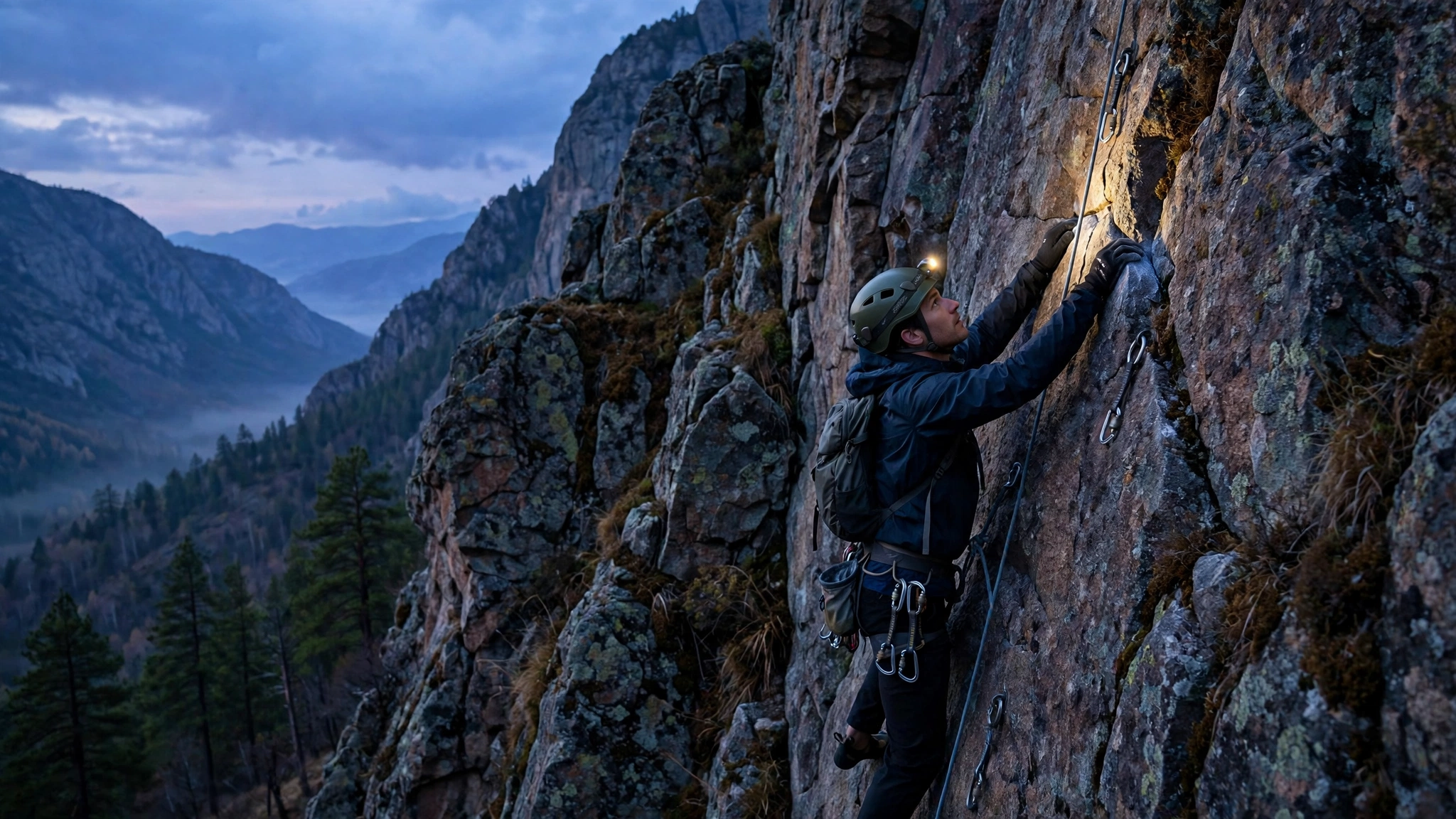
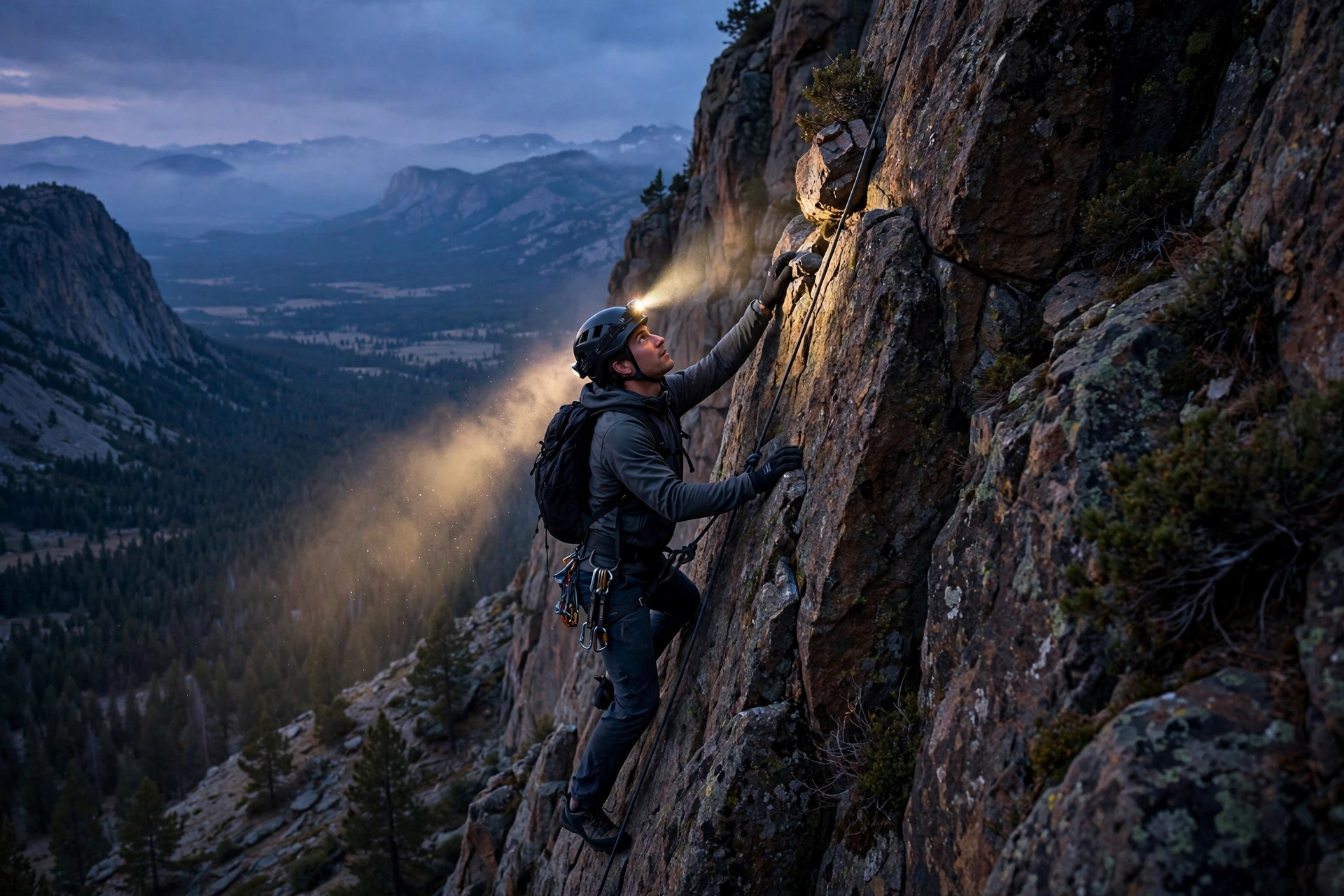
Yes, a helmet headlamp mount is a bracket or clip that holds a headlamp securely on a climbing helmet, and in general terms it keeps your hands free and your light pointing where you are looking. Climbing often takes place in low light, in caves, on early starts, or on long routes that run into darkness, and a headlamp is the usual way to see. A mount fixes the lamp to the helmet so it stays in place while you move, reach, and look around, instead of slipping, bouncing, or needing a hand to hold it. The right mount depends on your helmet and your lamp, but the idea is the same in every case: a stable, comfortable light that moves with your head.
What Is a Helmet Headlamp Mount for Climbing?
A helmet headlamp mount is a fitting that attaches a headlamp to a climbing helmet. It may be a clip that slides onto the helmet, a bracket that bolts or sticks to the shell, or a set of hooks that hold the lamp’s elastic strap in place. Some climbing helmets come with built in clips or slots designed for a headlamp, while others need an aftermarket mount that you add yourself. Either way, the mount’s job is to keep the lamp centred on the front of the helmet and to stop it sliding sideways or downwards.
It is worth noting that a headlamp mount is not part of the helmet’s safety structure. It is an accessory, and it should be fitted in a way that does not weaken the shell or cover the vents in a way that makes the helmet uncomfortable. Most mounts are designed with this in mind, but it is still important to follow the instructions for both the helmet and the mount, and to avoid drilling holes or using fixings that the helmet maker does not approve.
What Types of Headlamp Mount Are Used for Climbing?
The simplest type is the strap clip mount. Many headlamps come with an elastic strap that can be worn on the head on its own, and a clip mount lets you hook that strap onto the helmet instead. The helmet usually has small clips or slots at the front and back, and the strap threads through them to hold the lamp in place. This is a common setup on climbing helmets, because it is light, simple, and easy to remove when you do not need the lamp.
A second type is the adhesive or stick on mount. This is a small bracket with a strong adhesive pad that sticks to the front of the helmet shell, and the headlamp clips or slides into it. It can be a practical choice for helmets that have no built in clips, and it keeps the lamp low and centred. The trade off is that the adhesive needs a clean, smooth surface to hold well, and it may not be suitable for every helmet shell. It is also worth checking whether the helmet maker approves adhesive mounts, because some finishes can be affected by adhesives.
A fourth option is the universal clamp or bracket mount, which grips the edge of the helmet or clips onto a vent or rim. These can be useful if you want to move one lamp between different helmets, but they need to be checked carefully for fit. A clamp that is too tight could mark the shell, while one that is too loose could slip. In general terms, a mount made for your helmet model, or one that uses the helmet’s own clips, is usually the most reliable choice. If you are learning about helmet safety features, reading about what MIPS is for helmets can help you understand how modern helmets are designed to manage impact forces.
How Do You Choose a Headlamp Mount for Climbing?
Start with your helmet. Look for built in headlamp clips, slots, or a mounting point, and check the helmet instructions to see what the maker recommends. If your helmet already has clips, you may only need a lamp with a compatible strap, and no extra mount at all. If it has no clips, look for a mount made for that helmet model, or a universal mount that is known to fit it well.
Weight and balance matter on a long climb. A heavy lamp on the front of a helmet can pull the helmet forward and become tiring over time, especially if the mount adds extra weight of its own. A light mount and a light lamp are usually the most comfortable combination, and some lamps have a rear battery pack that helps balance the weight. If you use a rear battery pack, make sure its strap or clip also fits the helmet and does not interfere with the mount.
How Do You Fit a Headlamp Mount Safely?
Fitting a headlamp mount starts with reading the instructions for both the helmet and the mount. If the mount uses the helmet’s own clips, thread the lamp strap through them evenly and check that the lamp sits centred on the front of the helmet. The strap should be snug but not so tight that it distorts the helmet or pulls it out of position. Put the helmet on and move your head from side to side to check that the lamp stays put.
Once the lamp is mounted, test it before you climb. Switch it on, tilt it up and down, and check that the beam points where you are looking. Walk around with the helmet on, look up and down, and shake your head gently to see if the lamp moves. If it slips, tighten the strap, reposition the mount, or try a different mount. It is better to find a problem on flat ground than halfway up a route in the dark.
What Should Climbers Remember When Using a Mounted Headlamp?
The first thing to remember is that a headlamp is a tool for seeing, not a substitute for planning. Check your lamp and batteries before you set off, and carry a spare lamp or spare batteries if you expect to be out after dark. A mount will hold the lamp, but it will not stop the batteries running out, so a quick check before a climb is a simple habit that can save a difficult situation.
Finally, remember that a mounted headlamp is most useful when it is part of a simple, reliable system. A light mount, a lamp you know how to use, and a helmet that fits well are usually better than a complicated setup with extra parts. Test the whole system on a short, easy route first, and only then rely on it on a longer or harder climb.
Frequently Asked Questions
Q: Can I fit a headlamp mount to any climbing helmet?
A: In general terms, most climbing helmets can take a headlamp, either through built in clips or an added mount. Check your helmet’s instructions first, because some shells are not suited to adhesive mounts, and a mount made for your helmet model usually fits best.
Q: Will a headlamp mount damage my climbing helmet?
A: A mount fitted as the maker intends should not damage the helmet. Avoid drilling holes, using fixings the maker does not approve, or sticking a mount over a vent, and check the mount regularly for wear.
Q: Is a strap clip or an adhesive mount better for climbing?
A: It depends on your helmet and lamp. A strap clip is simple and easy to remove, while an adhesive mount can hold a lamp low and centred on a helmet with no clips. In general terms, the best choice is the one that holds your lamp firmly and lets you adjust its angle easily.

Olivia
Writer at Helmet Today, covering helmet reviews, fit and riding safety.