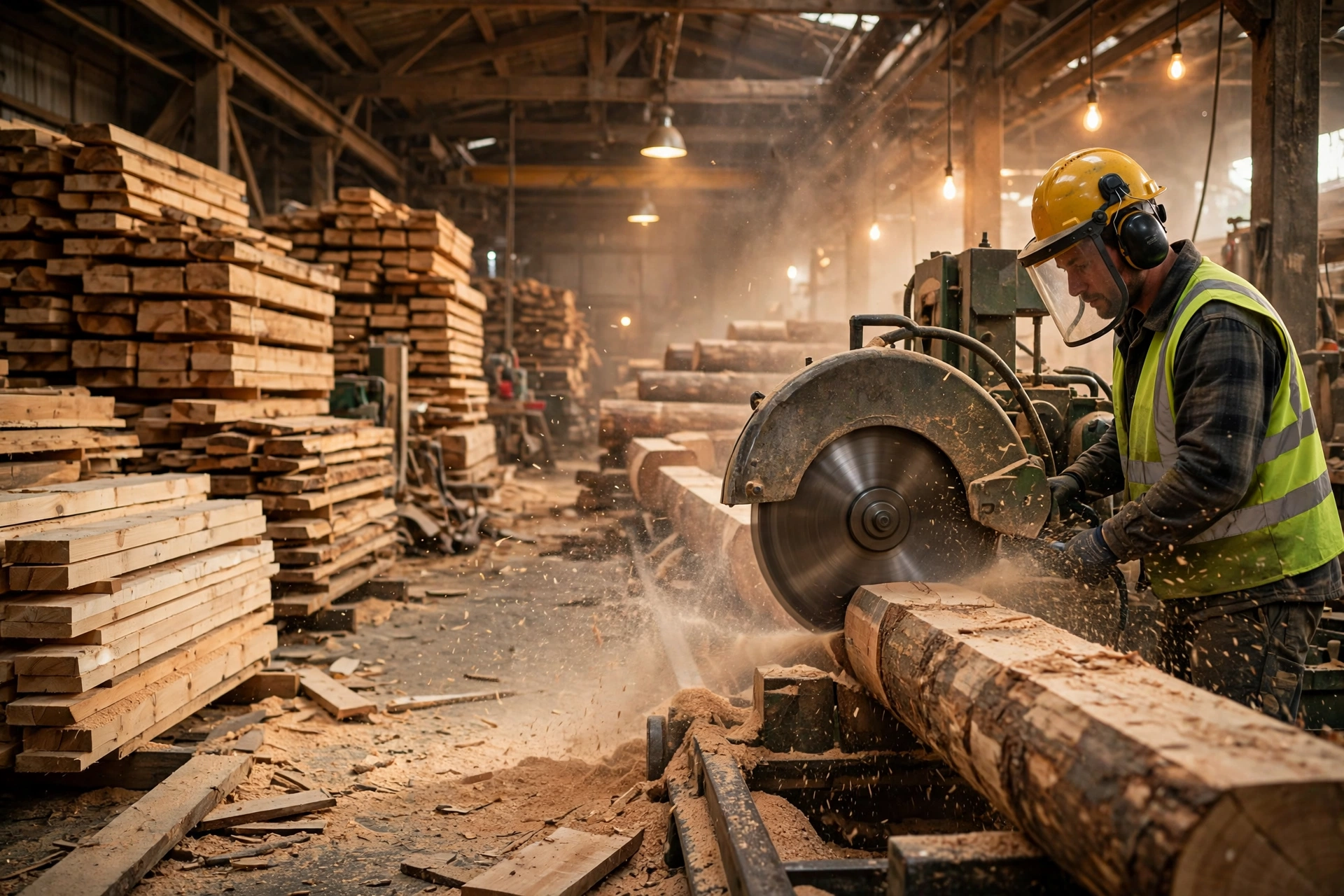
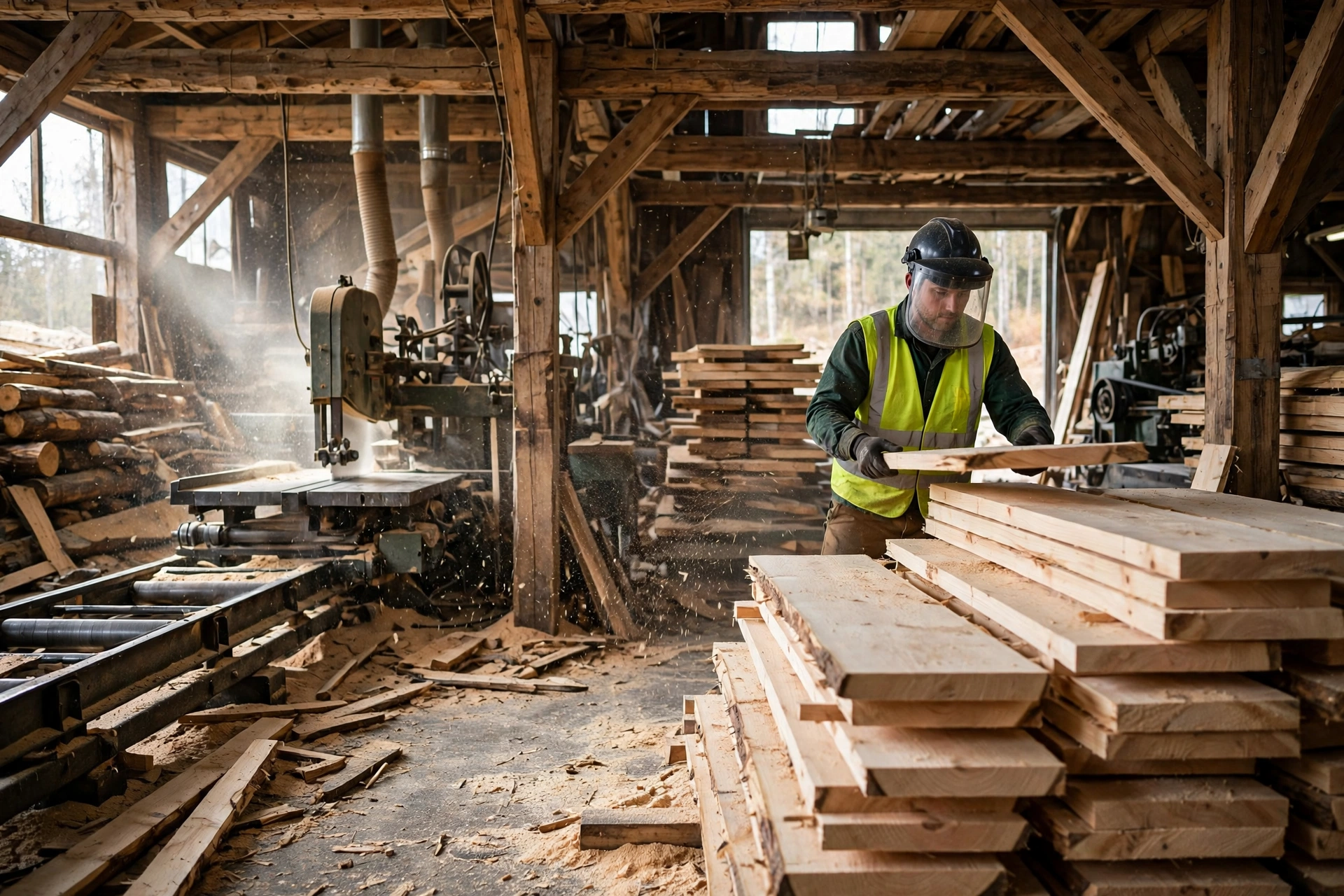
A helmet for sawmill workers is a hard hat style helmet worn by a person working in a sawmill to protect the head from falling timber, flying wood, and moving machinery, and in general terms every sawmill worker should wear one that fits well and is fastened securely before work begins. A sawmill is a busy industrial workplace where logs are cut into boards, timber is stacked and moved, and saws, conveyors, and forklifts are in use all day. A helmet is treated as essential safety equipment in a sawmill, not as an optional extra.
A sawmill worker’s day can include feeding logs into a saw, stacking fresh-cut boards, clearing sawdust, and loading timber onto trucks. Each of those jobs brings its own risks to the head: a board can fall from a stack, a log can roll, a saw can throw wood chips and splinters, and a forklift can drop its load. A helmet gives the worker a layer of protection against all of those hazards.
Why do sawmill workers need a helmet?
Sawmill workers need a helmet because timber is heavy and it moves overhead. Boards are stacked high, logs are lifted by cranes and forklifts, and a piece of timber can fall from a stack or slip from a load without warning. In general terms, a helmet spreads the force of a falling board or a piece of timber and helps to protect the skull, and that protection matters all the more when the worker cannot see what is falling.
There is also the risk of flying wood. A saw cutting through a log can throw chips, splinters, and sawdust at high speed, and a knot in the wood can break loose and fly across the mill. A helmet with a visor or a face screen helps to guard the face and eyes against those flying pieces too. The helmet is one part of a set of protective equipment that also includes ear protection, gloves, and safety footwear, and it works best when all of it is worn together.
What kind of helmet is best for sawmill workers?
The best helmet for sawmill workers is, in general terms, a hard hat style helmet with a hard outer shell, a suspension system inside, a secure chin strap, and a face screen or visor. Many sawmill workers use an industrial helmet, which combines the hard hat with a mesh visor and ear defenders in one unit. The key points are a snug fit, strong protection from falling objects, and a screen that keeps wood chips and sawdust out of the eyes.
The helmet should also cope with the noise and the dust of the mill. A sawmill is loud, so a helmet that works well with ear defenders is a practical choice. Sawdust gets into everything, so a helmet that is easy to clean is useful, and a lining that can be removed and washed is a good feature. A helmet that is too heavy or too hot will become a distraction on a long shift, so comfort matters as much as protection.
How should a helmet for sawmill workers fit?
A helmet for sawmill workers should fit snugly, sit level on the head, and stay in place when the worker bends, looks up, or moves quickly. The helmet should cover the top of the head, and the chin strap should be fastened securely every time the worker is on the mill floor. A strap that is left loose lets the helmet slide or fall off when the worker looks up at a stack, and a helmet that falls off at the wrong moment is no help at all.
The fit should be checked with the ear defenders and the face screen the worker will actually wear, because that equipment can change how a helmet sits. The screen should sit neatly in front of the face without leaving a gap that lets chips in, and the helmet should not press on the ears or push the ear defenders out of place. The worker should also check that they can hear warnings and calls from other workers, because a sawmill crew relies on clear signals to work safely together.
What should a sawmill worker check before starting work?
Before starting work, a sawmill worker should check the helmet for cracks, dents, or damage to the shell, and should look at the suspension, the lining, the strap, and the buckle to make sure they are sound and working. A helmet that has been hit by a falling board or dropped onto a hard floor should be looked at with care, and in general terms a helmet that has taken a serious impact should be replaced rather than used again. The damage may not be easy to see, so the worker should think honestly about what the helmet has been through.
The worker should also check the work area, the machines, and the condition of the saws before starting. A helmet is only one part of staying safe in a sawmill, and it works best when the worker also checks that the walkways are clear, that the timber stacks are stable, and that other workers know the plan. Keeping clear communication with the crew is a sensible habit too.
How should a sawmill worker’s helmet be looked after?
A sawmill worker’s helmet should be looked after with regular cleaning and sensible storage, in the same way as any work helmet. After a day in the mill, the worker should shake out the sawdust, clean the vents, and wipe the shell and the screen with a soft cloth. Sawdust left inside the helmet can wear down the lining and the strap, so a clean helmet lasts longer and feels better to wear.
The helmet should be kept where it will not be knocked about or left in strong heat, because a hard knock or a hot vehicle can harm the materials in a helmet over time. A helmet bag or a shelf in a dry place is a simple way to protect it between shifts. Sawmill workers who are choosing a new helmet may also want to learn about features that can help in a fall, including a system designed to reduce rotational forces, such as MIPS, which is found in some helmets made for industrial and forestry use. A well-kept helmet, worn every time, gives a sawmill worker the best chance of getting through a hard day in the mill in safety.
Do all sawmill workers wear a helmet?
In general terms, most sawmill workers wear a helmet today, and many employers and work sites expect it. A worker who is unsure should check the rules for the site before starting work.
Can a builder’s hard hat be used in a sawmill?
Yes, in general terms a hard hat that fits well and is in good condition is often suitable for sawmill work when it is worn with a face screen and ear protection. The key points are fit, protection from falling objects, and a secure chin strap.
When should a sawmill worker’s helmet be replaced?
A sawmill worker’s helmet should be replaced after a hard impact or a falling timber strike, or when it no longer fits well, shows damage, or has been worn for a long time. When in doubt, replace it rather than keep working in it.

Olivia
Writer at Helmet Today, covering helmet reviews, fit and riding safety.