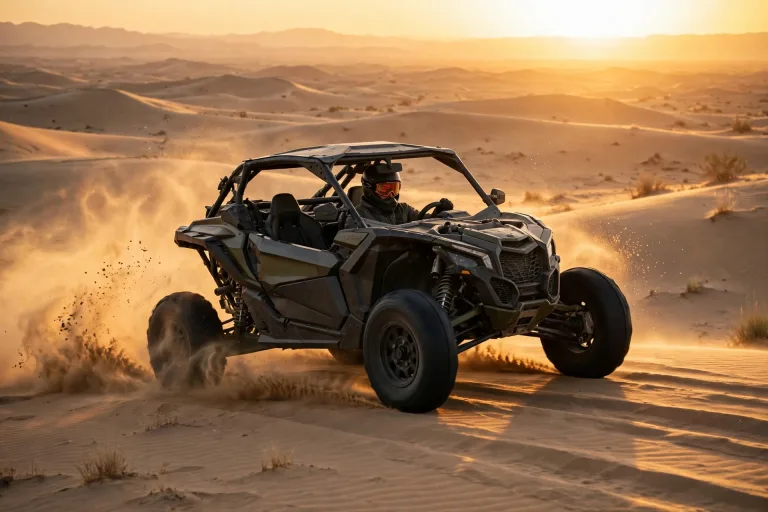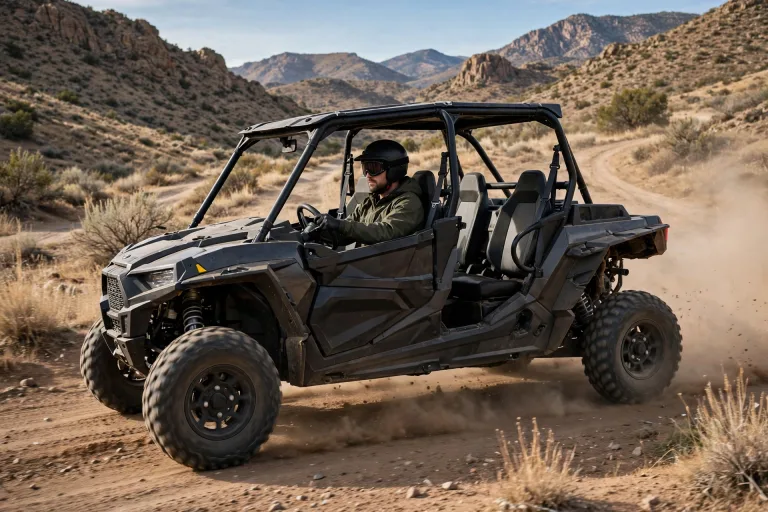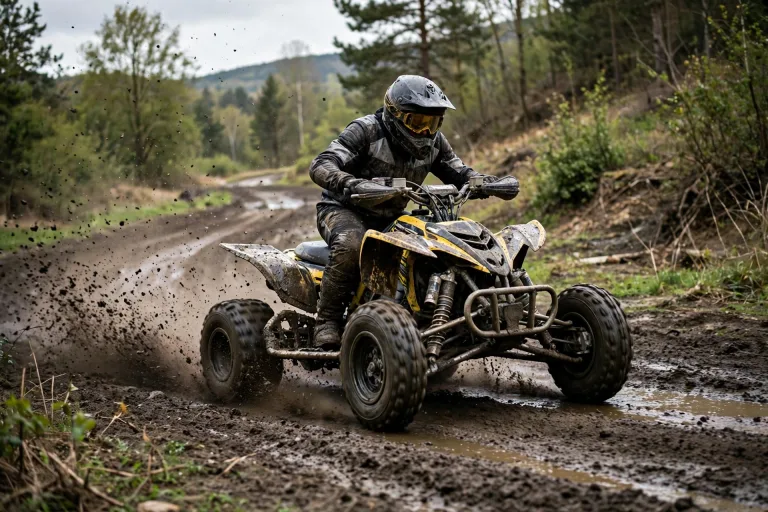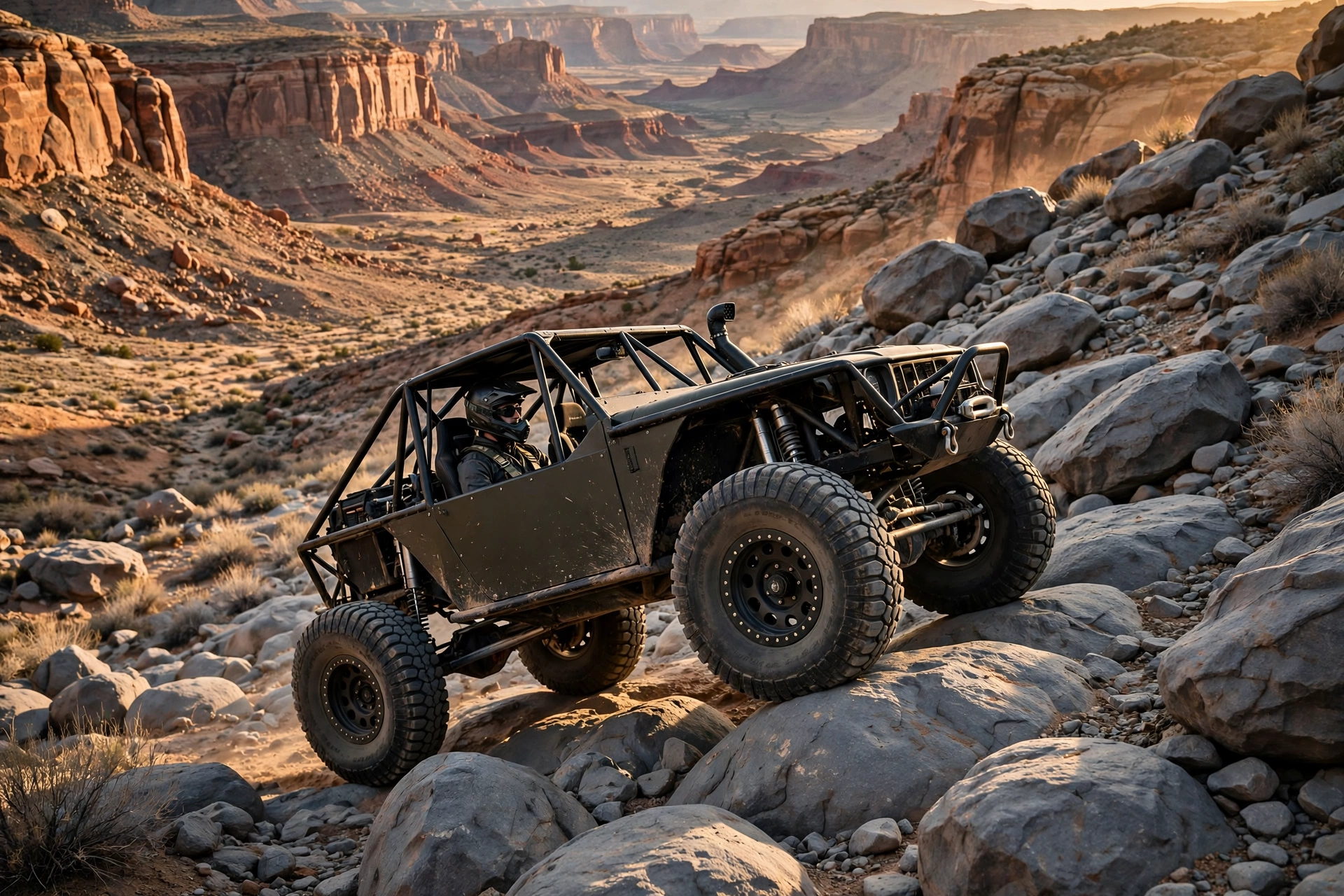
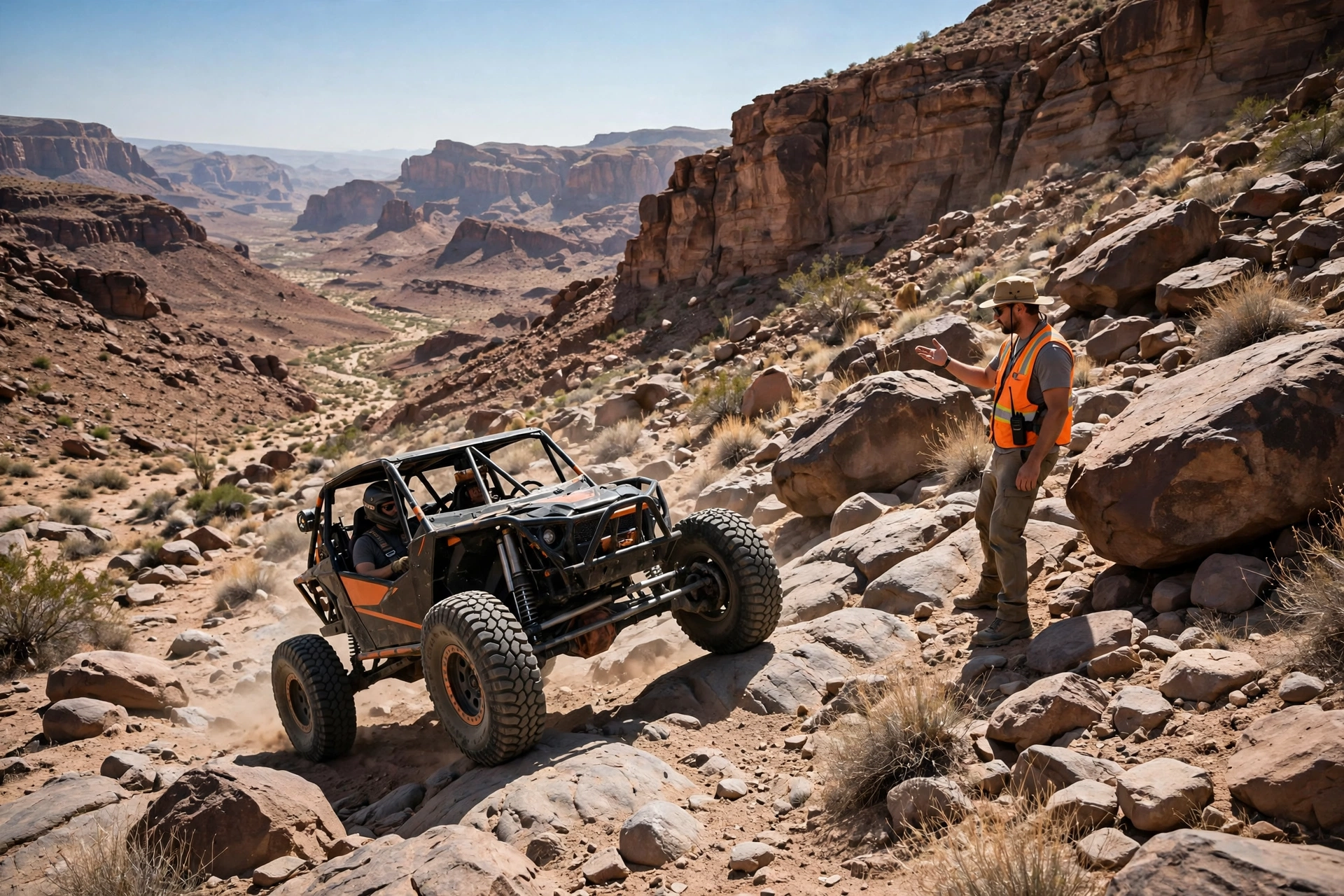
A helmet for rock crawling is a full-face or open-face off-road helmet worn by a driver or passenger in a rock crawler to protect the head from rollovers, low branches, and hard knocks against the roll cage, and in general terms every person in a rock crawler should wear one that fits well and is fastened securely before the vehicle moves. Rock crawling is a slow, technical form of off-road driving in which a specially built vehicle climbs over boulders, ledges, and steep rock faces. The vehicle moves slowly, but the angles are extreme, and a rollover or a sudden tip can happen in a moment. A helmet is treated as essential safety equipment in this kind of driving, not as an optional extra.
A rock crawler is built to grip and climb, with large tyres, a low gear range, and a strong roll cage. The driver picks a line over the rocks inch by inch, and the vehicle can lean at a steep angle or lift a wheel clear off the ground. A helmet protects the driver when the vehicle tips, when a wheel drops off a ledge, or when the driver’s head is thrown against the cage.
Why do rock crawlers need a helmet?
Rock crawlers need a helmet because the vehicle can tip over even at very low speed. A crawler climbing a steep rock face can roll sideways if a tyre slips or if the weight shifts the wrong way, and the driver can be thrown against the roll cage or the roof. In general terms, a helmet spreads the force of those impacts and helps to protect the skull, and that protection matters all the more when the driver cannot control how or where the vehicle falls.
There is also the risk of being struck by a low branch or a rock overhang, and of loose stones falling from above on a steep climb. A helmet gives a layer of protection against those knocks too. The slow pace of rock crawling can make it feel safe, but the angles and the weight of the vehicle mean that a tip or a roll can be a serious one, and a helmet is the simplest protection against it.
What kind of helmet is best for rock crawling?
The best helmet for rock crawling is, in general terms, a full-face or open-face helmet made for off-road use, with a hard outer shell, a secure chin strap, and good ventilation. Many crawlers use a helmet made for motocross or UTV driving, because those helmets are light, comfortable, and made to cope with dust and heat. The key points are a snug fit, strong protection, and airflow that keeps the driver cool on a long day on the rocks.
The helmet should also cope with dust and sun. A rock crawling course can be thick with fine dust kicked up by the tyres, so a helmet that works well with goggles is a practical choice. A visor or a peak that shades the eyes from the sun is useful, and a lining that can be removed and washed is a good feature. A helmet that is too heavy or too hot will become a distraction on a long day, so comfort matters as much as protection.
How should a helmet for rock crawling fit?
A helmet for rock crawling should fit snugly, sit level on the head, and stay in place when the driver shakes their head or the vehicle tips to one side. The helmet should cover the forehead and the back of the head, and the chin strap should be fastened securely every time the driver is in the vehicle. A strap that is left loose lets the helmet slide in a tip or a roll, and a helmet that comes off at the wrong moment is no help at all.
The fit should be checked with the goggles and the communication headset the driver will actually wear, because that equipment can change how a helmet sits. Goggles should sit neatly against the helmet without leaving a gap that lets dust in, and the helmet should not press on the headset or push it out of place. The driver should also check that they can hear the spotter clearly, because a rock crawler relies on the spotter’s calls to pick a safe line over the rocks.
What should a driver check before a rock crawling run?
Before a rock crawling run, a driver should check the helmet for cracks, dents, or damage to the shell, and should look at the lining, the strap, and the buckle to make sure they are sound and working. A helmet that has been dropped onto hard ground, or that has taken a knock in a roll, should be looked at with care, and in general terms a helmet that has taken a serious impact should be replaced rather than used again. The damage may not be easy to see, so the driver should think honestly about what the helmet has been through.
The driver should also check the vehicle, the course, and the weather before setting off. A helmet is only one part of staying safe on the rocks, and it works best when the driver also checks that the tyres, the steering, and the roll cage are in good order, and that the spotter and the recovery crew know the plan. Driving with a spotter and a crew who can help if something goes wrong is a sensible habit too.
How should a rock crawling helmet be looked after?
A rock crawling helmet should be looked after with regular cleaning and sensible storage, in the same way as any off-road helmet. After a day on the rocks, the driver should shake out the dust, clean the vents, and wipe the shell and visor with a soft cloth. Dust left inside the helmet can wear down the lining and the strap, so a clean helmet lasts longer and feels better to wear.
The helmet should be kept where it will not be knocked about or left in strong heat, because a hard knock or a hot vehicle can harm the materials in a helmet over time. A helmet bag is a simple way to protect it between runs. Drivers who are choosing a new helmet may also want to learn about features that can help in a roll, including a system designed to reduce rotational forces, such as MIPS, which is found in some helmets made for off-road and motorsport use. A well-kept helmet, worn every time, gives a rock crawler the best chance of enjoying a challenging day on the rocks in safety.
Do all rock crawlers wear a helmet?
In general terms, most rock crawlers wear a helmet today, and many events and clubs expect it. A driver who is unsure should check the rules for the event before taking part.
Can a motocross helmet be used for rock crawling?
Yes, in general terms a motocross helmet that fits well and is in good condition is often suitable for rock crawling. The key points are fit, ventilation, and a secure chin strap.
When should a rock crawling helmet be replaced?
A rock crawling helmet should be replaced after a hard impact or a roll, or when it no longer fits well, shows damage, or has been worn for a long time. When in doubt, replace it rather than keep driving in it.

Olivia
Writer at Helmet Today, covering helmet reviews, fit and riding safety.