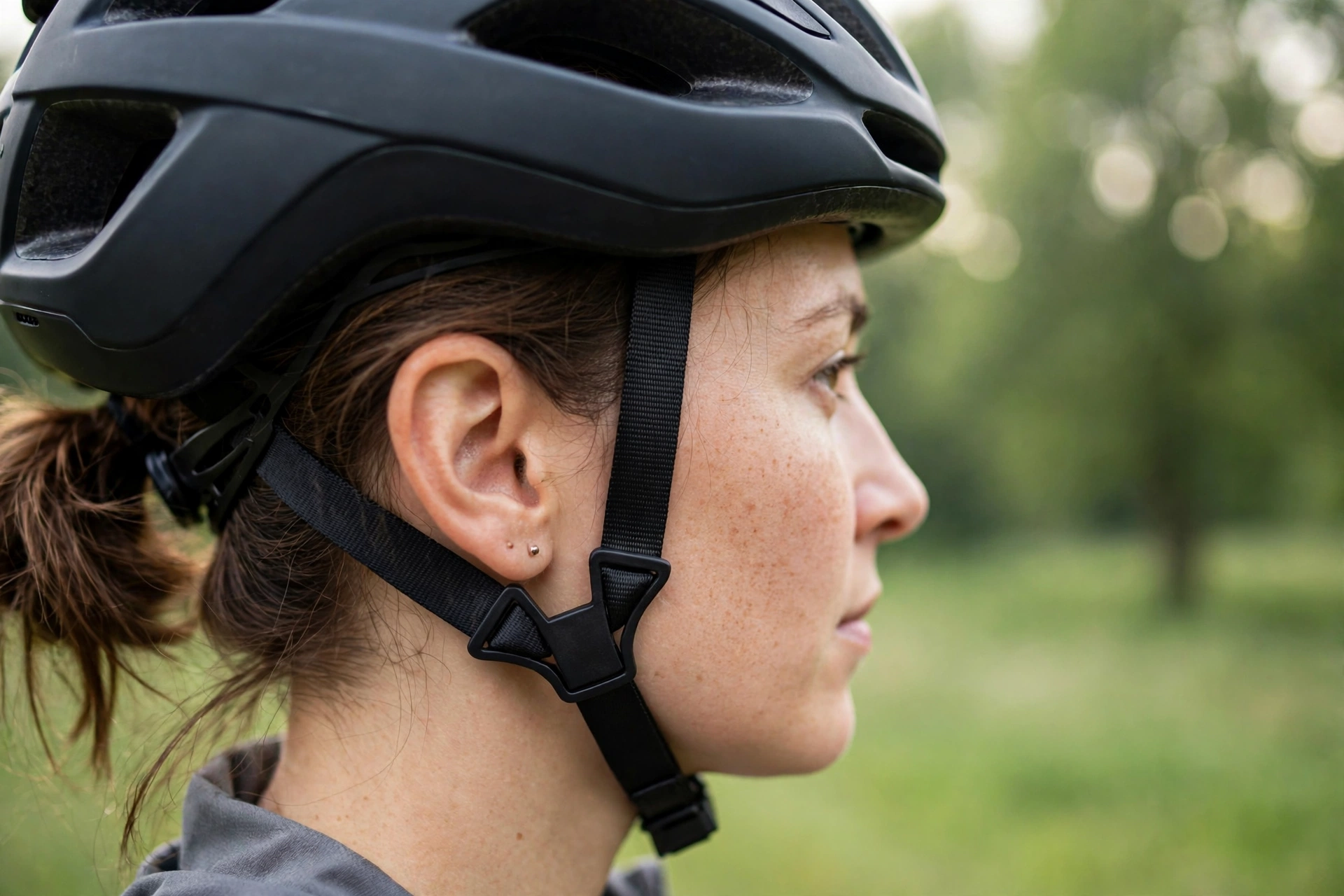
A helmet strap divider is a small plastic or metal piece on a helmet strap that joins the front and back straps together below the ear, holding them in place so the chin strap sits in the right position and the helmet stays secure on the head. The divider is the little fitting that most riders see every time they put a helmet on, yet few people know its name or what it does. In general terms, a strap divider is a small part with a big job: it keeps the straps from sliding around and it keeps the helmet in the right place.
Most helmets have two straps on each side: one that runs from the front of the helmet and one that runs from the back. The strap divider joins those two straps into a single strap that runs under the chin, forming a Y shape below the ear. Without the divider, the two straps would slide freely and the helmet would not stay in the right place.
What does a helmet strap divider do?
A helmet strap divider holds the front and back straps together at the right point below the ear, so that the strap forms a neat Y shape and the chin strap sits squarely under the chin. In general terms, the divider keeps the straps from sliding forward or backward, and that keeps the helmet sitting level on the head instead of tipping forward over the eyes or sliding back off the forehead.
The divider also spreads the load of the strap across the side of the head. When the chin strap is tightened, the divider stops the straps from bunching up or cutting into the skin below the ear. A well-placed divider makes the helmet feel comfortable and secure, while a divider that has slipped out of place can make the helmet feel loose or uneven, even when the chin strap is fastened.
How should a strap divider sit on the helmet?
A strap divider should sit just below the ear, with the front strap running forward towards the temple and the back strap running back towards the nape of the neck. The two straps should meet at the divider in a neat Y shape, and the single strap below the divider should run under the chin. When the divider is in the right place, the helmet sits level on the head and the chin strap feels even on both sides.
If the divider has slipped up towards the ear, the front strap can pull the helmet forward, and if it has slipped down towards the chin, the helmet can tip backward. The rider should check the divider every time they put the helmet on, and adjust it so that it sits in the same place on both sides. A divider that is crooked or uneven is a sign that the straps need to be adjusted.
How do you adjust a helmet strap divider?
A helmet strap divider is adjusted by sliding it up or down along the straps until it sits just below the ear, with the chin strap snug but comfortable. Most dividers slide freely when the chin strap is undone, and they hold their place once the strap is tightened. The rider should adjust both sides so that the dividers sit at the same height, and then check that the helmet sits level and does not rock from side to side.
The adjustment should be made with the helmet on and the chin strap fastened, because the straps sit differently when the helmet is on the head. A good check is to open the mouth wide: the helmet should pull down slightly on the head, which shows that the chin strap is snug. If the helmet does not move, the strap may be too loose, and if the divider digs into the skin, it may need to be moved slightly.
Can a strap divider be replaced?
A strap divider can often be replaced, but it depends on the helmet. Some dividers are made to slide off the straps, so a broken or lost divider can be swapped for a new one. Other dividers are sewn or riveted into the straps, and those cannot be replaced without replacing the straps or the helmet. In general terms, a rider should check with the helmet maker or a helmet shop before trying to fit a new divider.
A broken divider is worth fixing rather than ignoring, because a helmet with a broken divider will not sit properly on the head. If the divider cannot be replaced, the rider should think about replacing the helmet, especially if the helmet is old or has already taken a knock. A helmet that does not sit properly gives less protection, and a loose helmet is no help at all in a fall.
How should a helmet with a strap divider be looked after?
A helmet with a strap divider should be looked after with regular cleaning and sensible storage, in the same way as any helmet. The rider should check the divider, the straps, and the buckle each time the helmet is used, and should look for fraying, cracking, or damage. Straps that are dirty can be washed gently with mild soap and water, and the helmet should be left to dry naturally away from direct heat.
The helmet should be kept where it will not be knocked about, because a hard knock can crack the divider as well as the shell. Riders who are choosing a new helmet may also want to learn about features that can help in a fall, including a system designed to reduce rotational forces, such as MIPS, which is found in some helmets across many sports. A well-kept helmet, with its strap divider in the right place and worn every time, gives a rider the best chance of staying safe on every ride.
What is a helmet strap divider made of?
In general terms, a helmet strap divider is made of plastic on most helmets, and of metal on some higher-end models. The key point is that it holds the straps firmly in place without slipping.
Should the strap divider touch the ear?
No, in general terms the strap divider should sit just below the ear, not on it. A divider that presses on the ear is likely out of place and should be adjusted.
When should a helmet with a broken strap divider be replaced?
A helmet with a broken strap divider should be replaced or repaired as soon as possible, especially if the divider cannot be swapped for a new one. When in doubt, replace it rather than keep riding in it.

Olivia
Writer at Helmet Today, covering helmet reviews, fit and riding safety.