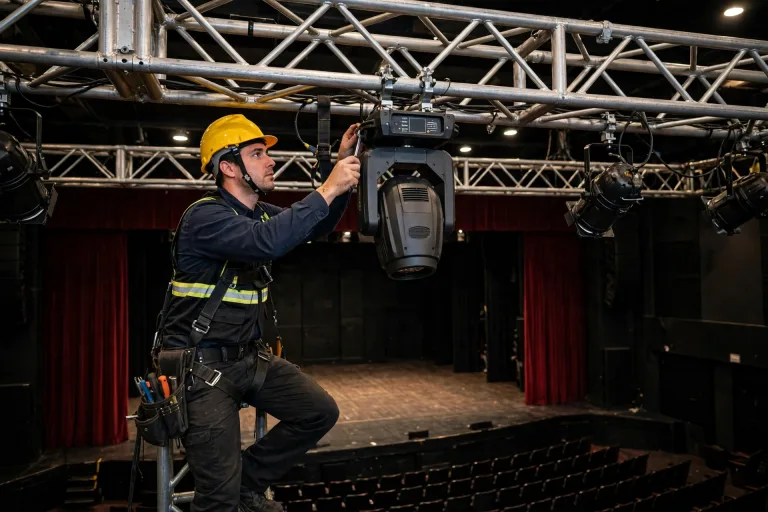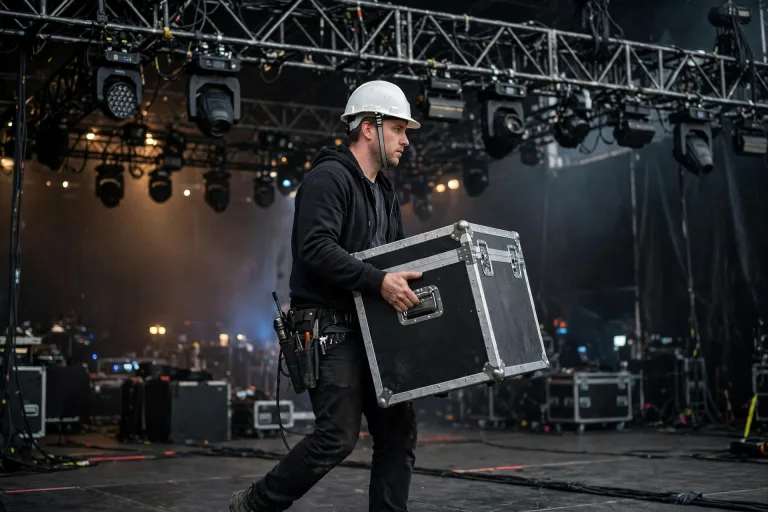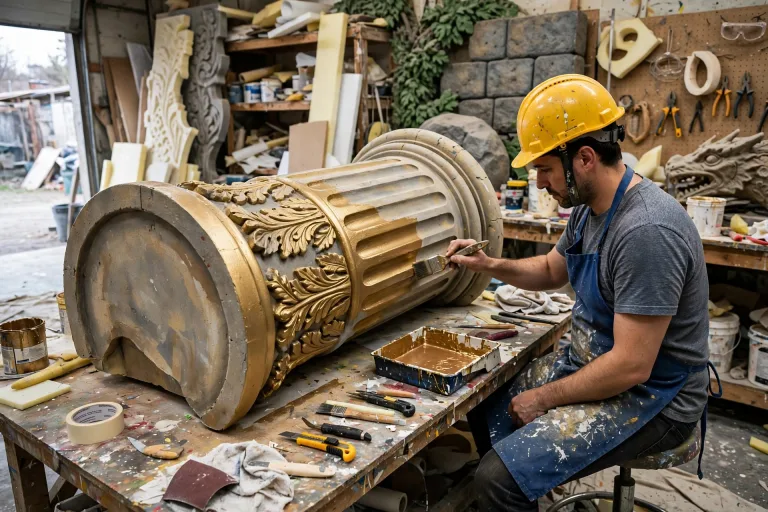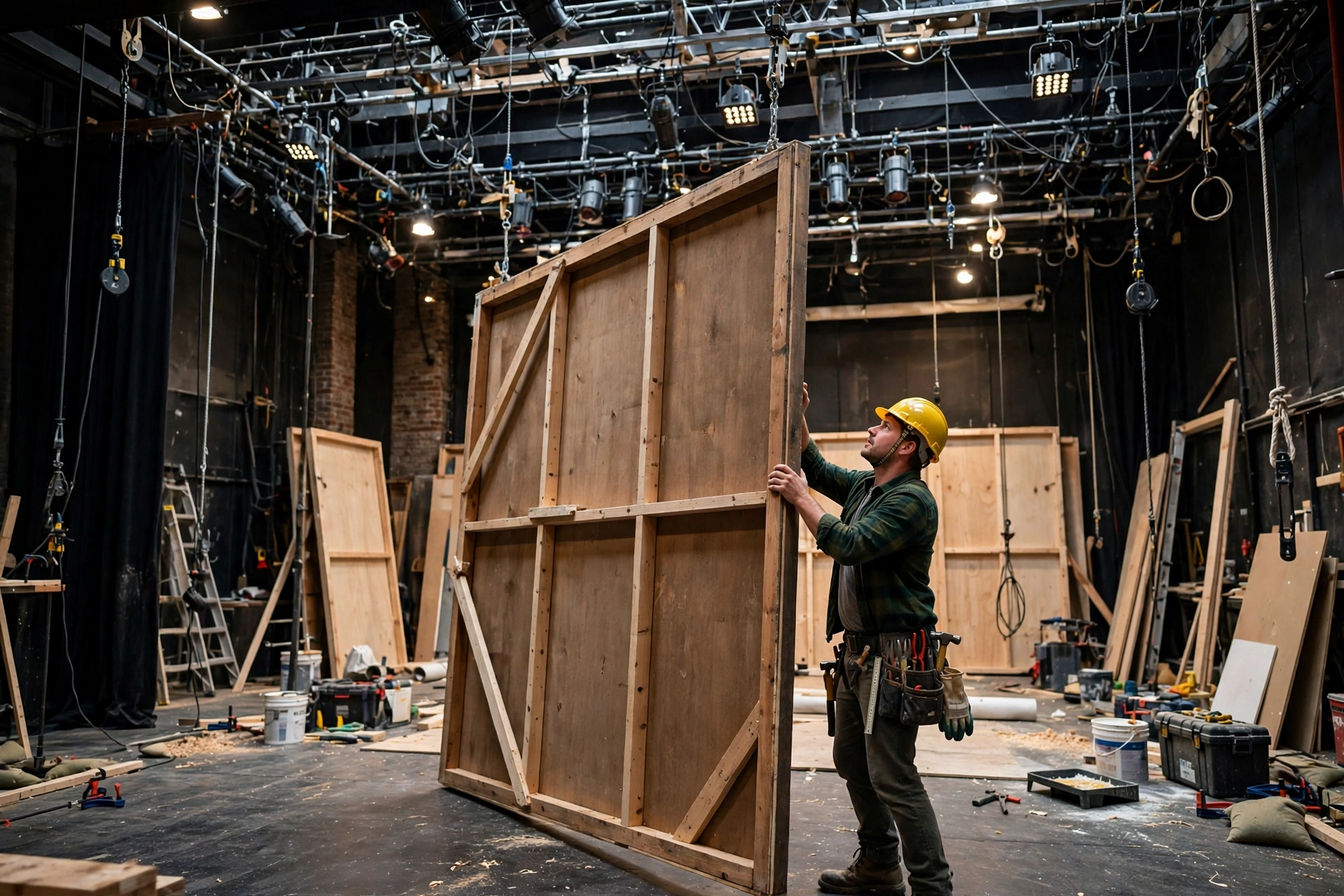
A helmet for set builders is a hard hat worn by the crew who build scenery for theatre, film, and television, and in general terms it should protect the head from falling objects, bumps, and knocks on a busy set. Set builders work with timber, steel, flats, and heavy scenery pieces, often at height and often while other people are working overhead. A helmet is essential safety equipment in that setting, because a set can be a fast-moving workplace where a falling clamp or a swinging flat can strike without warning.
A set builder’s day can move from a workshop to a stage to a studio floor, and the risks change with each move. In the workshop there are saws, drills, and stacked materials; on the stage there are lighting bars, flown scenery, and rigging overhead; on a film set there are cranes, scaffolding, and large set pieces being moved into place.
Why do set builders need a helmet?
Set builders need a helmet because they work in places where heavy objects are lifted, carried, and fixed above head height every day. A flat can slip while it is being raised, a lighting fixture can be dropped from a bar, or a tool can fall from a scaffold platform. Even a small object falling from a height can cause a painful cut or a head injury, and a helmet spreads the force of an impact and helps to protect the skull.
There is also the risk of bumping the head on the set itself, because a half-built set is full of low beams, sharp corners, and parts that stick out at head height. A set builder who is carrying a heavy piece of scenery may not see a beam until they walk into it, and a helmet takes the worst of that knock. In general terms, a helmet is worth wearing on any set-building job where something could fall or where the head could be struck, which in practice means most of the working day.
What kind of helmet is best for set building?
The best helmet for set building is, in general terms, a hard hat that meets a recognised safety standard and fits the wearer well. Most set builders choose a standard hard hat with a short peak, because it is light, comfortable, and easy to wear for a full working day. A hard hat with a chin strap is a good choice for work on a scaffold, a ladder, or a lighting rig, because the strap keeps the helmet in place when the wearer bends over or looks up.
Some set builders choose a helmet with slots for ear defenders, which can be useful in a noisy workshop or on a stage where saws and drills are in use. A helmet with ventilation holes can feel cooler under hot stage lights, but the wearer should check that the vents do not reduce the protection the helmet gives. The helmet should be in good condition, with no cracks or dents, and it should be replaced if it has taken a hard knock, even if the damage is hard to see.
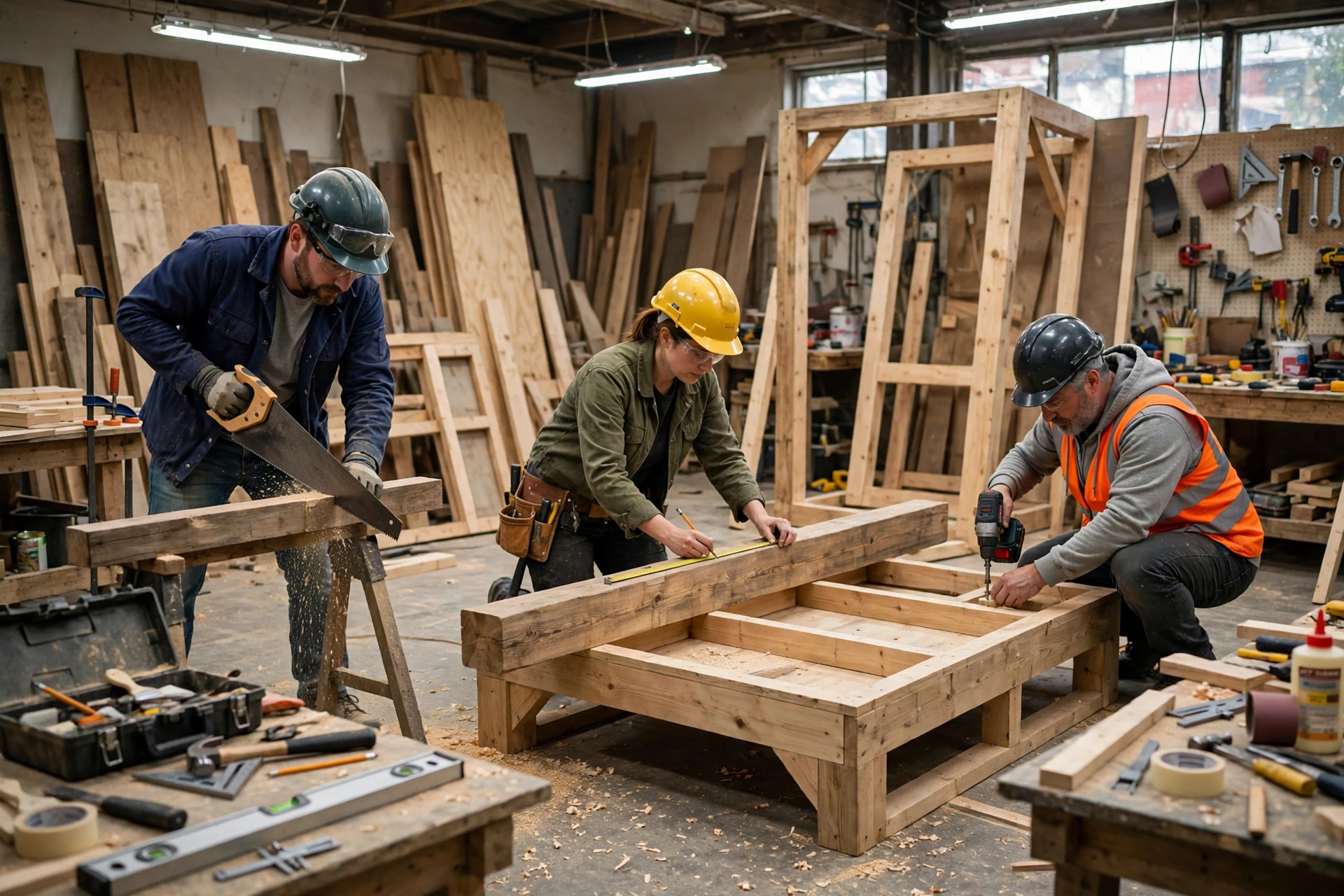
How should a helmet for set builders fit?
A helmet for set builders should fit snugly, sit level on the head, and stay in place when the wearer bends down, climbs a ladder, or looks up at a lighting bar. The helmet should cover the forehead and the top of the head, and the suspension or headband inside should be adjusted so the helmet does not wobble or slip forward over the eyes. A helmet that slides around is a distraction, and it may not be in the right place when it is needed most.
The fit should be checked with the other gear the set builder will wear, such as safety glasses, ear defenders, or a dust mask, because these can change how a helmet sits. Safety glasses should sit comfortably under the peak of the helmet without pushing it up, and ear defenders should fit neatly against the sides of the helmet. The chin strap, where one is fitted, should be fastened securely every time the helmet is worn, because a strap left loose lets the helmet fall off just when it is needed.
What rules apply to helmets on a set?
The rules for helmets on a set are set by the production, the venue, or the company running the job, and they can be different from one set to another. Most productions ask for a helmet that meets a recognised safety standard whenever work is taking place overhead, and some ask for helmets to be worn at all times on the stage or studio floor. A set builder should read the safety briefing before the job starts, and should bring the helmet’s paperwork or labels with them if the production asks to see them.
Some venues also have rules about when helmets must be worn, such as during a get-in, a get-out, or any work at height, and a set builder who turns up without a helmet may not be allowed to work. It is far better to check in advance than to be turned away on the day. A set builder who is unsure should ask the stage manager or the production manager directly, because a short question before the job can save a wasted journey and a lost day of work.
How should a set builder’s helmet be looked after?
A set builder’s helmet should be looked after with regular cleaning and sensible storage, in the same way as any work helmet. After a job, the wearer should wipe the shell clean, let the lining air out, and check the helmet for cracks, dents, or damage to the shell and the suspension inside.
The helmet should be stored in a cool, dry place, away from direct heat and sunlight, and kept in a bag or a toolbox where it will not be knocked about. Harsh cleaning chemicals should be avoided, because they can weaken the shell over time, and the helmet should never be painted with ordinary paint, which can also affect the material. Set builders who want to learn more about how helmets protect the head may also want to read about features that can help in a fall, including a system designed to reduce rotational forces, such as MIPS, which is found in some helmets. A well-kept helmet, worn every time, gives a set builder the best chance of finishing a production safely.
Do set builders need a helmet in the workshop?
Yes, in general terms a helmet is worth wearing in the workshop as well as on the stage, because materials are stacked overhead and tools can fall. The production or venue rules should be followed, and a helmet should be worn whenever there is a risk to the head.
Can a set builder wear a helmet with a headlamp?
Yes, many hard hats have a clip or a slot for a headlamp, which can be useful when working in a dark theatre or under a stage. The headlamp should be fitted so it does not unbalance the helmet or block the wearer’s view.
When should a set builder’s helmet be replaced?
A set builder’s helmet should be replaced after a hard impact, or when it shows cracks, dents, or damage, or when the suspension inside no longer holds it firmly. When in doubt, replace it rather than keep using it.

Olivia
Writer at Helmet Today, covering helmet reviews, fit and riding safety.