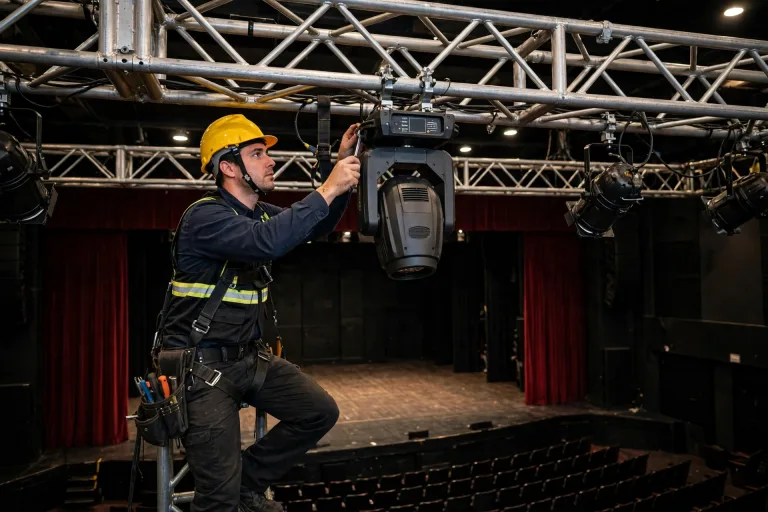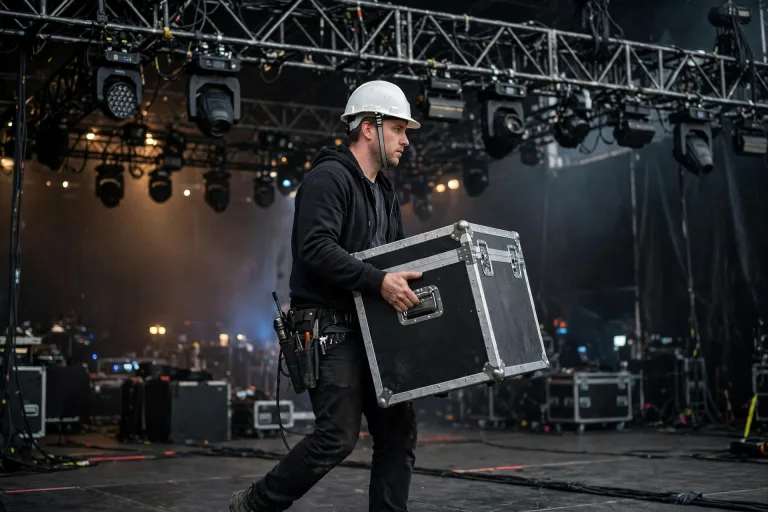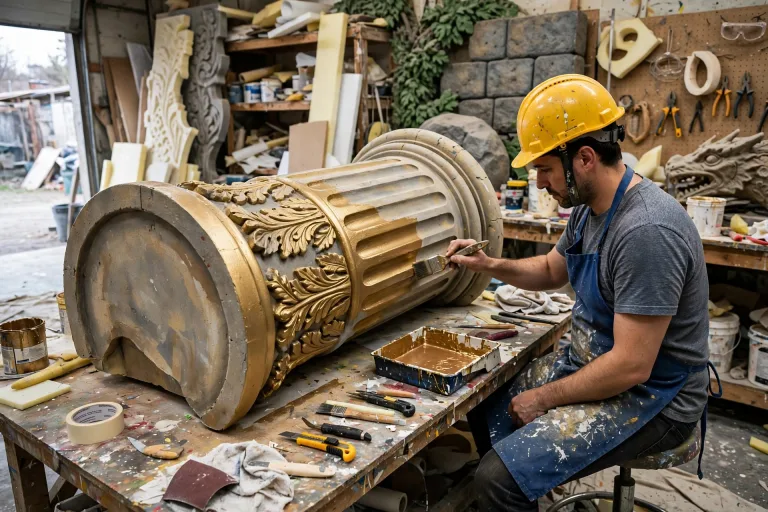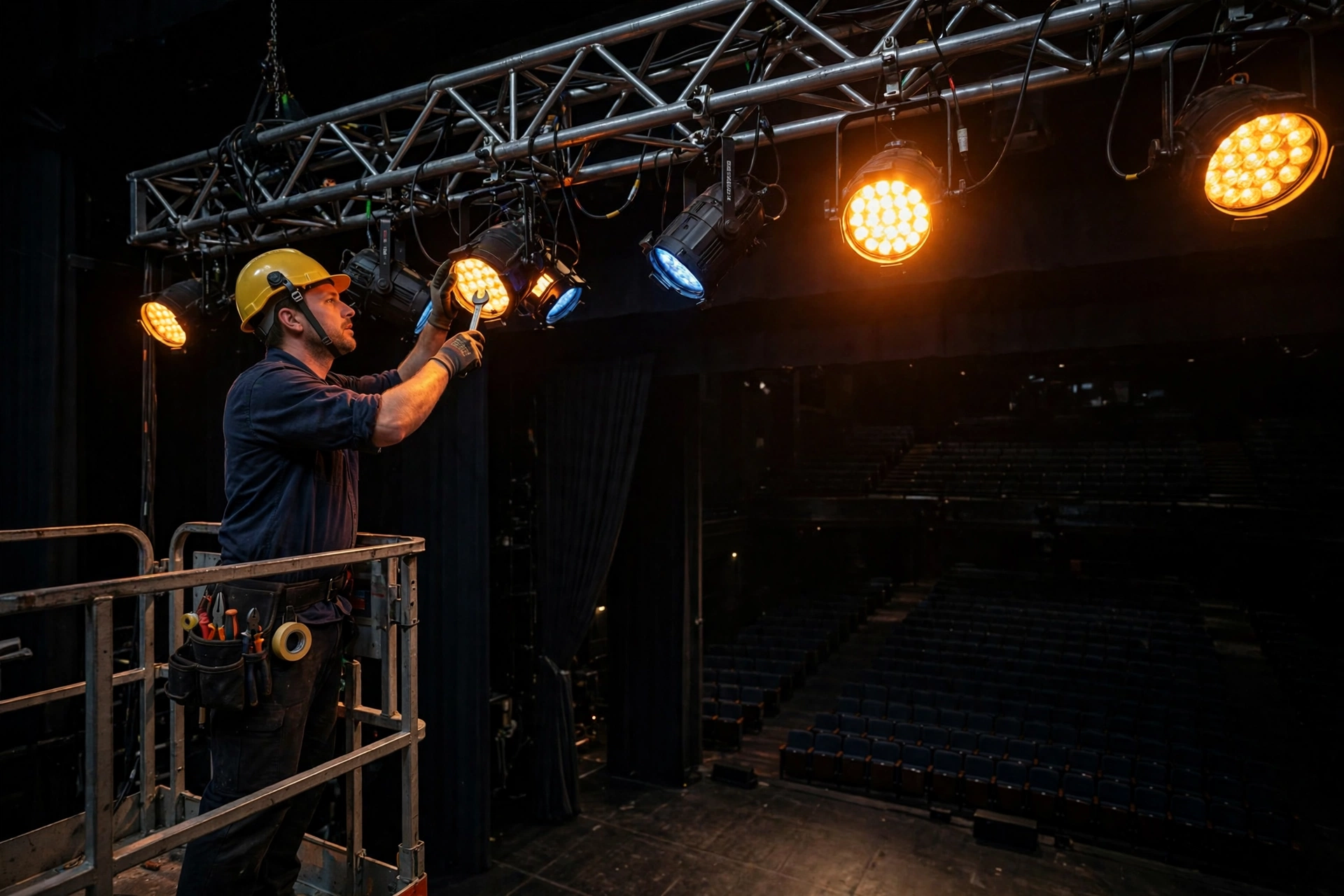
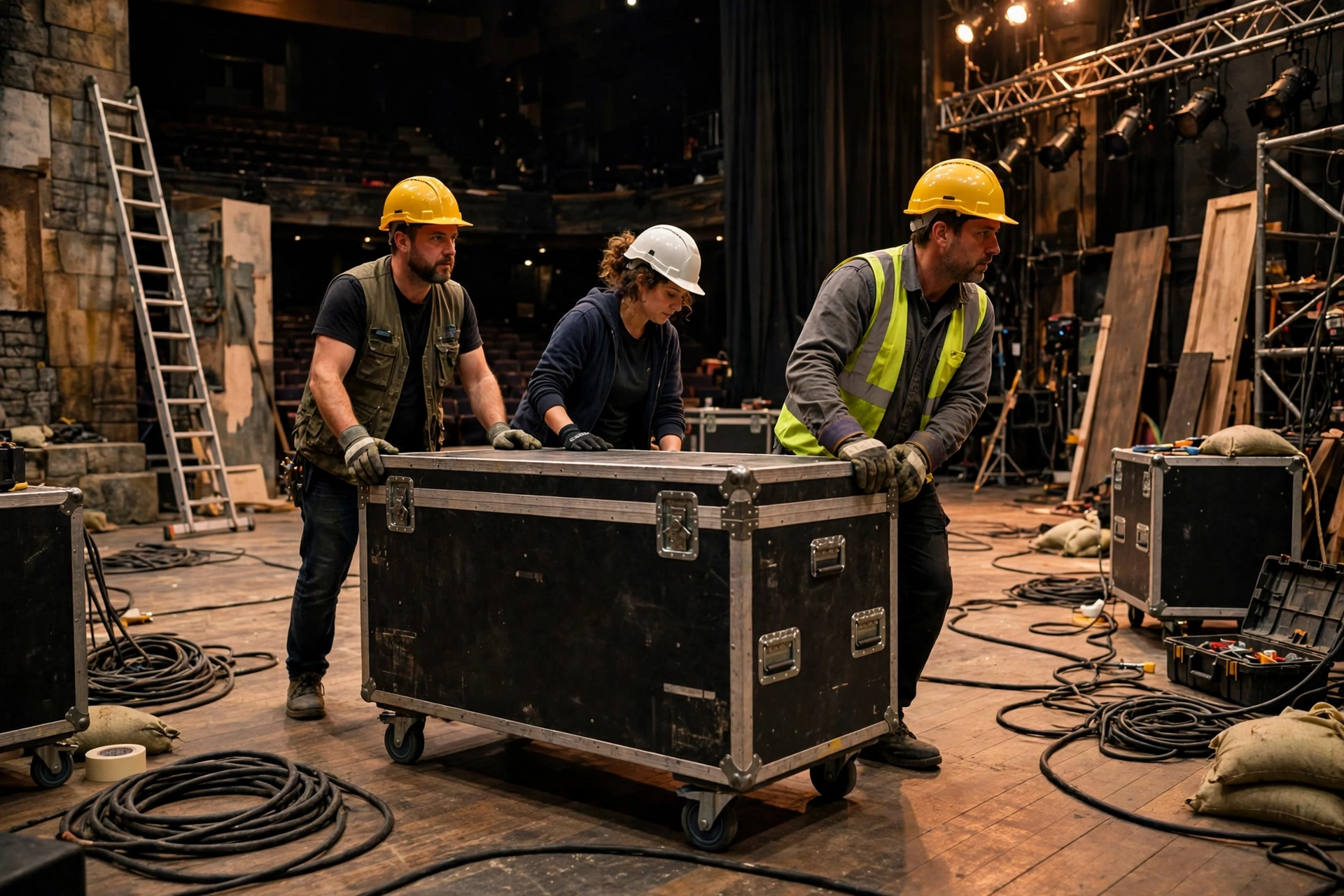
A helmet for stagehands is a hard hat worn by the crew who set up, run, and take down a live show, and in general terms it should protect the head from falling objects, bumps, and knocks in a busy theatre or venue. Stagehands work with lighting, sound, scenery, and rigging, often in the dark and often while heavy equipment is being moved overhead. A helmet is essential safety equipment in that setting, because a theatre during a get-in or a get-out is a fast-moving workplace where a falling clamp or a swinging lighting bar can strike without warning.
A stagehand’s day can move from the stage to the fly floor to the loading dock, and the risks change with each move. On the stage there are lighting bars and flown scenery overhead; in the fly tower there are ropes, counterweights, and moving parts; at the loading dock there are trucks, road cases, and scenery being lifted and stacked.
Why do stagehands need a helmet?
Stagehands need a helmet because they work in places where heavy objects are lifted, carried, and fixed above head height every day. A lighting fixture can be dropped from a bar, a piece of scenery can slip while it is being flown in, or a tool can fall from a catwalk. Even a small object falling from a height can cause a painful cut or a head injury, and a helmet spreads the force of an impact and helps to protect the skull.
There is also the risk of working in the dark, because much stage work takes place with the house lights down and only working lights to see by. A stagehand who is focused on a cue or a scene change may not see a low beam or a piece of scenery until they walk into it, and a helmet takes the worst of that knock. In general terms, a helmet is worth wearing on any stage job where something could fall or where the head could be struck, which in practice means most of the working day.
What kind of helmet is best for stage work?
The best helmet for stage work is, in general terms, a hard hat that meets a recognised safety standard and fits the wearer well. Most stagehands choose a standard hard hat with a short peak, because it is light, comfortable, and easy to wear for a full working day. A hard hat with a chin strap is a good choice for work on a ladder, a catwalk, or a lighting rig, because the strap keeps the helmet in place when the wearer bends over or looks up.
Some stagehands choose a helmet with a clip or a slot for a headlamp, which can be useful when working in a dark theatre or under a stage. A helmet with slots for ear defenders can also be useful in a noisy venue where sound checks and power tools are in use. The helmet should be in good condition, with no cracks or dents, and it should be replaced if it has taken a hard knock, even if the damage is hard to see.
How should a helmet for stagehands fit?
A helmet for stagehands should fit snugly, sit level on the head, and stay in place when the wearer bends down, climbs a ladder, or looks up at a lighting bar. The helmet should cover the forehead and the top of the head, and the suspension or headband inside should be adjusted so the helmet does not wobble or slip forward over the eyes. A helmet that slides around is a distraction, and it may not be in the right place when it is needed most.
The fit should be checked with the other gear the stagehand will wear, such as a headset, safety glasses, or ear defenders, because these can change how a helmet sits. A headset should sit comfortably under the helmet without pushing it up, and ear defenders should fit neatly against the sides of the helmet. The chin strap, where one is fitted, should be fastened securely every time the helmet is worn, because a strap left loose lets the helmet fall off just when it is needed.
When should a stagehand wear a helmet?
A stagehand should wear a helmet whenever there is a risk of something falling or of the head being struck, which in practice covers most of the get-in, the show, and the get-out. Helmets are most important when scenery is being flown, when lighting is being rigged, or when work is taking place overhead, but they are also worth wearing during a scene change or a quick fix in the dark. The venue or the production will usually set out when helmets must be worn, and those rules should be followed.
Some stagehands are tempted to take the helmet off once the show is running, because the stage looks quiet and the work seems to have stopped. That is the moment when a piece of scenery can still shift, a cable can be dropped, or a colleague can move a lighting bar overhead. In general terms, a stagehand should keep the helmet on for the whole working call unless the production or the venue says it is safe to take it off. A helmet that is left backstage is no help at all if something falls during the show.
How should a stagehand’s helmet be looked after?
A stagehand’s helmet should be looked after with regular cleaning and sensible storage, in the same way as any work helmet. After a show, the wearer should wipe the shell clean, let the lining air out, and check the helmet for cracks, dents, or damage to the shell and the suspension inside.
The helmet should be stored in a cool, dry place, away from direct heat and sunlight, and kept in a bag or a road case where it will not be knocked about. Harsh cleaning chemicals should be avoided, because they can weaken the shell over time, and the helmet should never be painted with ordinary paint, which can also affect the material. Stagehands who want to learn more about how helmets protect the head may also want to read about features that can help in a fall, including a system designed to reduce rotational forces, such as MIPS, which is found in some helmets. A well-kept helmet, worn every time, gives a stagehand the best chance of finishing a show safely.
Do stagehands need a helmet during the show?
Yes, in general terms a stagehand should keep the helmet on during the show as well as during the get-in and get-out, because scenery can still shift and equipment can still be moved overhead. The venue or production rules should be followed, and the helmet should stay on unless it is safe to take it off.
Can a stagehand wear a helmet with a headset?
Yes, many stagehands wear a headset under a hard hat, and the two can work well together if the helmet fits properly. The headset should be tried with the helmet before the show, so the fit can be adjusted and the helmet does not push the headset out of place.
When should a stagehand’s helmet be replaced?
A stagehand’s helmet should be replaced after a hard impact, or when it shows cracks, dents, or damage, or when the suspension inside no longer holds it firmly. When in doubt, replace it rather than keep using it.

Olivia
Writer at Helmet Today, covering helmet reviews, fit and riding safety.