In general terms, helmet speakers are safer on the road than earbuds, because they leave your ears open to traffic sounds while earbuds seal sound out. Helmet speakers sit inside the helmet near your ears without blocking the ear canal, so you can hear music or directions and still hear a car approaching, a horn, or a siren. Earbuds sit inside the ear and isolate you from exactly the sounds that warn you of danger.
That difference matters more than sound quality or convenience. This guide compares the two options on safety, legality, sound, and comfort so you can choose the one that keeps you aware on the road.
Why Does Hearing Traffic Matter So Much?
On a bike or motorcycle, your ears are an early warning system. The sound of an engine behind you, a horn, a siren, or tyres on gravel tells you about hazards you cannot yet see — a vehicle in your blind spot, an emergency vehicle approaching, or a car pulling out ahead. Losing that information means you are reacting later to dangers that other road users assume you can hear.
Vision alone cannot replace hearing. Mirrors help, but they do not cover every angle, and a rider looking at the road ahead cannot see behind. Sound fills those gaps, which is why many safety experts treat open ears as part of defensive riding.
This is also why the comparison is not just about volume. Even quiet music through earbuds reduces your ability to pick out traffic sounds, because the buds physically block the ear canal. Helmet speakers, by contrast, add sound without removing the sounds around you.
How Do Helmet Speakers Work?
Helmet speakers are small, flat drivers that fit into pockets inside the helmet lining, beside your ears. They connect to your phone by Bluetooth or a cable, and they play music, calls, and navigation prompts at a modest volume. Because they do not seal the ear, ambient sound passes around them naturally.
Sound quality is decent but not spectacular. At low speeds the audio is clear, but wind noise at higher speeds competes with the speakers, and bass is limited by the small drivers. Most riders find them fine for podcasts, directions, and background music, but not a substitute for a home stereo.
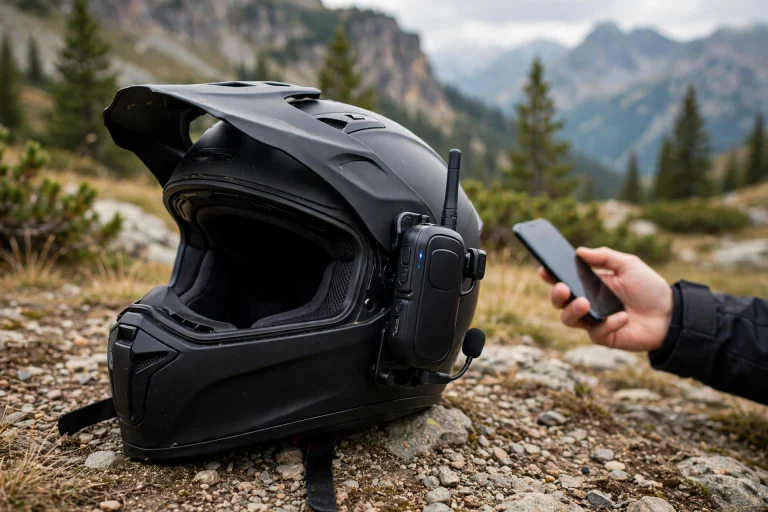
Installation is usually simple: the speakers slip into existing ear pockets, and a small control unit mounts on the helmet shell or clips to the strap. If your helmet has no speaker pockets, thin speakers can still often be fitted under the lining, though the fit should be checked so they do not create pressure points.

What Are the Problems With Earbuds on the Road?
The main problem is isolation. Earbuds, especially in-ear models with silicone tips, are designed to seal the ear canal and block outside noise. That is a feature for a train journey and a hazard on the road, because it removes the traffic sounds that warn you of danger.
There is also a legal angle. In general terms, some places restrict or prohibit earbuds or headphones while riding or driving, precisely because of the hearing issue. Rules vary by location, so check the current rules where you ride — but even where earbuds are legal, legality is not the same as safety.
Comfort and fit add further problems. Earbuds can press painfully under a helmet, slip out when you put the helmet on or take it off, and create a distraction if you keep adjusting them mid-ride. A loose earbud rattling inside a helmet is a small annoyance that can pull attention from the road at the wrong moment.
Are Bone Conduction Headphones a Middle Ground?
Bone conduction headphones are worth mentioning because they solve the same problem as helmet speakers in a different way. They sit on the cheekbones and transmit sound through vibration, leaving the ears completely open. For riders whose helmets lack speaker pockets, they are a practical alternative.
Sound quality is similar to helmet speakers — good for speech and podcasts, less impressive for music — and wind noise affects them the same way. They also need to fit comfortably under or alongside a helmet strap, so trying them with your own helmet is wise.
In general terms, bone conduction headphones and helmet speakers are comparable on safety, and both are better than earbuds for road awareness. The choice between them comes down to which fits your helmet and your ears more comfortably.
Which Option Should You Choose?
For road riding, choose helmet speakers or bone conduction headphones over earbuds. Both keep your ears open to traffic while still letting you hear music, calls, and directions. If your helmet has speaker pockets, built-in speakers are the neatest option; if not, bone conduction is an easy add-on.
Keep the volume moderate whatever you use. Even open-ear audio can mask quiet traffic sounds if it is too loud, so set a level where you can still hear a conversation or a car engine clearly. If you cannot hear the road, turn it down.
Finally, remember that audio is only one part of helmet safety. The helmet’s fit and impact protection matter far more than its speakers, and modern liners that reduce twisting forces in angled crashes are worth knowing about. For a plain-language explanation, see how MIPS helmet technology works and why rotational protection matters.
Volume discipline ties the whole comparison together. Even with open-ear speakers, a volume set high enough to drown out the world removes the very advantage that makes them safer. A good rule is to set the volume before you ride, at a level where you can still hear normal speech and passing traffic, and to resist turning it up as wind noise grows. If you regularly find yourself maxing out the volume, that is a sign to improve wind protection or accept quieter audio, rather than to sacrifice the hearing that keeps you safe.
Frequently Asked Questions
Q: Are earbuds illegal while riding?
A: In general terms, it depends on where you ride. Some places restrict headphones or earbuds for riders and drivers, while others do not. Check the current local rules, and remember that legal does not always mean safe.
Q: Do helmet speakers sound as good as earbuds?
A: Not quite. Helmet speakers offer decent sound for music and clear speech, but wind noise and small drivers limit bass and detail compared with sealed earbuds. The trade-off buys you road awareness.
Q: Can I fit speakers into any helmet?
A: Most helmets with ear pockets accept speakers easily, and many without pockets can still take thin speakers under the lining. Check that they do not create pressure points before a long ride.

Olivia
Writer at Helmet Today, covering helmet reviews, fit and riding safety.