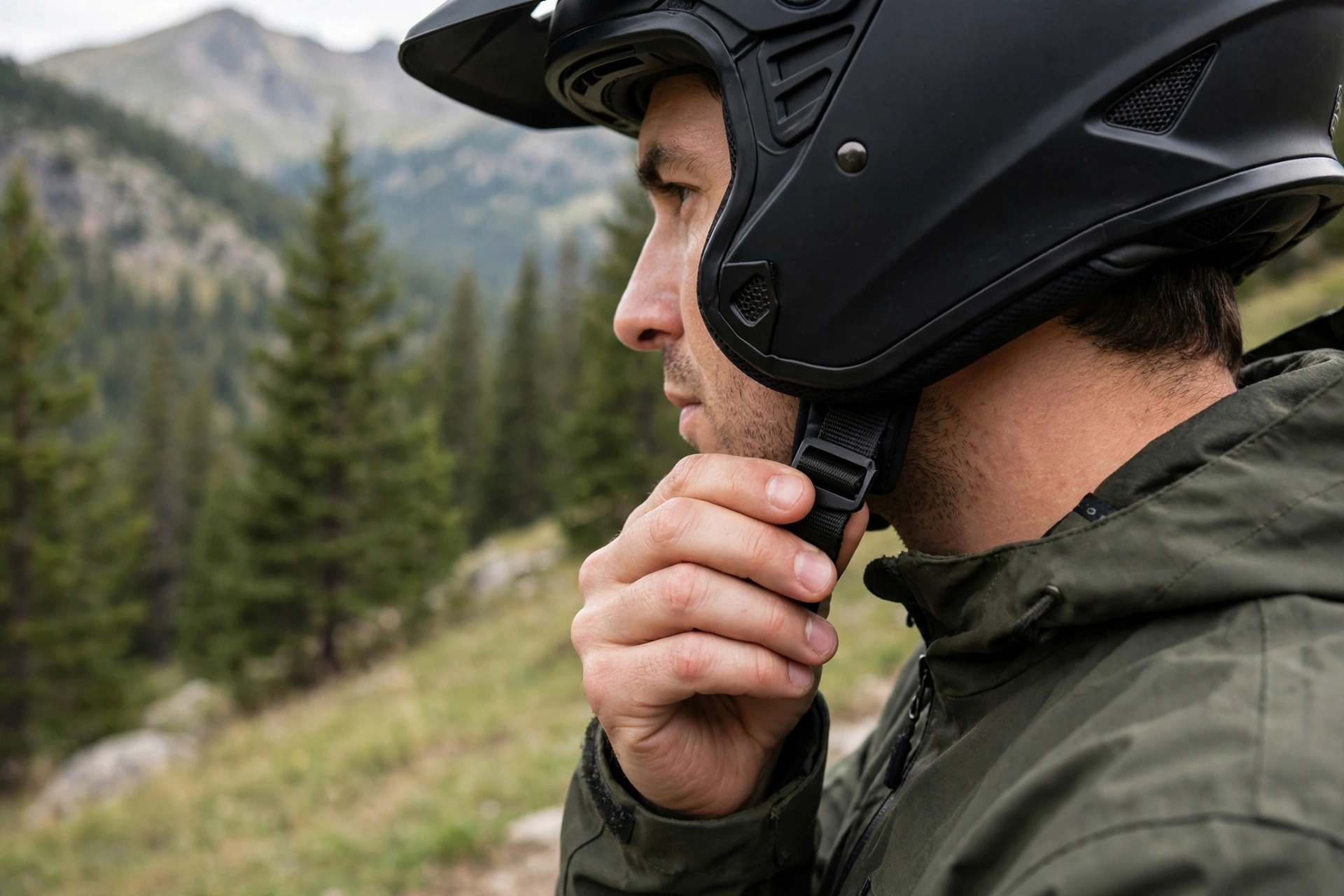
To adjust motorcycle helmet straps correctly, fasten the chin strap so it sits snugly under your chin — tight enough that only two fingers fit between the strap and your jaw — with the strap threaded correctly through its buckle and no twists. A strap that is too loose is the most common fit mistake riders make, and it can let the helmet roll off in a crash. The adjustment takes two minutes and should be re-checked every time the liner has been out for washing.
The retention system is the only thing keeping the helmet on your head when it matters most. Riders obsess over shell ratings and forget that an unfastened or badly adjusted strap makes those ratings irrelevant. This guide walks through threading a double D-ring, setting a micrometric quick-release buckle, running the snugness tests, and knowing when a worn strap means professional service rather than adjustment.
How Do You Thread a Double D-Ring Strap Correctly?
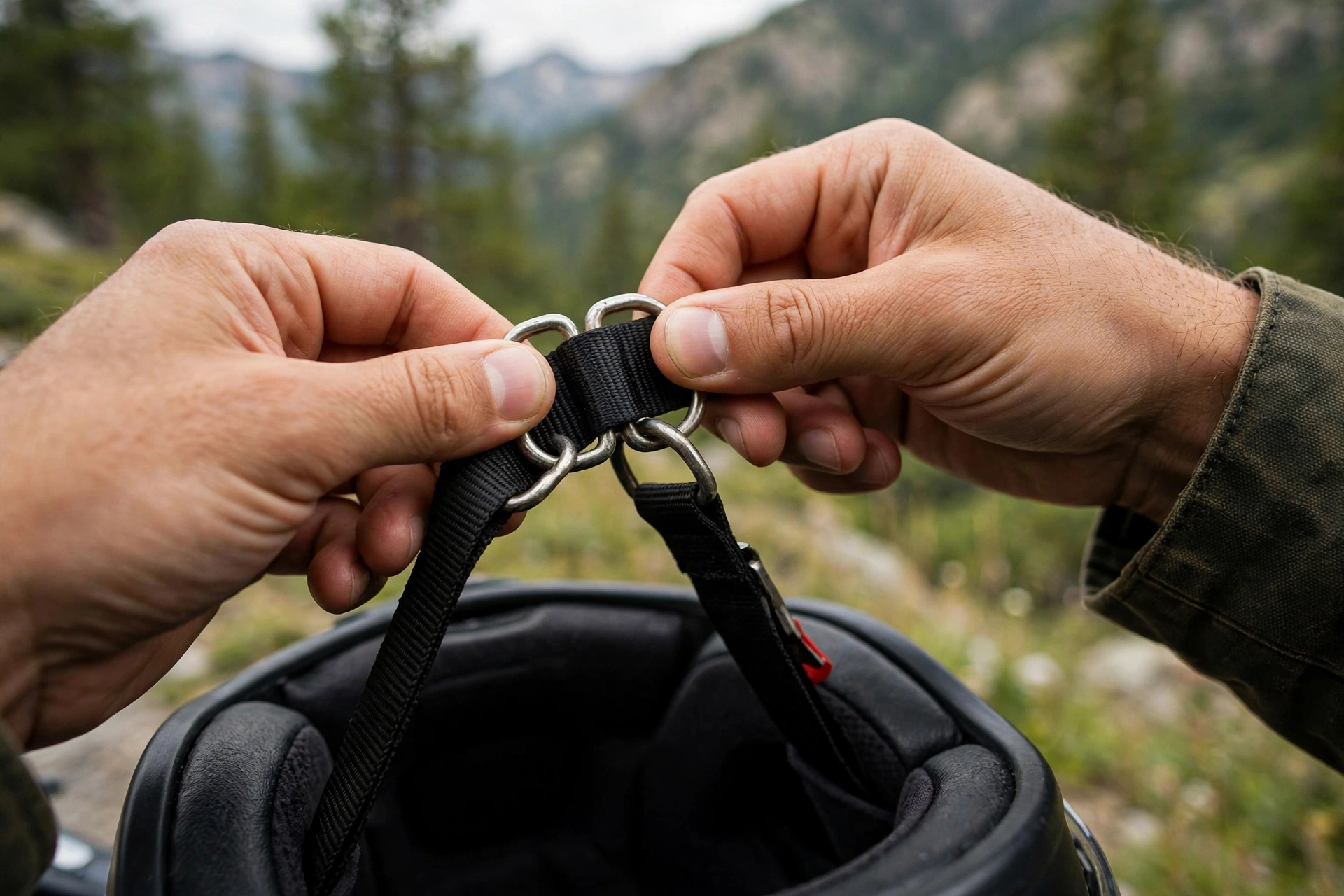
The double D-ring is the classic racing-proven closure, and it only works when threaded in the correct path. Pull the strap end up through both D-rings together. Then separate the rings, loop the strap back over the outer ring and down through the inner ring only. Pull the end to tighten. Done this way, the strap locks under tension and cannot slip; threaded any other way — through both rings twice, or not looped back at all — it can work loose while you ride.
To release, pull the small release tab (often red) to slacken the strap, then unthread. If your D-rings feel gritty or the strap frays where it passes through them, clean the rings with water and inspect the webbing under good light. Practice the threading a few times at home with gloves on, since roadside adjustments happen in real riding gear.
Keep the strap flat through the rings. A twisted strap concentrates pressure on one edge, feels uncomfortable within minutes, and does not tension evenly.
How Do You Adjust a Micrometric or Quick-Release Buckle?
Micrometric (ratchet) buckles adjust in small clicks. Insert the toothed tongue into the receiver until it clicks in snugly, then fine-tune by moving the adjustment slider on the strap to change the base length. The goal is the same as with D-rings: firm contact under the jaw with no slack. Set the base length once so that your normal setting lands in the middle clicks — if you are at the last click every time, the base strap is too long and needs shortening at the adjuster.
Fidlock-style magnetic buckles and simple quick-release clips work on the same principle: the mechanism only closes the strap, but the length still has to be set correctly at the adjusters on each side. Whichever system your helmet uses, tug-test it firmly after fastening. The buckle should not creep, slip, or pop under a hard pull.
While you are working around the jaw area, note that the strap works together with the helmet’s fit systems rather than replacing them — rotational liners and cheek pad fit all assume the retention system is doing its job, as explained in our look at what MIPS is for helmets.
How Tight Should a Helmet Strap Be? The Two-Finger Test
Fasten the strap and slide two fingers flat between the strap and the underside of your jaw. They should fit snugly: if three fingers slide in easily, the strap is too loose; if you cannot fit two fingers at all, it is too tight and will fatigue your jaw and distract you on longer rides. The strap should sit against the underside of your chin and jaw, not against your throat or Adam’s apple — reposition it forward if it has crept back.
Then run two movement tests. First, try to roll the helmet forward off your head by pushing up on the back edge: a correctly fitted helmet with a correct strap barely moves. Second, shake your head firmly side to side and nod — the helmet should move with your head, with your skin shifting slightly, not slide independently. If the helmet rotates or lifts, adjust the strap shorter in small steps and retest. If it still moves with the strap correctly tight, the helmet itself is the wrong size or shape for you, and no strap setting fixes that.
What Should You Do With the Excess Strap?
Most helmets provide a snap button, loop, or keeper for the loose end of the strap. Use it, every time. A free strap end flaps at speed, which is annoying, distracting, and slowly wears the webbing. If your helmet has a snap on the strap end, press it onto its stud after fastening; if it has an elastic or fabric keeper, tuck the end through it.
Never cut a strap shorter. The excess length exists so the strap can be fully loosened for removal, and the cut end of webbing frays and loses its finished edge. Never tie knots in a strap either — a knot changes how the webbing loads in a crash and can jam the buckle.
Why Is a Loose Strap So Dangerous?
In a crash, forces try to strip the helmet from the head — forward rolls, wind blast, and contact with the ground all pull at it. A loose strap lets the helmet rotate forward or lift completely off early in the impact sequence, leaving your head unprotected for the hardest contact. Accident investigators consistently find that helmets that came off in crashes were usually unfastened or loosely fastened, not failed. Two minutes of adjustment is the cheapest safety improvement in motorcycling.
When Does a Strap Need Service Instead of Adjustment?
Adjust at home; replace only through the manufacturer or an authorized dealer. Strap webbing, buckles, and their anchor points are safety-critical components stitched and riveted into the helmet. Frayed or cut webbing, bent or cracked D-rings, a ratchet buckle that slips, or stitching coming loose at an anchor point are all dealer-service items — never sew, glue, or rivet a strap yourself.
Frequently Asked Questions
Should the chin strap sit on my chin or under my jaw?
Under your jaw, pulled up snug against the underside of your chin. A strap resting on the point of the chin or back against the throat is positioned wrong.
Why does my strap feel looser after I wash the liner?
Removable pads often route over or near the straps, and reinstalling them slightly differently changes strap geometry. Always re-run the two-finger test after any liner removal.
Can I replace a worn helmet strap myself?
No. Straps are permanently anchored into the helmet’s structure. Contact the manufacturer or an authorized dealer for inspection and service instead.

Olivia
Writer at Helmet Today, covering helmet reviews, fit and riding safety.