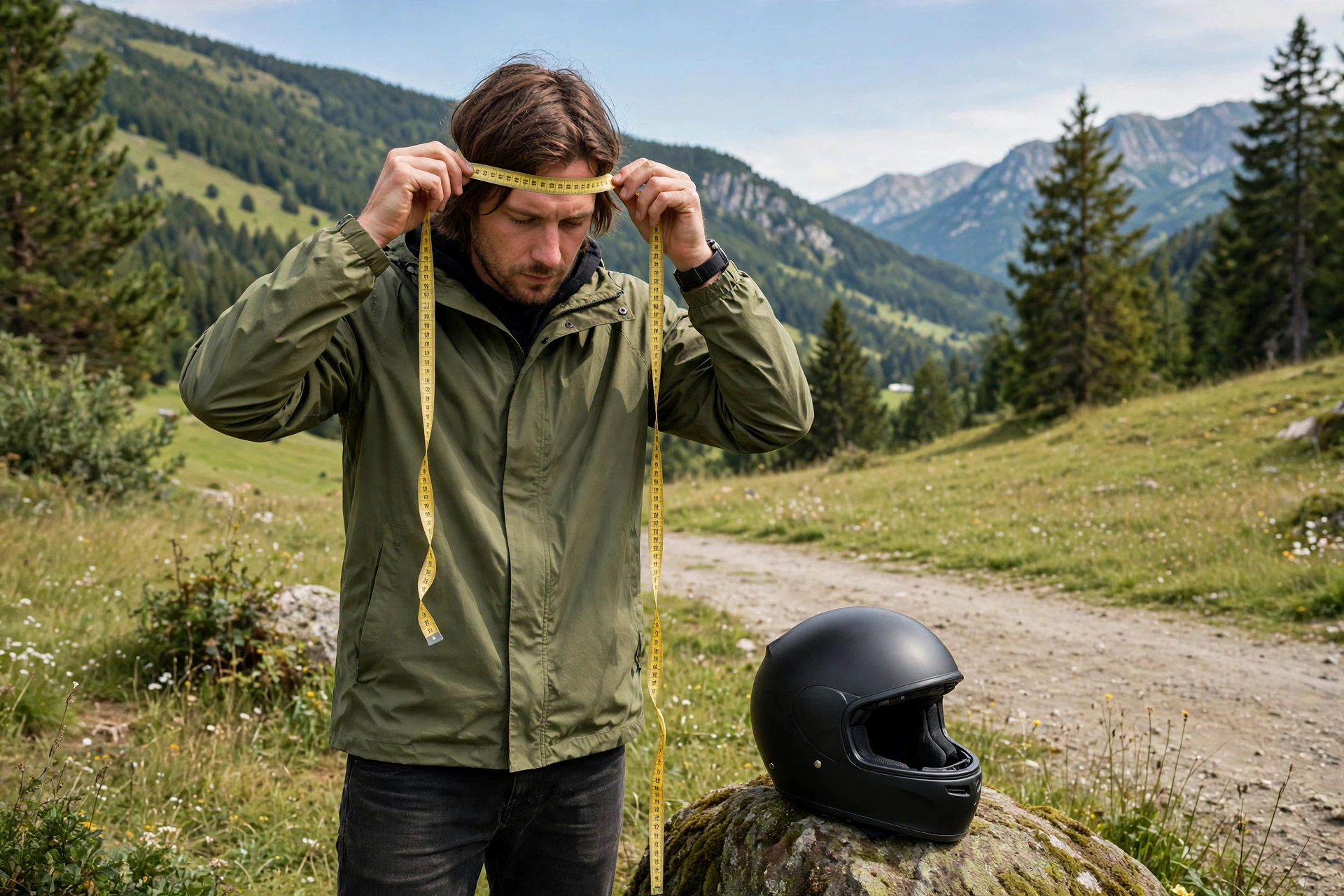
To measure your head for a motorcycle helmet, wrap a soft tape measure around the largest part of your head — roughly 2.5 cm (1 inch) above your eyebrows and just above your ears — keeping the tape level and snug but not tight. Note the measurement in centimeters, measure two or three times, and match the largest consistent result to the helmet brand’s size chart.
That one number does most of the work in helmet sizing, but it is not the whole story. Head shape, brand differences, and how a helmet should actually feel when you try it on matter just as much. This guide covers the measurement itself, how to read a size chart, and the fit checks that confirm you picked the right size.
How Do You Measure Your Head Correctly?
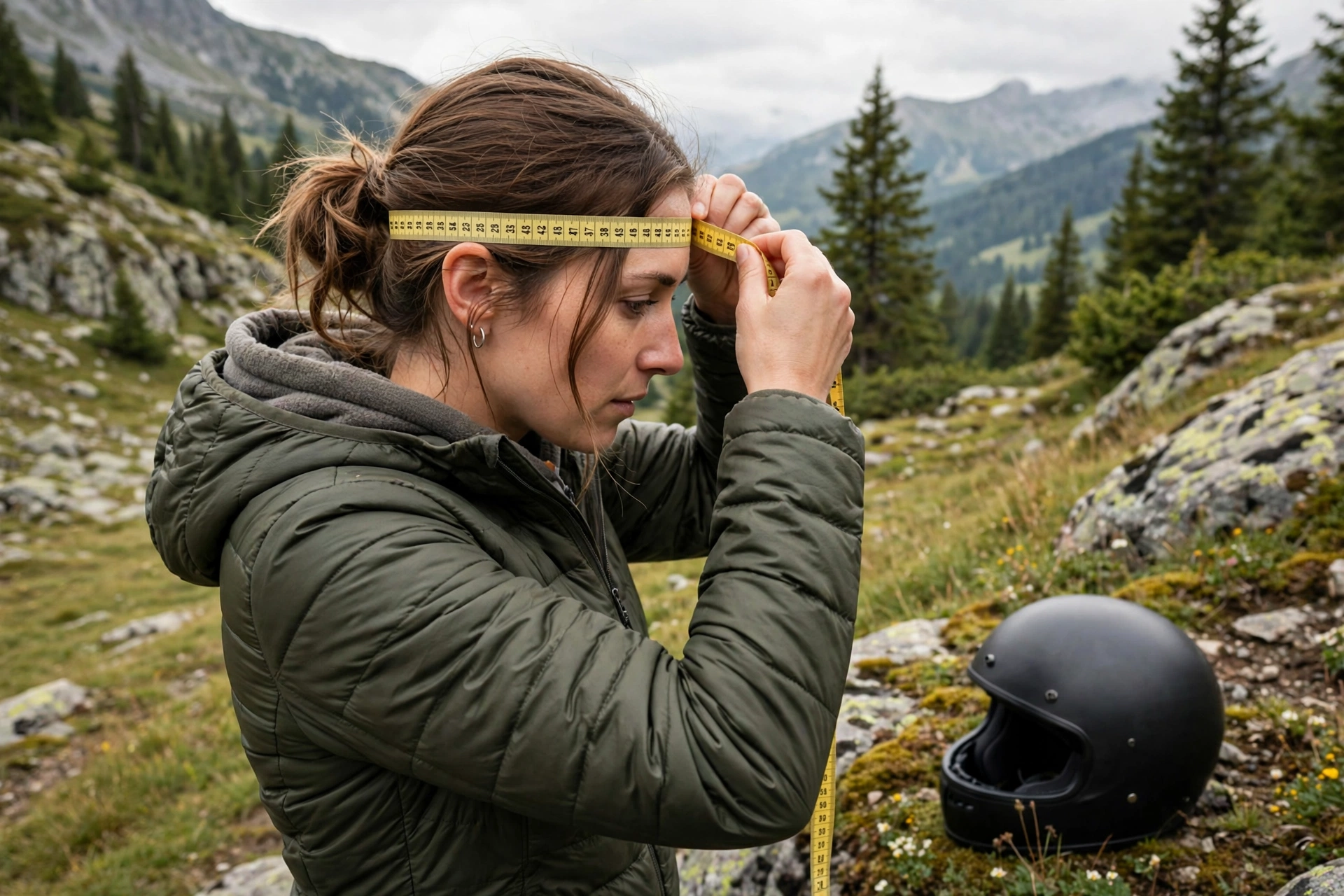
Use a flexible tailor’s tape. If you do not have one, wrap a non-stretch string or cord around your head, mark where it meets, then lay it flat against a ruler. Position the tape so it circles the widest part of your head: across the forehead about an inch above the eyebrows, just above the tops of your ears, and around the prominent bump at the back of your skull. This is the line a helmet’s crown actually grips.
Keep the tape level all the way around — if it rides up at the back or dips at the front, the number comes out wrong. It should sit snug against your hair without compressing it hard, so flatten thick hair down as much as you reasonably can. Measure in centimeters if possible, since most size charts are most precise in cm; convert inches by multiplying by 2.54.
Why Should You Measure More Than Once?
Small differences change your size. A half-centimeter can be the gap between a medium and a large, and tape placement easily drifts by that much between attempts. Measure two or three times, ideally with a mirror or a helper, and use the largest reading that repeats — that is your true circumference. If a friend measures you, have them read the tape at the front while you hold it in place at the back.
Write the number down rather than trusting memory. You will want it every time you shop, because each brand converts circumference to its own XS–XXL labels slightly differently.
How Do You Use a Helmet Size Chart?
Always use the chart of the specific brand and model you are buying — never assume your size in one brand equals your size in another. As a rough orientation only, many brands put a small around 55–56 cm, a medium around 57–58 cm, a large around 59–60 cm, and an XL around 61–62 cm, but the boundaries move between makers. Find your measurement on the chart and note the corresponding size.
A note on buying for someone else: a surprise helmet is a kind thought but a risky gift, because the measurement is only half of fitting — the try-on checks below cannot be done by tape alone. If you are buying for a passenger or a new rider, measure their head with them, choose a retailer with easy exchanges, and treat the first fitting as part of the purchase. For children and teenagers, re-measure every season; growing heads move up a size faster than most parents expect, and a youth helmet that has become tight gets quietly left behind — exactly the outcome nobody wants.
If your measurement lands right at the top of a size range or between two sizes, that is normal and is handled by the fit checks below. Also remember that a helmet’s stated size is about the shell and liner combination: some models share a shell across two sizes with different liner thicknesses, which is why swapping cheek pads can fine-tune fit on some helmets.
Does Head Shape Matter as Much as Size?
Yes. Two heads with the same circumference can be shaped very differently. Most riders are “intermediate oval” — slightly longer front-to-back than side-to-side — and most helmets sold in the US are built for that shape. Riders with rounder heads may get forehead pressure in an oval helmet, while long-oval heads can feel side pressure in a rounder model.
The symptom tells the story: a painful hot spot on the forehead or at the back of the head after 15–20 minutes usually means a shape mismatch, not a size problem, and going up a size rarely fixes it — it just makes the helmet loose everywhere else. If you consistently get a forehead hot spot, look for models described as rounder or more neutral in fit.
What Should You Check When You Try the Helmet On?
With the correct measured size on your head and the strap fastened:
- Cheek pressure: The cheek pads should press firmly enough to squeeze your cheeks slightly — new helmets feel snug and the pads bed in over the first hours of riding.
- Crown feel: Pressure should be even all around with no single painful point.
- Shake test: Shake your head side to side and up and down. Your skin should move with the helmet; the helmet should not rotate or slide independently.
- Roll-off awareness: Grip the back edge and try to roll the helmet forward. Some movement is normal with the strap fastened, but it should never feel close to coming off — if it does, the size or shape is wrong.
- Wear test: Keep it on in the shop for at least 10–15 minutes. Serious pressure points announce themselves in that window.
Between sizes? Start with the smaller one if your measurement straddles a boundary, because liners compress with use and a helmet that starts loose only gets looser. A slightly snug new helmet is correct; a painful one is not. And since fit also changes as liners age and compress over the years, it helps to know how long a motorcycle helmet lasts so you can judge when an old helmet’s looseness means replacement rather than adjustment.
Frequently Asked Questions
What if my head measurement is between two helmet sizes?
Try the smaller size first. New liners compress during the first hours of use, so a snug fit settles in, while a helmet that starts slightly loose will only get looser. If the smaller size creates a painful hot spot within 15 minutes, the issue may be head shape rather than size.
Should I measure my head with my hair in its usual style?
Measure with your hair roughly as you wear it when riding, but press the tape down so bulky hair does not inflate the reading. If you regularly wear a balaclava or skull cap under the helmet, measure with it on.
Is a helmet size the same across all brands?
No. Each brand uses its own size chart and internal shape, so a medium in one brand may fit like a large in another. Always convert your centimeter measurement using the chart of the brand you are buying.

Olivia
Writer at Helmet Today, covering helmet reviews, fit and riding safety.