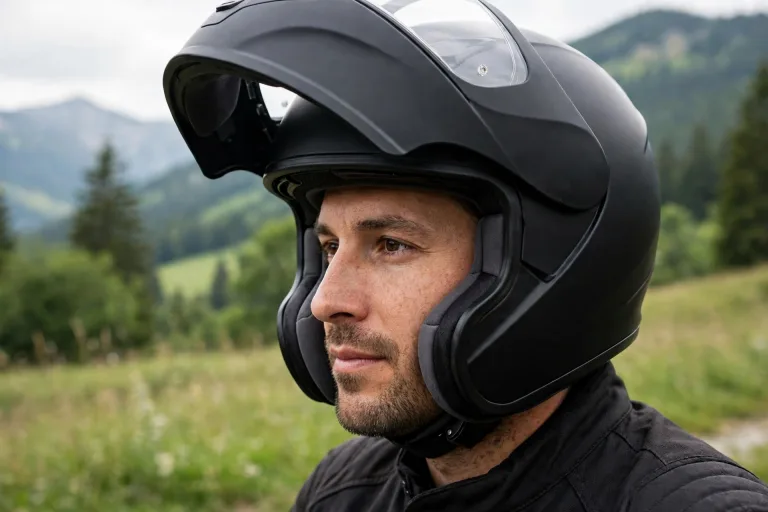
To make a helmet quieter, start by closing the vents, fitting a wind-blocking chin curtain, and wearing a thin balaclava or ear covers, and in general terms the biggest gains come from blocking wind at the neck and around the ears rather than from buying a new helmet. Wind noise is the most common complaint among riders, and it can turn a pleasant ride into a tiring one. The good news is that most of the fixes are simple, cheap, and easy to try at home before spending money on new gear.
Helmet noise usually comes from the wind, not from the engine or the road. Air rushes past the helmet at speed, slips under the chin bar, and swirls around the ears, and that turbulence is what the rider hears as a roar. A helmet that fits loosely lets in more air, and open vents can whistle or hum. Understanding where the noise comes from is the first step to making a helmet quieter, because each source of noise has its own simple fix.
Why is my helmet so noisy?
A helmet is noisy when wind finds its way inside and swirls around the ears, and in general terms the main entry points are the gap under the chin, the vents, and the space around the ears. A helmet that is too big lets air in from every side, and a visor that does not seal properly lets a thin stream of air whistle past the rider’s face. Even a well-made helmet can be noisy if the fit is wrong, because a loose helmet moves on the head and lets wind in with every movement.
The shape of the helmet matters too. A helmet with large vents, a peak, or a spoiler can catch more wind and make more noise, and a helmet with a rough or angular shell can be louder than a smooth, rounded one. The rider’s own position matters as well: sitting upright catches more wind than leaning forward, and a tall windscreen can throw turbulent air straight at the helmet. Noise is a mix of helmet, fit, and riding position, and all three can be improved.
What is the easiest way to make a helmet quieter?
The easiest way to make a helmet quieter is to close the vents and to block the wind at the neck, and in general terms a chin curtain or a neck gaiter makes the biggest difference for the least money. A chin curtain is a small flap that fits under the chin bar and stops air rushing up from below, and many helmets come with one in the box. A thin balaclava or a neck gaiter does a similar job, sealing the gap between the helmet and the jacket.
Ear covers are another simple fix. Soft foam ear pads that fit inside the helmet, or a balaclava with built-in ear covers, can cut wind noise around the ears without blocking the sounds a rider needs to hear. Earplugs are also widely used, and in general terms a good pair of foam or moulded earplugs can make a long ride far more comfortable. The rider should still be able to hear traffic and warnings, so earplugs should reduce noise, not block hearing altogether.

How does helmet fit affect noise?
Helmet fit affects noise a great deal, because a helmet that fits snugly lets in far less wind than one that is loose. A helmet should sit level on the head, cover the forehead, and stay in place when the rider shakes their head. If the helmet rocks from side to side or lifts at speed, air is getting in, and the rider will hear it. The chin strap should be fastened securely, because a loose strap lets the helmet move and lets wind in from below.
The fit should be checked with the gear the rider will actually wear, such as a balaclava or glasses. A balaclava can change how a helmet sits, and glasses can leave a small gap that lets air whistle past the ears. The rider should also check that the visor seals properly when it is closed, because a visor that does not sit flat against the seal will let a thin stream of air in and make a whistling sound. A visor with a worn seal can often be fixed by replacing the seal rather than the whole helmet.
Can accessories make a helmet quieter?
Yes, accessories can make a helmet quieter, and in general terms the most useful ones are a chin curtain, a wind-blocking neck gaiter, and ear covers or earplugs. A wind deflector that fits under the chin bar is another option, and some riders use a small foam wind jammer that sits in the ear pockets of the helmet. These accessories are cheap, easy to fit, and can be removed in summer when the rider wants more airflow.
Some riders also fit a small strip of foam or tape over a vent that whistles, although this should be done with care so the helmet can still breathe. A helmet that cannot breathe at all will fog up and become hot, so the rider should only block the vents that are actually causing noise. A little trial and error, one change at a time, is the best way to find which accessory makes the biggest difference for a particular helmet and riding position.
When should I replace a noisy helmet?
A noisy helmet should be replaced when the noise comes from damage or from a poor fit that cannot be fixed, and in general terms a helmet that has taken a serious impact should be replaced rather than used again. The rider should check the shell for cracks, the visor for a worn seal, and the lining for wear that lets the helmet move on the head. A helmet that no longer fits well cannot be made quiet, because the wind will always find its way in.
The rider should also think about the age of the helmet. A helmet that has been worn for a long time may have a lining that has compressed and a seal that has hardened, and both of those let in more wind. Riders who are choosing a new helmet may also want to learn about features that can help in a crash, including a system designed to reduce rotational forces, such as MIPS, which is found in many helmets made for riding. A well-fitting, well-kept helmet, worn with a chin curtain and ear covers, gives a rider the best chance of a quiet and comfortable ride.
Do earplugs make a helmet quieter?
Yes, in general terms earplugs reduce wind noise a great deal, and many riders use them on every ride. Foam or moulded earplugs cut the roar of the wind while still letting the rider hear traffic and warnings.
Will closing the vents make my helmet quieter?
Yes, in general terms closing the vents cuts wind noise, especially at speed. The rider should open them again in hot weather to stay cool and to stop the visor fogging.
Does a windscreen help with helmet noise?
Yes, in general terms a taller or better-shaped windscreen can push clean air over the helmet instead of throwing turbulent air at it. The rider should try different heights to find the quietest setting.

Olivia
Writer at Helmet Today, covering helmet reviews, fit and riding safety.