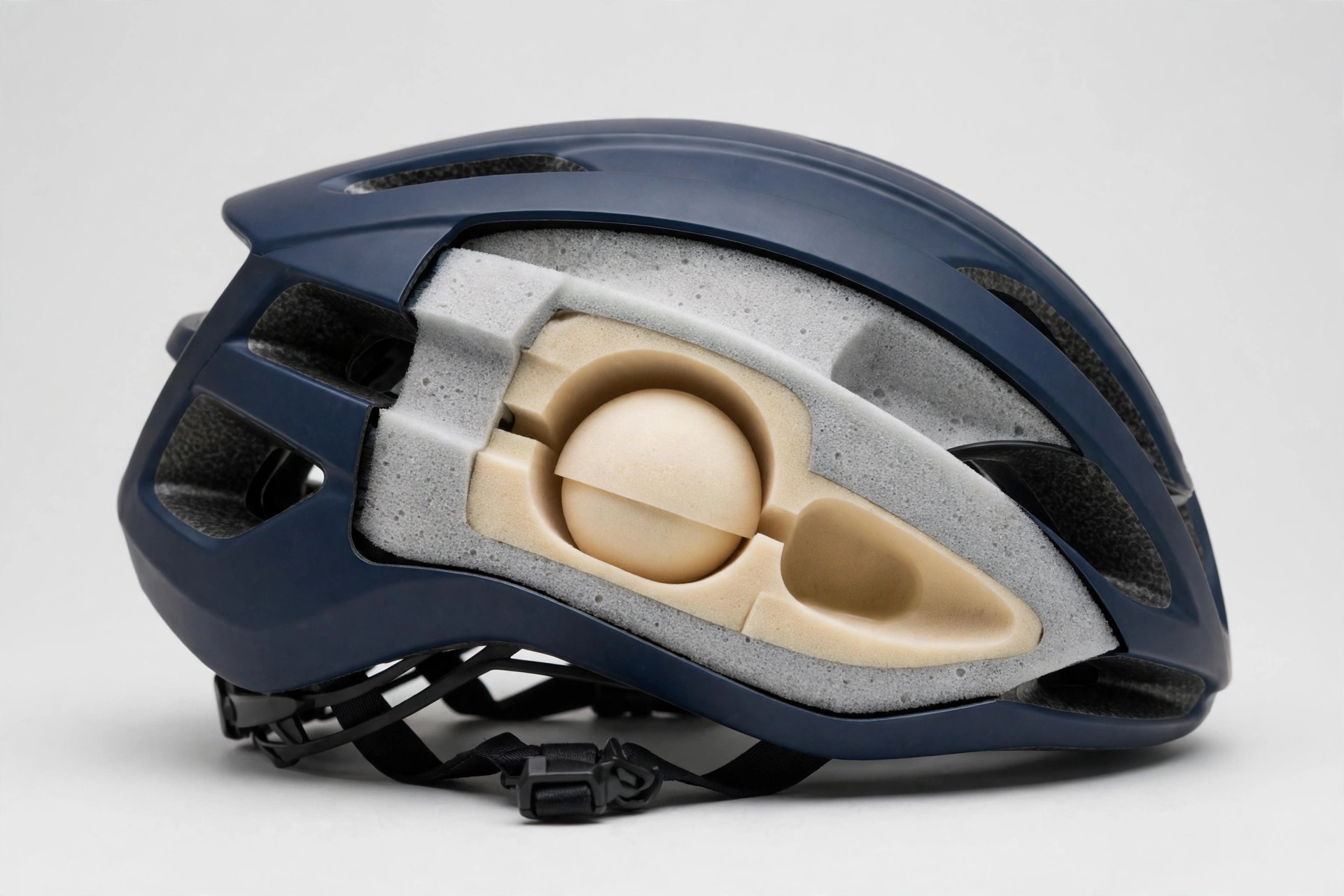
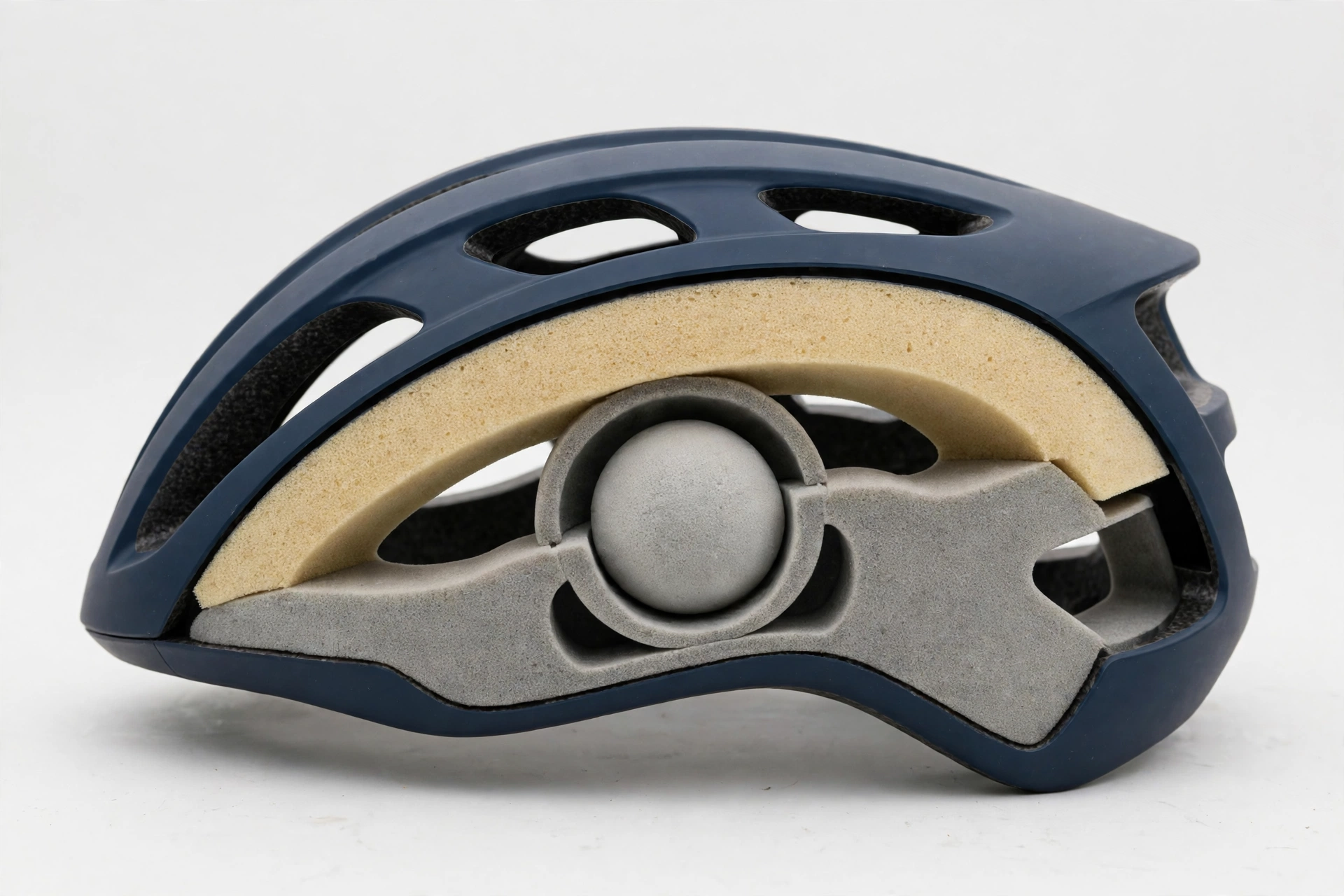
MIPS Spherical is a version of the MIPS rotational-impact system in which two separate layers of the helmet liner are designed to move against each other, like a ball inside a socket, to help reduce the rotational motion that can reach the head in an angled impact. Instead of a thin plastic slip layer sitting between the liner and the head, MIPS Spherical uses two foam layers shaped to slide against each other, so the outer layer can rotate slightly relative to the inner layer when the helmet is struck at an angle. The aim is the same as with other MIPS systems: to let the helmet absorb some of the twisting motion before it reaches the head.
MIPS Spherical is found mainly in cycling helmets, including road, mountain bike, and commuter helmets, and it is one of several ways helmet makers have tried to address rotational forces. It is a development of the original MIPS idea, but the way it is built into the helmet is different, and that difference affects how the helmet looks, feels, and is cared for. This guide explains what MIPS Spherical is in general terms, how it works, and how it compares with other approaches.
What Is MIPS Spherical in a Helmet?
MIPS Spherical is a helmet technology that deals with rotational motion in an angled impact. When a helmet hits the ground at an angle, the impact does not just push straight into the helmet — it also twists it. That twisting motion, sometimes called rotational motion, can be passed on to the head, and helmet designers have spent years looking for ways to reduce it. MIPS, which stands for Multi-directional Impact Protection System, is one of the best-known approaches to this problem, and MIPS Spherical is a particular way of building that idea into a helmet.
In a MIPS Spherical helmet, the liner is made in two parts. The outer part is a shell of foam that sits against the helmet’s outer shell, and the inner part is a separate foam layer that sits closer to the head. The two layers are shaped so that they can slide against each other — the inner layer is rounded, a little like a ball, and the outer layer has a matching socket shape. When the helmet is struck at an angle, the outer layer can rotate slightly while the inner layer stays more still, which may help to reduce the amount of twisting motion that reaches the head.
How Does MIPS Spherical Work?
The idea behind MIPS Spherical is straightforward in general terms. In a straight, direct impact, the foam liner crushes and absorbs energy in the usual way, and the two layers of a MIPS Spherical liner behave much like a single liner. In an angled impact, however, the force has a sideways component as well as a straight one, and that sideways force tries to twist the helmet around the head. Because the two foam layers can slide against each other, the outer layer can move a little in the direction of that twist, while the inner layer moves less.
That small relative movement is the key to the system. It does not stop the impact, and it does not make the helmet absorb all of the rotational motion — no helmet system can do that. What it aims to do is reduce the amount of twisting motion that is passed on to the head, by letting the helmet itself take up some of that motion first. The movement between the layers is small, only a few millimetres in general terms, and it happens in the very short time of the impact itself. If you want a broader introduction to the idea behind it, reading about what MIPS is for helmets can help you understand the system in its wider context.
How Is MIPS Spherical Different from Standard MIPS?
The main difference is in how the sliding layer is built. Standard MIPS uses a separate thin plastic layer, often yellow, that sits between the foam liner and the rider’s head or between the liner and the shell. That layer is designed to slide, and it is the part that moves when the helmet is struck at an angle. MIPS Spherical removes that separate plastic layer and instead builds the sliding action into two foam layers, so the helmet has one fewer separate part.
That difference has a few practical effects. A MIPS Spherical helmet often looks tidier inside, because there is no plastic sheet to see or feel, and some riders find it more comfortable, because the inner foam sits directly against the head or against the helmet’s normal padding. It can also make the helmet a little easier to clean, since there is no thin layer to trap sweat or dirt underneath. On the other hand, a helmet with two foam layers can be a little heavier or a little bulkier than a similar helmet with a single liner and a thin plastic slip layer, though the difference is usually small.
What Are the Benefits and Limits of MIPS Spherical?
The main benefit claimed for MIPS Spherical is that it addresses rotational motion without adding a separate plastic layer that some riders find uncomfortable or noisy. Because the sliding action is built into the foam, the helmet can feel more like a conventional helmet while still offering the rotational-motion feature. Some riders also like the cleaner look inside the helmet, and the fact that there is no thin layer to shift or bunch up when the helmet is put on or taken off.
Who Might Benefit from a MIPS Spherical Helmet?
MIPS Spherical is most often found in cycling helmets, so it is mainly a choice for road cyclists, mountain bikers, and commuters who want a helmet with a rotational-motion system built in. It may appeal to riders who have tried a standard MIPS helmet and found the plastic slip layer uncomfortable, or who simply prefer the feel of a foam liner that sits directly against the head. It can also suit riders who want a helmet that looks and feels conventional, without an obvious extra layer inside.
Frequently Asked Questions
Q: Is MIPS Spherical better than standard MIPS?
A: In general terms, both systems aim to reduce rotational motion in an angled impact, and the main difference is how they are built. MIPS Spherical uses two sliding foam layers instead of a separate plastic slip layer, which some riders find more comfortable, but neither is a guarantee of safety on its own.
Q: Can I feel the two layers moving in a MIPS Spherical helmet?
A: No, not in normal use. The movement between the layers is very small and only happens during an impact. When you are wearing the helmet and riding normally, it should feel like a single, solid liner.
Q: Does a MIPS Spherical helmet need special care?
A: Not in general terms. Clean it with mild soap and water, let it air dry, and store it away from heat and sunlight. If it has been in a crash, or the liner looks damaged, replace the helmet rather than trying to repair it.

Olivia
Writer at Helmet Today, covering helmet reviews, fit and riding safety.