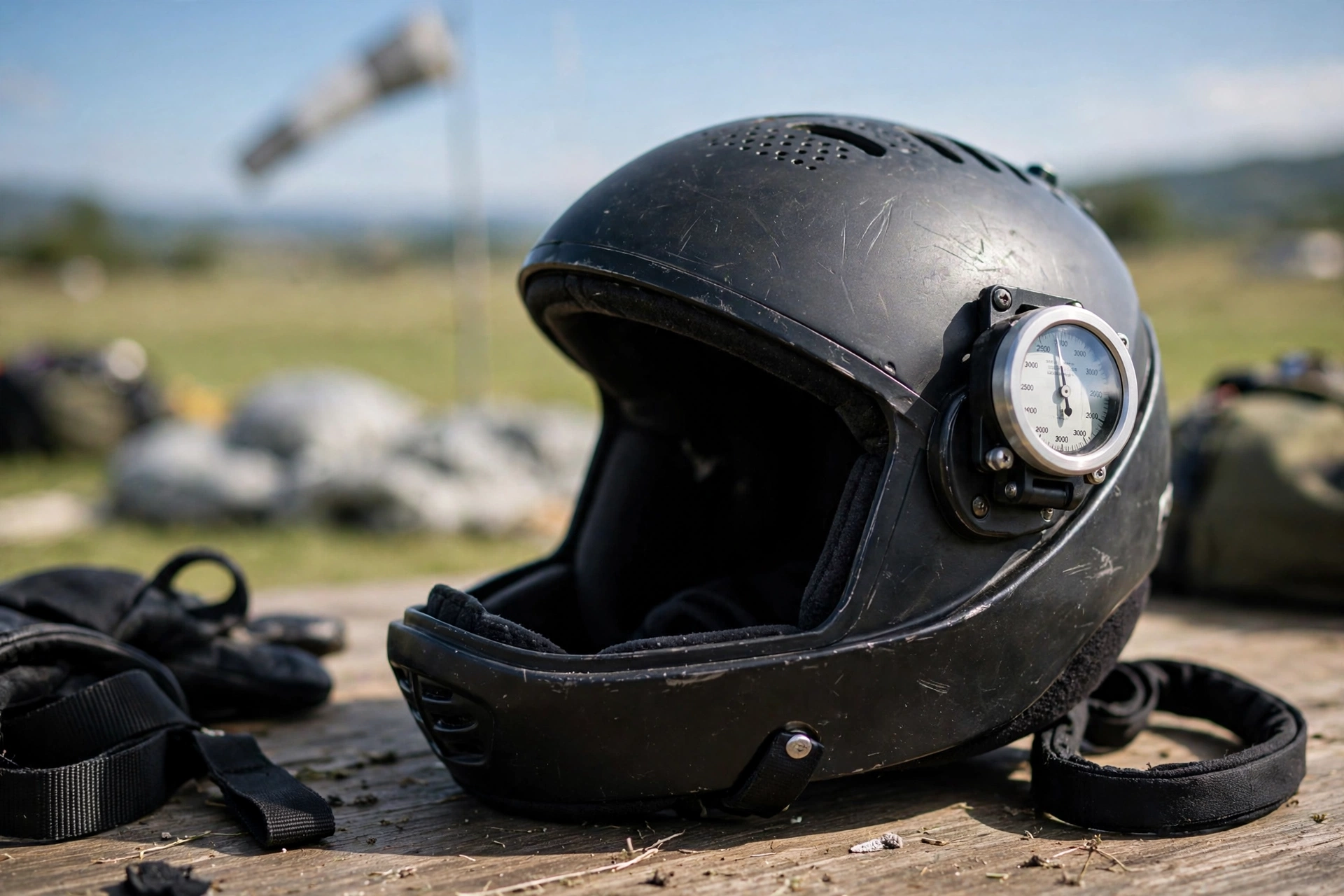
In general terms, a skydiving helmet with an altimeter mount is a helmet with a dedicated bracket, pocket, or mounting point that holds your altimeter securely where you can see it — usually on the side of the helmet or above the visor — so you can check your altitude at a glance without taking your hands off your body position. In freefall, altitude awareness is everything, and a mounted altimeter keeps that information in your line of sight.
Skydivers have traditionally worn altimeters on the wrist or chest, and many still do. But a helmet-mounted altimeter has become popular because it puts the dial or display exactly where the jumper is already looking — forward, in freefall position — rather than requiring a glance down at a wrist. That small difference matters when you are falling fast and every second counts.
How Does a Helmet Altimeter Mount Work?
A helmet altimeter mount is usually a bracket, a clamp, or a moulded housing that attaches to the side or top of the helmet and holds the altimeter in a fixed position. The most common style is a side mount, which places the altimeter on the left or right of the helmet, angled slightly inward so the jumper can see it by glancing sideways without moving their head much.
Some helmets have the mount built in, with a shaped recess or a bracket moulded into the shell. Others use an aftermarket mount that clamps onto the helmet or sticks to it with a strong adhesive pad. Built-in mounts are generally more secure and aerodynamic, while aftermarket mounts offer flexibility — you can move them between helmets or adjust the angle to suit your preference.
The altimeter itself may be analogue, with a needle dial, or digital, with a numeric display. Both work in a helmet mount, but digital altimeters are often smaller and lighter, which suits a helmet mount better. Whatever type you use, the mount must hold it firmly: an altimeter that wobbles, shifts, or falls off in freefall is worse than no altimeter at all.
Why Mount an Altimeter on Your Helmet?
The main advantage is visibility. In freefall, a jumper’s body position is belly-to-earth, head up, arms out — and a helmet-mounted altimeter sits naturally in the peripheral vision, so a quick glance gives the altitude without breaking that position. A wrist altimeter, by contrast, requires the jumper to look down at their hand, which changes body position and can destabilise a formation.
A helmet mount also keeps the altimeter safe. A wrist altimeter can snag on a parachute handle or get knocked during exit, while a helmet-mounted altimeter is tucked close to the shell and less likely to catch on anything. It is also easier to protect: the helmet shields the altimeter from direct wind blast and from knocks during landing.
There is a training benefit too. Students learning to judge altitude often find a helmet-mounted altimeter easier to read, because it is always in the same place and does not require a deliberate look away from the horizon. Instructors sometimes recommend a helmet mount for students who struggle to check a wrist altimeter regularly in freefall.
What Types of Altimeter Mount Are There?
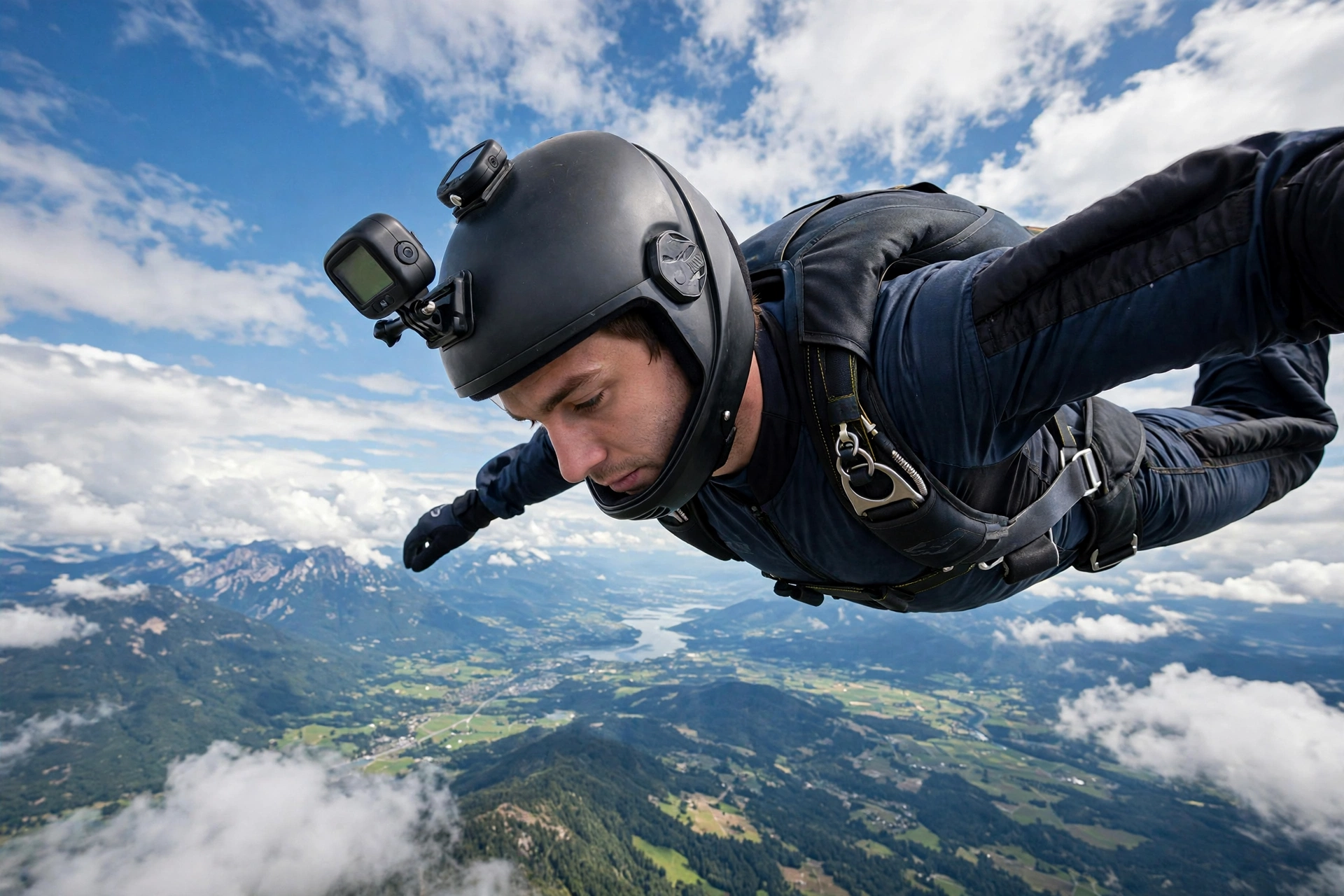
Side mounts are the most common. They attach to the left or right side of the helmet and hold the altimeter at an angle the jumper can read with a sideways glance. Side mounts suit both analogue and digital altimeters, and they keep the front of the helmet clear for a visor or camera. Most jumpers mount on their non-dominant side, so the dominant hand stays free.
Top mounts place the altimeter above the visor, in the jumper’s upper field of view. These are less common, but some jumpers prefer them because the altimeter is visible without any head movement at all — just a glance upward. Top mounts work best with small digital altimeters, since a large analogue dial on top of the helmet can obstruct vision and catch the wind.
Some helmets also offer mounts for audible altimeters, which beep at set altitudes rather than showing a dial. An audible altimeter sits inside the helmet near the ear, and its mount is usually a pocket in the lining rather than an external bracket. Many experienced jumpers use both: a visual altimeter on a mount and an audible altimeter as a backup warning.
How Do You Choose a Helmet With an Altimeter Mount?
Start with the helmet, not the mount. The helmet must fit snugly, stay stable in freefall, and suit your jumping style — open-face or full-face, with or without a camera mount. Once you have a helmet that fits, check whether it has a built-in altimeter mount or whether an aftermarket mount is available for that model. Buying a helmet and then discovering no mount fits it is a frustrating mistake.
Check compatibility with your altimeter. Mounts are made for specific altimeter sizes and shapes, and a mount that fits one brand may not fit another. Bring your altimeter when you shop for a helmet or a mount, and test the combination: the altimeter should sit firmly, read clearly from your normal freefall head position, and not obstruct your vision or your visor.
Consider aerodynamics and snag risk. A mount that sticks out far from the shell can catch the wind, buffet in freefall, or snag on a parachute handle during deployment. Look for a low-profile mount that holds the altimeter close to the shell, and check that the mount’s edges are smooth with no sharp corners or loose straps.
Are There Downsides to a Helmet-Mounted Altimeter?
There are a few. A helmet-mounted altimeter adds weight to one side of the helmet, which can feel unbalanced in freefall until you get used to it. It also adds a protrusion that could, in theory, snag — though well-designed mounts minimise this risk. And if the mount fails, you lose your primary altitude reference, which is why many jumpers keep a wrist altimeter or an audible altimeter as a backup.
Cost is another consideration. Helmets with built-in mounts, and quality aftermarket mounts, cost more than a basic helmet, and the altimeter itself is a separate purchase. For a beginner doing a handful of jumps a year, a wrist altimeter may be perfectly adequate, and a helmet mount becomes worthwhile later, when jumping regularly and building more complex skills.
Finally, remember that an altimeter — wherever it is mounted — is only useful in a helmet that fits properly, and fit is what makes any helmet’s protection work, including systems that address angled impacts, as explained in this guide to what MIPS means for helmets. Choose the helmet first, the mount second, and always have a backup altitude reference.
Frequently Asked Questions
Q: Can I add an altimeter mount to any skydiving helmet?
A: In general terms, most helmets accept an aftermarket mount, but built-in mounts are more secure. Check that a mount exists for your helmet model and altimeter before buying.
Q: Is a helmet-mounted altimeter better than a wrist altimeter?
A: For many jumpers, yes — it is easier to read without breaking body position. But a wrist altimeter is a good backup, and many jumpers use both.
Q: Do I still need an audible altimeter with a helmet mount?
A: It is wise to have one. An audible altimeter beeps at set altitudes as a backup warning, which protects you if you miss a visual check or if the visual altimeter fails.

Olivia
Writer at Helmet Today, covering helmet reviews, fit and riding safety.