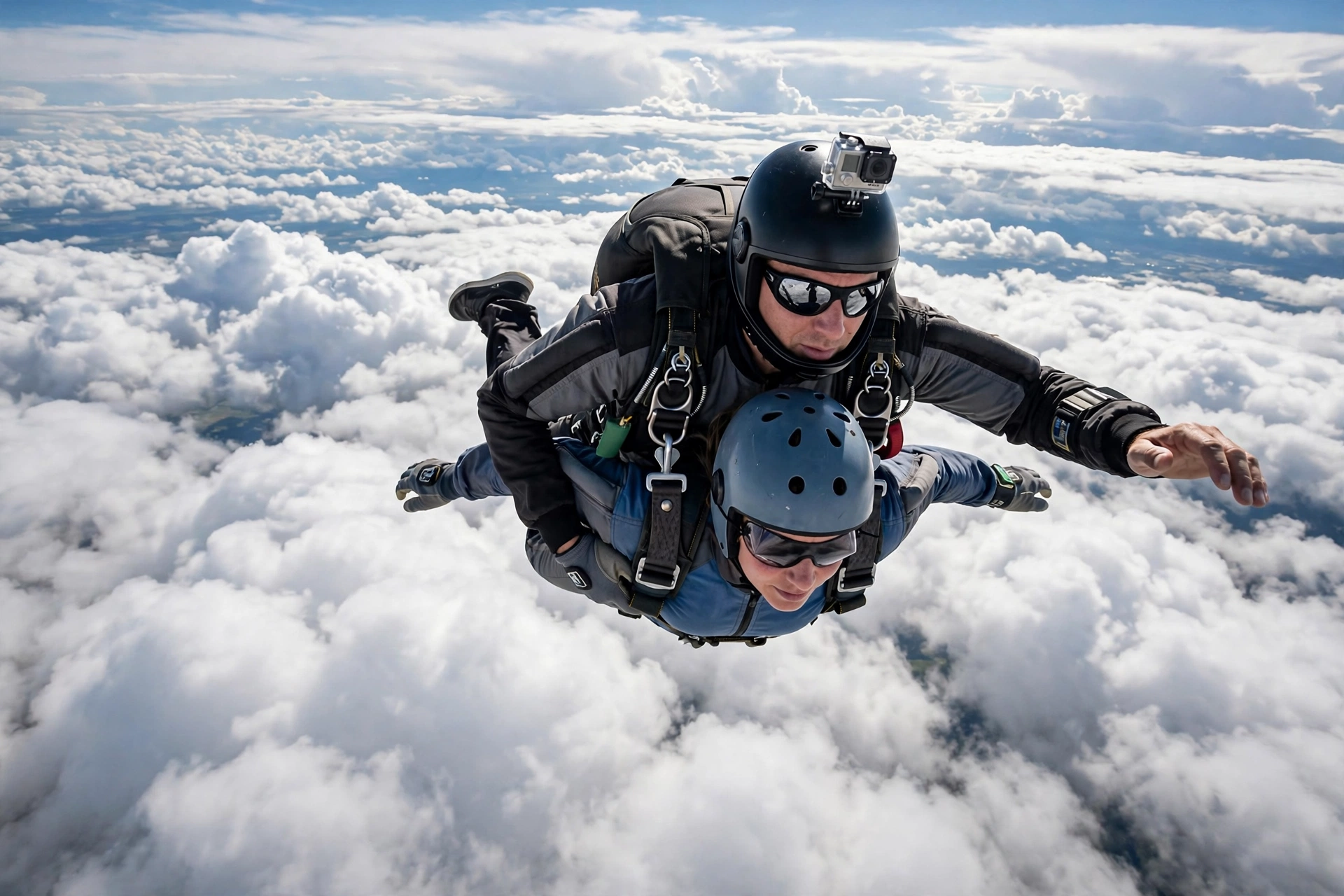
A helmet for tandem skydiving is a close-fitting skydiving helmet worn by both the passenger and the instructor during a tandem jump, to protect the head from knocks during the exit, the freefall, and the landing. In general terms, it is not there for the parachute ride itself so much as for the moments when heads can bump into the aircraft door, the instructor’s equipment, or the ground. Both people wear one, and both helmets are checked before the aircraft takes off.
Tandem skydiving is the way most people make their first jump. The passenger is harnessed to the front of an experienced instructor, and the two of them leave the aircraft together, fall together, and land together under one large parachute. Because the passenger has no parachute of their own and no training, the instructor controls everything, and the helmet is part of the shared safety routine that keeps the pair protected from the moment they board the aircraft to the moment they are back on the ground.
What is a helmet for tandem skydiving?
A helmet for tandem skydiving is a light, close-fitting helmet designed for freefall, usually made from a hard outer shell with a padded lining and a chin strap that keeps it in place at high speed. In general terms, it is different from a motorcycle helmet or a cycling helmet: it is lighter, it sits close to the head, and it is shaped so that it does not catch the wind or block the wearer’s view. Some are open-face helmets that leave the face clear, while others are full-face helmets with a visor that protects the eyes and face from the wind.
The helmet is worn from the time the pair boards the aircraft until they land, not just during the fall. It protects the passenger’s head while they shuffle to the door of the aircraft, while they sit in the doorway, and while they tumble out into the air. In the freefall, the two bodies can shift against each other, and the helmet keeps a knock from the instructor’s helmet or harness from becoming an injury. On landing, it gives a final layer of protection if the pair stumbles or falls forward on touchdown.
Why do tandem skydivers wear a helmet?
Tandem skydivers wear a helmet because the head is exposed to knocks at almost every stage of the jump, and a light helmet reduces the risk from those knocks without getting in the way. In general terms, the greatest risk is not the fall itself but the small collisions around it: bumping the head on the aircraft door frame on the way out, knocking helmets together as the pair stabilises in freefall, or catching the ground awkwardly on landing. A helmet turns those bumps into minor incidents rather than injuries.
The helmet also protects against the wind and against small objects in the air. At freefall speed, the wind is strong enough to sting the eyes and make it hard to breathe comfortably, and a full-face helmet with a visor solves that problem neatly. For the instructor, the helmet is working equipment worn on every jump of the day, so it also needs to be comfortable enough to wear for hours, light enough not to strain the neck, and easy to adjust between passengers of different head sizes.
What kind of helmet is used for tandem skydiving?
The helmets used for tandem skydiving are purpose-made skydiving helmets, and the dropzone usually provides them as part of the jump. In general terms, passengers are given an open-face helmet, which is simple, light, and easy to fit over different head shapes, while instructors often wear a full-face helmet with a visor, since they need eye protection and a clear view while they steer the parachute. Some passengers who wear glasses may be given a full-face helmet or goggles to wear under an open-face helmet.
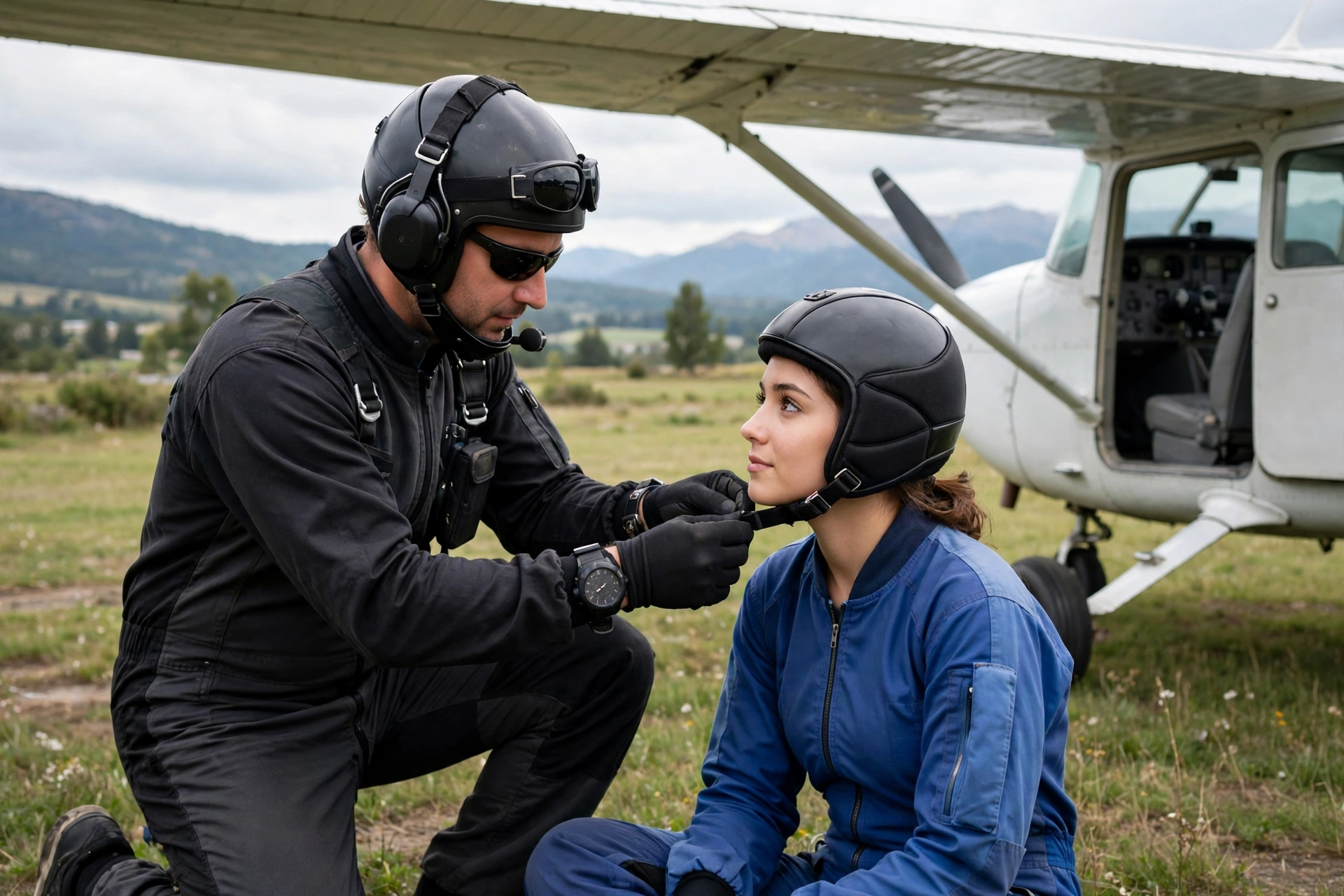
The fit matters more than the style. A skydiving helmet should sit snugly on the head without squeezing, and the chin strap should be tightened so that the helmet cannot slide forward over the eyes or backwards off the head in freefall. The instructor or a member of the ground crew will usually check the fit before boarding, and they will adjust the strap and the lining for the passenger. A helmet that is too loose can shift at speed and block the passenger’s view, which is why the check is done on the ground rather than in the air.
Does the passenger need a helmet too?
Yes, the passenger wears a helmet as well as the instructor, and in general terms this is standard practice at dropzones. The passenger is the one with no experience of freefall, so they are the most likely to be surprised by the wind, to tense up, or to move their head suddenly at the wrong moment. The helmet protects them if their head knocks against the instructor’s helmet or the aircraft, and it also helps them keep their eyes open and enjoy the view instead of squinting against the wind.
Some people worry that the helmet will be uncomfortable or that it will spoil the experience, but most passengers forget about it within seconds of leaving the aircraft. The helmet is light, the lining is padded, and once the pair is in stable freefall the passenger’s attention is on the ground far below and the horizon around them.
What should you check before a tandem jump?
Before a tandem jump, the passenger should check that the helmet fits snugly, that the chin strap is fastened and adjusted, and that nothing is loose or flapping. In general terms, long hair should be tied back or tucked inside the helmet, glasses should be secured with a strap if they are worn, and any loose items should be left on the ground, since anything loose can be lost in freefall. The instructor will run through these checks as part of the briefing, and the passenger should speak up if the helmet feels too tight, too loose, or uncomfortable.
It is also worth asking the dropzone what kind of helmet will be provided and whether a full-face option is available, especially for passengers who wear glasses or who are nervous about the wind. Some helmets include a system designed to reduce rotational forces in a fall, such as MIPS, although the main protection in a tandem helmet comes from its snug fit and its hard shell. The most important check, though, is the simplest one: the helmet should feel secure, the strap should be fastened, and the passenger should feel comfortable asking for an adjustment before the aircraft door opens.
Do you wear a helmet for tandem skydiving?
Yes, in general terms both the passenger and the instructor wear a helmet on a tandem jump, from boarding the aircraft until landing, to protect against knocks at the door, in freefall, and on landing.
What kind of helmet is best for a first tandem jump?
A light, close-fitting skydiving helmet provided by the dropzone is best, usually open-face for the passenger, with goggles if needed. The fit and the chin strap matter more than the style.
Can you wear glasses under a tandem skydiving helmet?
Yes, in general terms glasses can be worn under an open-face helmet with goggles, or under a full-face helmet with a visor. Tell the dropzone in advance so the right helmet and eye protection can be arranged.

Olivia
Writer at Helmet Today, covering helmet reviews, fit and riding safety.