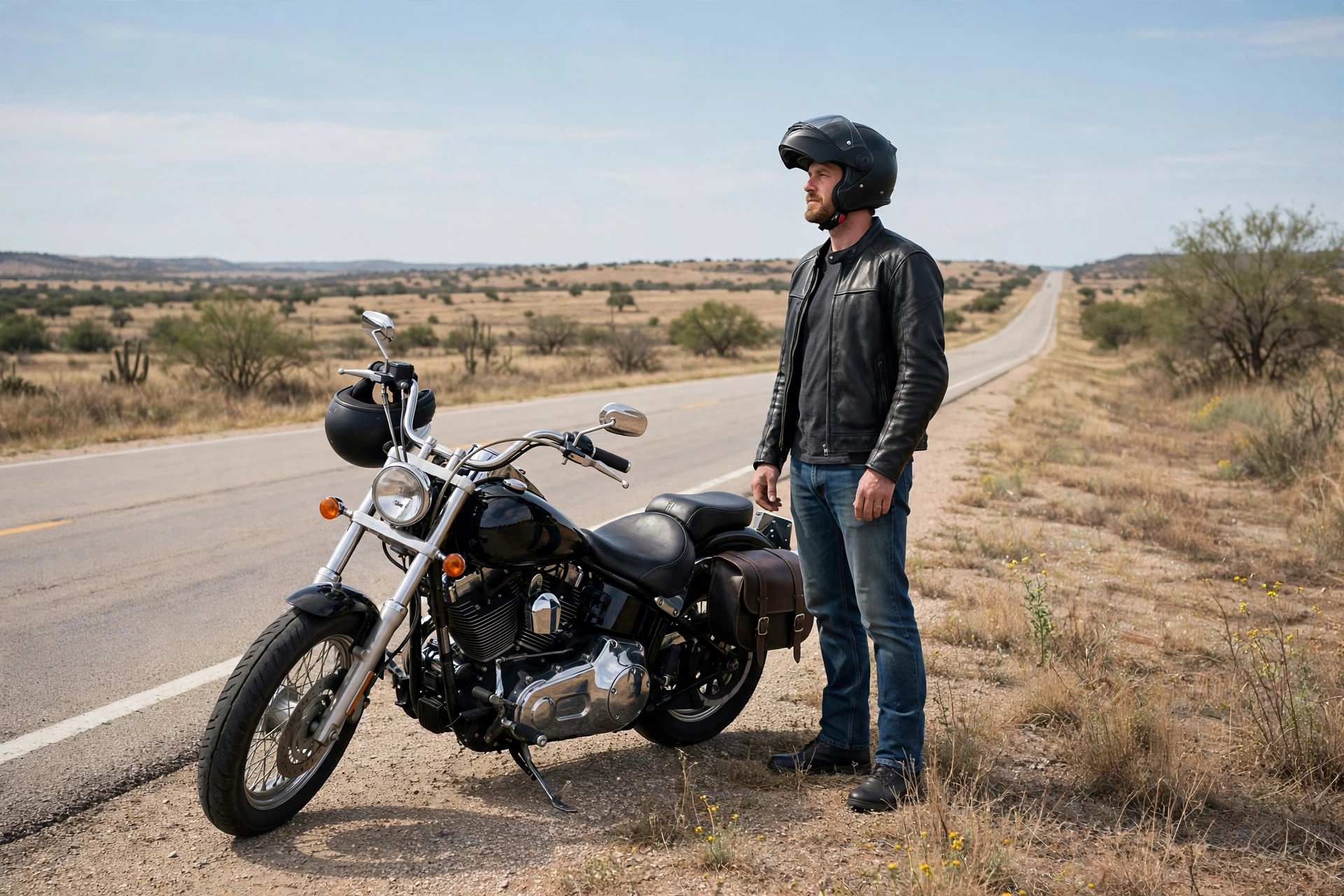
In Texas, motorcycle riders aged 21 and older can legally ride without a helmet if they qualify for an exemption — and the most common route is insurance. A rider 21 or older is exempt if they are covered by a health insurance plan that provides medical benefits for injuries from a motorcycle accident, or if they have completed an approved motorcycle safety course. Riders under 21 must always wear a helmet, with no exemptions.
How Does the Texas Helmet Law Work?
The Texas helmet rule sits in Transportation Code Section 661.003. It requires a helmet for anyone operating or riding on a motorcycle who is under 21 years old. For riders 21 and over, the law offers the exemption described above. Both the operator and any passenger are covered by the same framework: a passenger needs to meet the same conditions as the driver.
Texas used to require a specific minimum amount of medical coverage, and older guides still quote a $10,000 figure. The current law is written around being covered by a health insurance plan that provides medical benefits for injuries incurred in a motorcycle accident, rather than that old fixed dollar test. If you are relying on the insurance exemption, the plan needs to actually cover motorcycle crash injuries — a policy that excludes motorcycle accidents would leave you exposed both legally and financially. To see how Texas compares nationally, read our overview of helmet laws by state.
The Two Ways a Rider 21+ Can Qualify for the Exemption
There are exactly two qualifying routes under Texas law, and a rider only needs one of them:
- The safety course route: successfully completing a motorcycle operator training and safety course approved by the Texas Department of Public Safety. Completers typically receive a course completion card, which serves as their proof.
- The insurance route: being covered by a health insurance plan that provides medical benefits for injuries incurred while operating or riding a motorcycle.
Many Texas riders qualify under both without realizing it. If you took a basic rider course to get your Class M license and you also carry ordinary health insurance, you are doubly covered. The practical problem is proof at the roadside, which is why carrying your course completion card or insurance card matters — keep a photo of both on your phone as a backup.
Note that the exemption is personal. It follows the individual rider, not the motorcycle. Borrowing a friend’s bike does not borrow their exemption, and carrying a passenger who does not qualify does not extend yours to them.

Can Police Stop You Just to Check Your Exemption?
Texas law limits this. An officer may not stop or detain a motorcycle operator or passenger solely to determine whether they qualify for the helmet exemption. In other words, riding helmetless at an obviously adult age is not, by itself, a reason for a stop. If you are stopped for another reason — speeding, a faulty light, a lane violation — an officer can then ask whether you meet the exemption conditions.
When asked, a rider can show the standard proof: a course completion card for the safety course route, or evidence of qualifying health insurance for the insurance route. Riders who cannot show they qualify risk a citation for the helmet offense. The cleanest habit is simple: decide which exemption you rely on, carry its proof every ride, and keep a digital copy as backup in case the card is lost.
Enforcement details and related rules can change, so check the current Texas Transportation Code and DPS guidance if you have been cited or if your situation is unusual.
What About Passengers and Young Riders?
Passengers follow the same age line. A passenger under 21 must wear a helmet in Texas, period — the insurance and safety course exemptions do not apply to them. A passenger who is 21 or older needs to qualify in their own right, through their own insurance coverage or their own completed safety course. The driver’s exemption does not cover the person on the back.
Texas also has separate rules about young passengers generally, including a minimum age for child passengers on motorcycles. If you plan to carry a child, confirm both the passenger age rules and the helmet requirement before riding, and use a properly fitting, standards-approved helmet sized for the child — an adult helmet slid onto a small head offers very little protection. For a broader look at how other states treat passengers, our helmet laws by state guide breaks the rules down state by state.

Should You Ride Without a Helmet Just Because You Can?
The exemption answers a legal question, not a safety one. Texas gives experienced, insured adults a choice, and plenty of riders on both sides of that choice ride carefully for decades. But the facts behind the law are worth weighing: in a crash, the unhelmeted rider is the one relying on that health insurance plan for exactly the kind of head injury a helmet is designed to reduce. That is also why the statute ties the exemption to medical coverage in the first place.
If you do choose to ride without a helmet, treat the exemption conditions as a checklist, not a loophole: confirm your plan does not exclude motorcycle injuries, keep proof with you, and consider the course route as well — the training is valuable in its own right. And if there is any doubt about whether you qualify, wear the helmet. It is the one option that is legal in every state you might ride into, including states with universal helmet laws just across the Texas border.
The insurance exemption depends on coverage you hold today, not coverage you once had. Changing jobs, switching plans, letting a policy lapse, or moving to a plan that excludes motorcycle injuries can quietly end your exemption without any change in how your daily ride feels. Reviewing your coverage once a year — the same habit that keeps your registration and inspection current — is the simplest way to stay legal. If there is a gap in coverage, you have two clean options: wear a helmet until the new plan is active, or complete an approved safety course so you qualify under the course route instead. Riders who commute across the state line should also remember that the Texas exemption ends at the border; Louisiana and Arkansas, for example, apply their own age-based rules to everyone riding there.
Frequently Asked Questions
Does health insurance really exempt you from wearing a helmet in Texas?
Yes, if you are 21 or older and your health insurance plan provides medical benefits for motorcycle accident injuries. Riders under 21 are never exempt.
How much insurance did Texas used to require for the helmet exemption?
Older versions of the law were tied to a $10,000 medical coverage figure, which is why it still appears in old guides. Check the current Texas statute for the wording that applies today.
Can a Texas officer pull me over only to check my helmet exemption?
No. Texas law prohibits stopping a rider solely to check exemption status, though an officer can ask about it during a stop made for another reason.

Olivia
Writer at Helmet Today, covering helmet reviews, fit and riding safety.