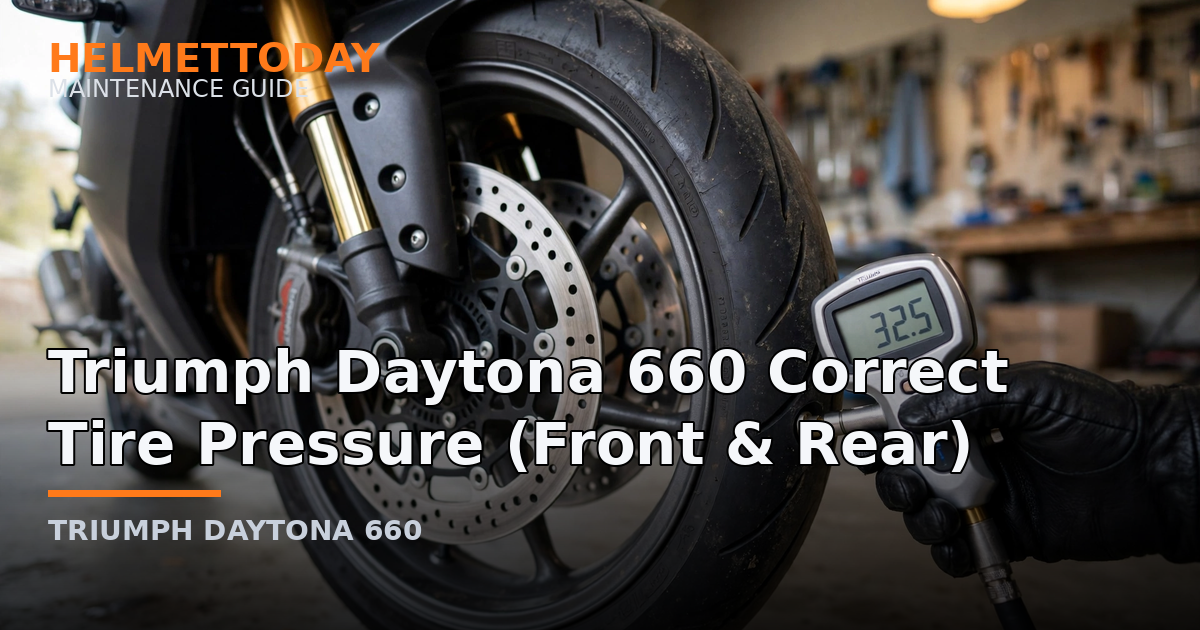
Tire pressure is the simplest performance and safety adjustment on your Triumph Daytona 660 — and the most neglected. Correct pressures for the Triumph Daytona 660 are 34 PSI front / 42 PSI rear for solo riding.
Check pressures cold (before riding) at least weekly. A tire just 5 PSI low handles worse, wears faster, and runs hotter.
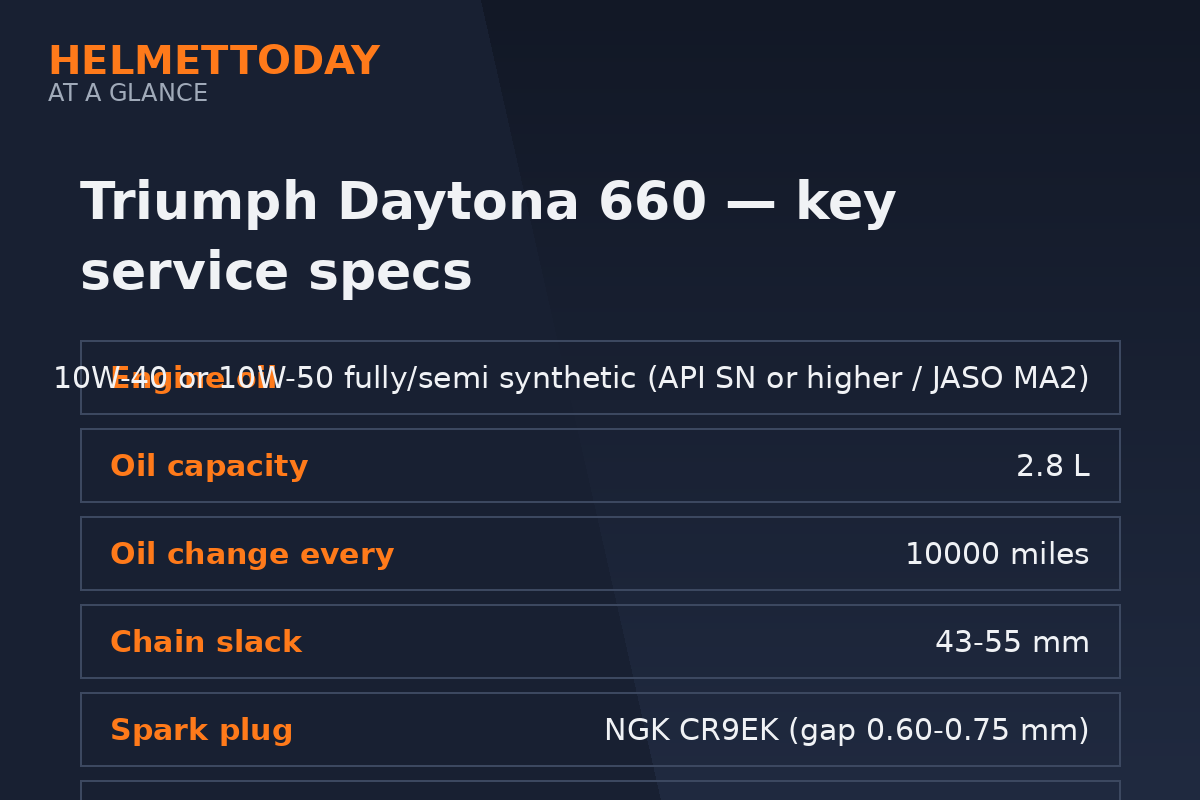
Triumph Daytona 660 quick service specs
| Item | Specification |
|---|---|
| Engine oil | 10W-40 or 10W-50 fully/semi synthetic (API SN or higher / JASO MA2) |
| Oil capacity | 2.8 liters |
| Oil change interval | 10000 miles |
| Chain slack | 43-55 mm |
| Spark plug | NGK CR9EK (gap 0.60-0.75 mm) |
| Tire pressure (F/R) | 34 PSI front / 42 PSI rear |
| Battery | 12V 8Ah (YTX9-BS) |
How to check and set tire pressure, step by step
- Check pressures when the tires are cold — at least 3 hours after riding.
- Remove the valve cap and press your gauge squarely onto the valve for a clean reading.
- Compare to 34 PSI front / 42 PSI rear. Add air in short bursts or bleed down to hit the target exactly.
- Don’t forget the rear — and re-check after adding a passenger or luggage (see your manual’s loaded spec).
- Refit the valve caps finger-tight and log the check.
- While you’re there, inspect tread depth, sidewalls for cracks, and remove any embedded stones or nails.
Common mistakes to avoid
- Checking hot — heat raises pressure, so you’ll set them too low.
- Trusting gas-station gauges — carry your own accurate gauge; they’re cheap.
- Ignoring the rear tire — it carries the load and wears fastest.
FAQ
What tire pressure for the Triumph Daytona 660 with a passenger?
Raise the rear pressure per your owner’s manual loaded spec — usually +3-6 PSI over solo.
Does pressure change with temperature?
Yes — roughly 1 PSI per 10°F. Re-check when seasons change.
Can I run lower pressure for better grip?
On the street, no — under-inflation overheats the carcass and hurts handling. Set it to spec.
Related guides

Dan Heiman
Writer at Helmet Today, covering helmet reviews, fit and riding safety.