In general terms, a women’s equestrian helmet should fit snugly all round, sit level just above the eyebrows, and stay in place when you ride — with no rocking forward or back, no pressure points, and a chin strap that holds it firmly without digging in. Many women’s riding helmets are shaped for a slightly narrower head, and some offer a lower profile or a ponytail opening, but the fit test is the same for every rider: snug, level, stable, and comfortable for a full lesson or hack.
Horse riding involves movement in every direction, from the gentle motion of a walk to the bounce of a trot and the forward position of a jump. A helmet that fits well stays where it should through all of that, while a loose helmet will slide and distract you, and a tight one will give you a headache before the lesson ends. This guide explains how to measure, try on, and check a women’s equestrian helmet, and what to look for with hair, hats, and different riding styles.
How Do You Measure for a Women’s Equestrian Helmet?
Start by measuring your head with a soft tape measure. Wrap the tape around the widest part of your head, just above the eyebrows and ears, keeping it level all the way round. Take the measurement twice and write it down in centimetres. Then compare it with the size chart for the helmet you are considering, because sizes vary between makers and between models, and the same number can fit very differently from one brand to another.
Think about how you wear your hair when you ride. If you usually ride with a low ponytail, a braid, or a hairnet, try the helmet on in that style. A helmet that fits with loose hair may feel tight with a ponytail, and a helmet with a ponytail opening can make a real difference to comfort. Measure and try on the helmet the way you will actually wear it at the yard.
What Does a Good Equestrian Helmet Fit Feel Like?
A good fit feels snug all round, with even contact and no hard pressure point on the forehead, the temples, or the back of the head. The helmet should sit level, with the front edge just above your eyebrows — about two fingers above them. It should not tilt back and expose your forehead, and it should not sit so low that it presses on your eyebrows or blocks your view of the horse and the ground ahead.
Shake your head gently from side to side and up and down, and try nodding as if you are looking down at your horse. The helmet should move with your head, not slide around on its own. If it rocks forward or back, it is too loose or the wrong shape. If it leaves a red mark after a few minutes, or if it hurts at one spot, it is the wrong size or shape for you. The padding should touch your head evenly, with no gaps at the sides or the back.
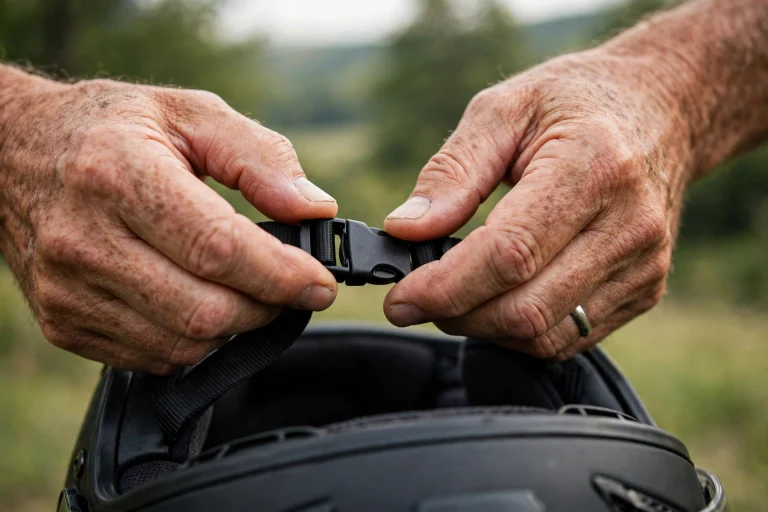
Use the fit system if the helmet has one. Many riding helmets have a dial at the back that tightens the inner band, while others come in fixed sizes with different padding options. Turn the dial until the helmet feels snug but not tight, and check that you can still move your jaw comfortably. The chin strap should sit snugly under your chin, with room for about two fingers, and it should hold the helmet firmly without rubbing your skin.

How Should Hair and a Hairnet Affect the Fit?
Hair is one of the biggest factors in equestrian helmet fit, because many riders wear their hair up. A low ponytail, a braid, or a bun can change how a helmet sits at the back, so always try the helmet on with your hair in your usual riding style. A hairnet can also add a little bulk, so try the helmet on with the net you normally use, rather than without it.
Some women’s riding helmets have a ponytail opening or a lower cut at the back that leaves room for tied hair. Others are shaped to sit comfortably over a braid without pressing on it. If you ride with a bun, check that the helmet does not push the bun down or press on it, because that can tilt the helmet forward. In general terms, a helmet should be tried on in the full set-up you will ride in, including any hairnet or thin skull cap you wear underneath.
What About Ventilation and Different Riding Styles?
Ventilation matters in a riding helmet because lessons and hacks can be warm work, especially in summer. Look for vents that let air flow over your head, and check that the padding does not block them. In general terms, a helmet with good airflow will feel cooler on a long ride, and it will dry faster afterwards. Try the helmet on for several minutes to see how warm it feels, because a helmet that feels fine for a moment may feel hot after ten minutes in the sun.
Different riding styles may call for different helmet shapes. A dressage rider may prefer a low, classic profile, while a show jumper or an eventer may prefer a helmet with a slightly different peak or vent layout. The fit test stays the same, though: snug, level, and stable. If you ride in more than one discipline, look for a helmet that fits well and meets the standard required for each one you take part in.
What Else Should You Check Before You Buy?
Before you buy, check the helmet’s weight. A lighter helmet is less tiring over a long lesson or a day at a show, and it can make a difference to neck comfort by the end of the day. Check that the liner is removable for washing on the model you choose, because riding helmet padding absorbs sweat and needs regular cleaning to stay comfortable and fresh.
Make sure the helmet meets the standard required for the riding you do, and check the maker’s guidance on replacement after a fall or an impact. A helmet that has taken a hard hit should be checked and usually replaced, even if the damage is not visible. It is also worth learning about the technology inside modern helmets, and reading about what MIPS is for helmets can help you understand one of the features you may see on an equestrian helmet.
Frequently Asked Questions
Q: Are women’s equestrian helmets different from men’s?
A: In general terms, some are shaped for a slightly narrower head and lower volume at the back, and some have a ponytail opening. The fit test is the same: snug, level, stable, and comfortable in the saddle.
Q: How tight should a women’s riding helmet feel?
A: It should feel snug all round, with even contact and no hard pressure point. It should stay put when you shake your head, and the chin strap should be snug with room for about two fingers.
Q: Should I try a riding helmet on with my hair up?
A: Yes. Try it on with your hair in your usual riding style, including any hairnet, because a ponytail or braid can change how the helmet sits at the back.

Olivia
Writer at Helmet Today, covering helmet reviews, fit and riding safety.