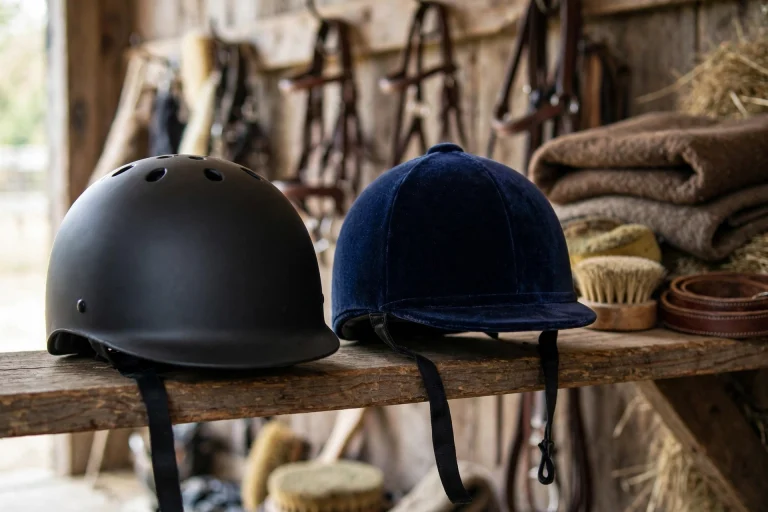
A skull cap is a jockey-style riding helmet with no fixed peak, usually worn under a thin fabric cover — a silk — in the rider’s colours. Eventers wear one for the cross country phase because, in general terms, cross country rules require a helmet without a fixed peak: in the rotational falls cross country produces, a rigid peak is a liability, while the skull cap’s smooth, round profile is not. Under the silk, it is a fully certified safety helmet, held to the same standards as any other.
The skull cap looks like a fashion choice and is actually a rules-driven piece of safety kit. This guide explains what it is, why cross country calls for it, and where else you will see one.
What Exactly Is a Skull Cap?
A skull cap is a close-fitting helmet with a smooth, rounded shell and no brim or fixed peak at the front. The design comes from horse racing, where jockeys have worn the style for generations, and it is built like any modern riding helmet: a hard outer shell, energy-absorbing foam inside, and a harness that fastens under the chin.
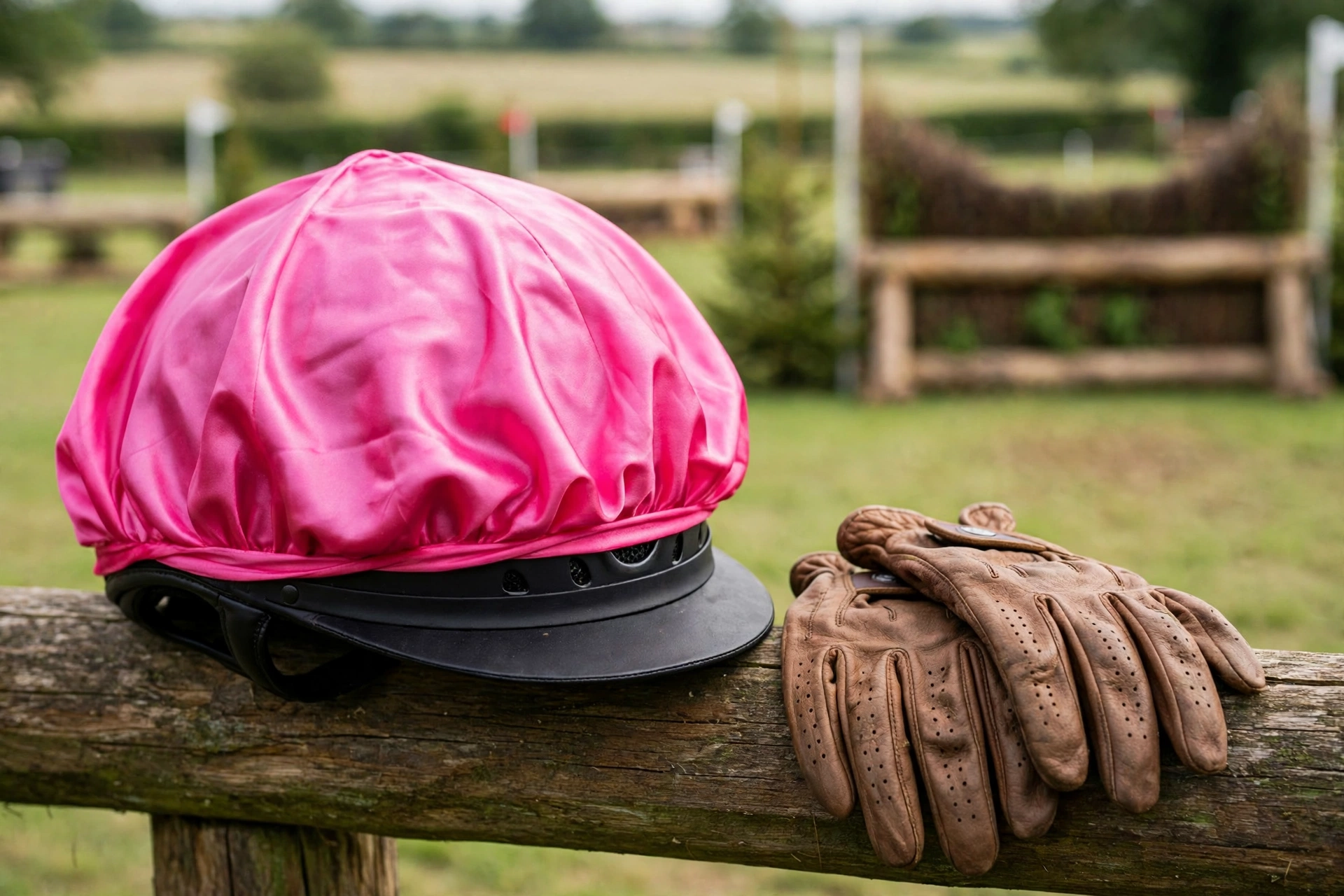
What covers it is the recognisable part. Skull caps are usually worn with a fitted cover — traditionally velvet, more often now a lycra or silk cover, also simply called a silk — which gives the helmet its colours and its finished look. Cross country silks are bold: bright colours and patterns that identify the rider across a big course and show up in photographs.
The cover is clothing, not equipment. It adds no protection, and the helmet beneath it must be certified on its own merits. Some skull caps have a very short, flexible stub where a peak would be, which is allowed because it is not fixed — but the classic form is a smooth dome, and that smoothness is the point.
Why Do Eventers Wear Skull Caps for Cross Country?
Cross country falls are the most violent in equestrian sport: horses and riders fall together at speed, often rotationally, with the rider’s head likely to strike the ground or a fence at an angle while still moving. In that kind of fall, a fixed peak can dig into the ground or catch, jerking the head and neck — and the peak itself becomes one more thing to fail.
So the rules address it directly. In general terms, eventing’s cross country phase requires a helmet without a fixed peak — which means a skull cap (or a helmet whose peak is entirely flexible) is the required equipment for that phase at affiliated competition. Riders plan their kit around it: skull cap and colours for cross country, with other helmet styles permitted for the dressage and show jumping phases under their own rules.
The same logic explains racing. Jockeys fall in packs at gallop speed, and the skull cap’s profile — nothing to catch, nothing to dig in — is the shape that suits chaotic, multi-directional falls. Wherever falling riders tumble rather than land neatly, the peakless profile earns its place.
What Standards Must a Skull Cap Meet?
The same ones as any other competition helmet. A skull cap used in affiliated eventing must be certified to one of the standards on the governing body’s accepted list — in general terms, standards such as PAS 015, VG1, or ASTM/SEI — and carry the label and any required certification mark inside to prove it. Officials check labels and helmet condition at events, and the absence of a peak does not exempt the helmet from any of that.
Construction-wise, a certified skull cap offers the same baseline protection as a certified peaked helmet: the standards test the helmet’s impact absorption, penetration resistance, and retention, not its silhouette. The foam manages the energy of a strike the same way in either shape, and some skull caps add the same optional extras as other helmets, including rotational-impact systems like MIPS designed for angled falls — arguably the falls this helmet style was born for.
Care rules are identical too: replace after any fall, retire with age, never buy second-hand.
When Else Are Skull Caps Worn?
Racing is the skull cap’s other home: jockeys race in them, again under silks in owners’ colours, and stable staff ride out in them daily. National hunt and flat racing alike treat the style as standard dress.
Within eventing itself, many riders use the skull cap beyond cross country. With a plain or velvet cover, it is a tidy choice for show jumping and schooling, and some riders prefer the secure, close fit for everyday work — particularly those who also hunt or team chase, where the same falling-off-at-speed logic applies. For dressage, convention favours a conventional helmet’s appearance, though a skull cap under a neat velvet cover is also seen.
Outside competition, skull caps suit any rider whose falls are likely to be tumbling ones, or who simply likes the fit. The style’s racing heritage means sizes and shapes are well developed, and many riders find the deep, close fit feels more secure than a peaked helmet’s.
How Is a Skull Cap Different From a Peaked Helmet?
The obvious difference is the profile. A peaked helmet has a fixed front brim — shading the eyes, shedding rain, and giving the traditional show-ring look. A skull cap has none, presenting a smooth dome that a cover dresses up. Sitting on a shelf, they read as two different sports; on the label inside, they are the same category of certified safety equipment.
Functionally, each gives something up. The peaked helmet’s brim is genuinely useful for sun and weather, and its shape is the required look in some showing contexts. The skull cap gives up shade in exchange for its fall behaviour and its versatility under covers — one helmet, many colours, which matters to eventers running cross country in their own colours and racing yards switching silks between horses.
Fit and safety practice do not differ between the two. Both must sit level and snug, both must be fastened every ride, both are finished by their first real fall. Choose between them by discipline and by rules: if you event, the cross country phase has already decided for you.
Frequently Asked Questions
Q: Why are fixed peaks not allowed for cross country?
A: In general terms, because of how cross country falls happen: at speed and often rotationally, with horse and rider together. A rigid peak can catch or dig into the ground during such a fall, jerking the rider’s head and neck. Eventing rules therefore require a helmet with no fixed peak for that phase — the skull cap exists to meet that requirement.
Q: Does the silk cover on a skull cap add any protection?
A: No. The silk or velvet cover is purely for appearance and identification — colours, sponsorship, tradition. All the protection is in the certified helmet underneath, which must meet the accepted standards on its own. A cover also cannot make an uncertified or out-of-date helmet legal or safer.
Q: Can I wear a skull cap for show jumping and dressage?
A: Usually yes, provided the helmet is certified to a standard your governing body accepts and its rules for those phases do not require a different style — many riders jump in skull caps with a smart cover, and dressage riders sometimes use one under a velvet cover. Check the current rules for your discipline and level, since helmet requirements are set phase by phase.

Olivia
Writer at Helmet Today, covering helmet reviews, fit and riding safety.