Multi-density foam liners work by using layers or zones of foam at different firmness levels, so the helmet can respond to both gentle knocks and harder impacts. A single foam density is a compromise: soft foam cushions light hits well but bottoms out under a hard hit, while firm foam handles hard hits but feels harsh on light ones. By combining densities, a liner can do a better job across a wider range of impacts.
You will find multi-density liners in many motorcycle, cycling and ski helmets. This guide explains how they are built, how each density behaves, where the different zones sit, and what to look for when you are choosing a helmet.
What Is a Multi-Density Foam Liner?
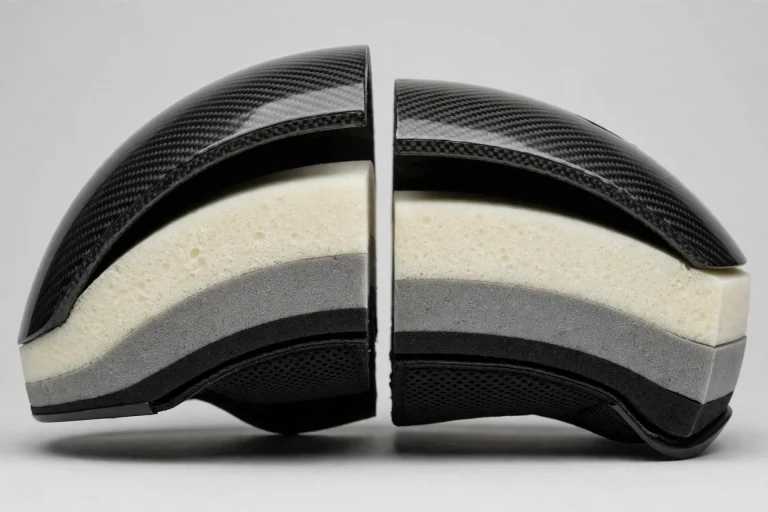
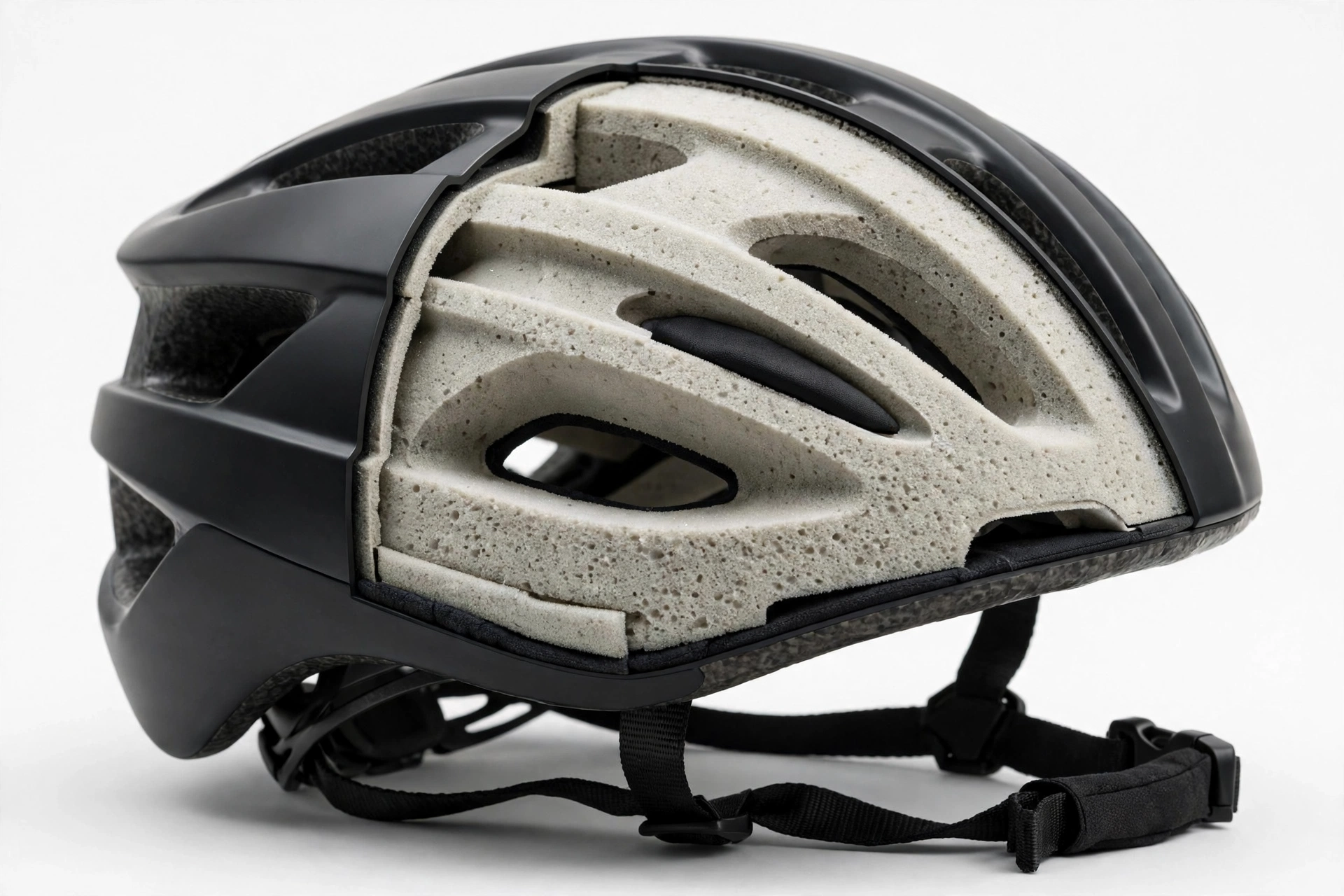
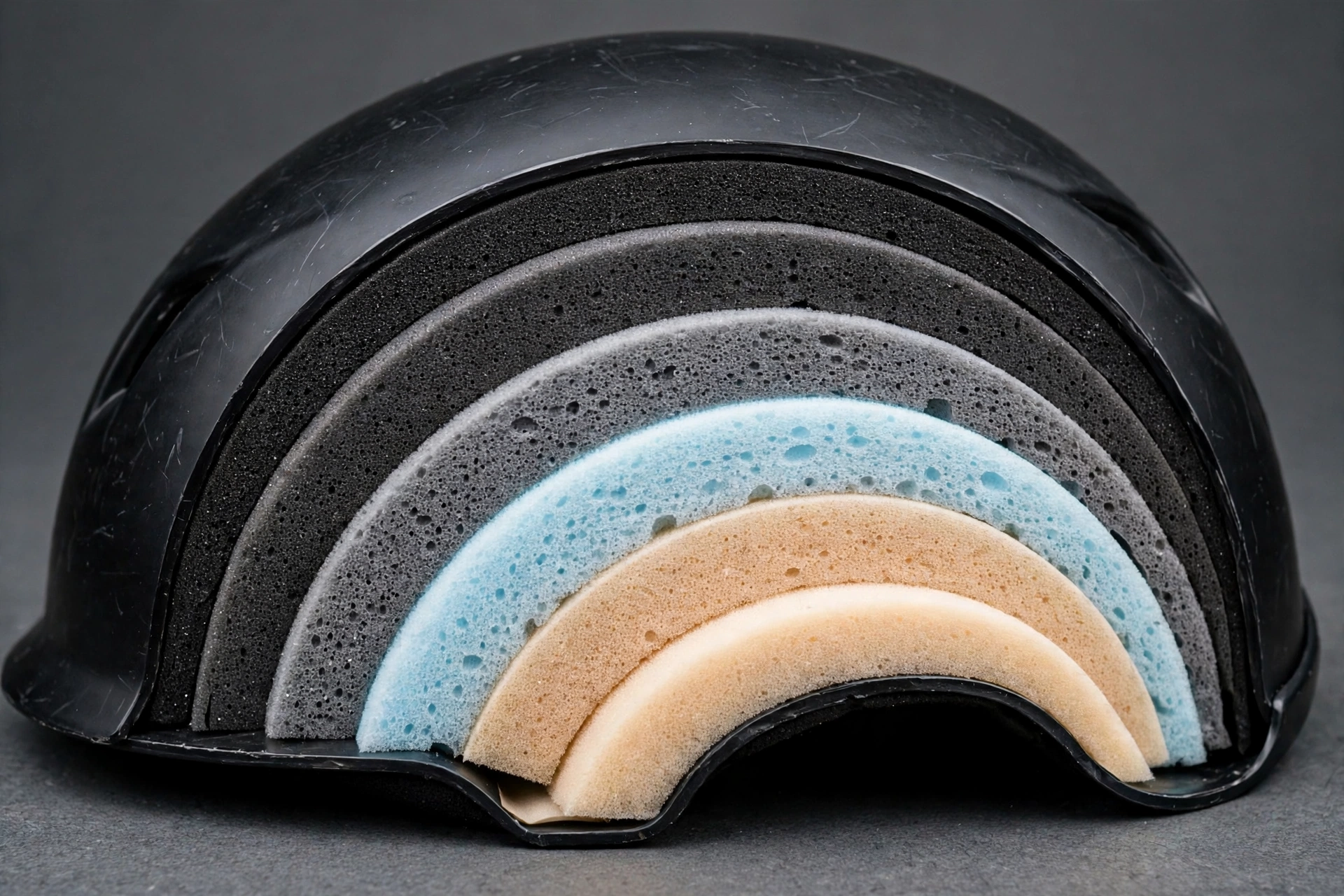
A helmet liner is the foam layer between the outer shell and your head. In most helmets it is made from expanded polystyrene, known as EPS, a foam of tiny beads fused together. In a single-density liner, the whole foam layer has the same firmness throughout. In a multi-density liner, the foam is made in two or more densities, either as stacked layers or as separate zones fitted together.
The densities are often described as soft, medium and firm. Soft foam crushes easily, firm foam resists crushing, and medium foam sits between the two. The maker arranges these densities so that each part of the liner responds to the kind of impact that part of the head is most likely to meet.
Multi-density liners are sometimes marketed under brand names, but the idea is the same whatever the name. The liner is not one uniform block of foam, but a carefully arranged set of foam pieces working together.
How Does Each Foam Density Behave in an Impact?
Foam protects your head by crushing. When the helmet hits something, the foam compresses and absorbs energy, slowing your head more gently than a sudden stop would. Soft foam starts crushing under a light load, so it is good at taking the edge off low-speed knocks. Firm foam needs a bigger load before it starts to crush, so it stays intact longer and handles harder impacts.
The problem with a single density is that it can only be tuned for one range. A liner made entirely of soft foam may crush completely in a hard impact, leaving nothing to slow your head further. A liner made entirely of firm foam may barely crush in a light impact, passing more force to your head than a softer foam would.
A multi-density liner aims to get the best of both. The softer zones handle the lighter impacts, while the firmer zones take over as the load grows. In general terms, this gives the helmet a wider working range, so it can protect across more kinds of fall.
Where Do the Different Densities Sit in a Helmet?
Makers place the densities where they expect them to be needed. Firmer foam often sits around the crown and the sides of the head, where a hard impact is most likely to land. Softer foam may sit near the forehead or around the edges, where lighter knocks are more common and where comfort matters too.
In some helmets, the densities are stacked in layers: a softer layer next to the head and a firmer layer next to the shell, or the other way round. In others, the liner is divided into separate blocks, each with its own density, fitted together like a puzzle inside the shell. Both approaches are in use, and neither is automatically better.
The exact layout is part of the maker’s design and testing. It is tuned alongside the shell, the shape of the helmet and the safety standard the helmet must meet. That is why two helmets with multi-density liners can feel and perform differently.
What Are the Advantages and Trade-Offs?
The main advantage is a wider range of protection. A multi-density liner can cushion a light knock without feeling harsh, and still have firm foam in reserve for a harder hit. Riders who use one helmet for different kinds of riding may benefit most, since the impacts they face can vary widely.
There are trade-offs. Multi-density liners are more complex to design and make, which can add cost. They can also be slightly heavier than a single-density liner, because the maker is adding extra foam pieces and joins. And the benefit depends on the design being done well: a poorly arranged multi-density liner is no better than a good single-density one.
Fit is not affected in a direct way, since the densities sit inside the shell and the comfort padding sits between the liner and your head. But a liner with more pieces can have more joins, so it is worth checking that the helmet feels smooth and even when you try it on.
How Can You Tell If a Helmet Has a Multi-Density Liner?
The simplest way is to check the maker’s description. Helmet makers usually mention a multi-density liner in the product details, often with a name of their own for the system. If the description says the liner uses two or three densities, or names different foam zones, that is what you are looking at.
You cannot tell by looking at the outside of the helmet, and the liner is usually covered by comfort padding, so you may not see the foam at all. If the padding is removable, you may be able to see joins or colour differences between foam pieces, but not every maker marks them.
When you compare helmets, treat a multi-density liner as one feature among several. Check the safety standard, the fit, the weight and the ventilation too. If you are learning about helmet technology, reading about what MIPS is for helmets can help you understand another feature that may sit alongside the liner inside the helmet.
Frequently Asked Questions
Q: Is a multi-density liner better than a single-density liner?
A: In general terms, a well-designed multi-density liner can protect across a wider range of impacts. But a good single-density liner in a helmet that fits well is still a solid choice.
Q: Does a multi-density liner make a helmet heavier?
A: It can add a little weight, because it uses more foam pieces. The difference is usually small, and many riders will not notice it in normal use.
Q: Do multi-density liners need special care?
A: No. Care for the helmet in the usual way: keep it clean, dry and out of strong heat, and replace it after a significant impact or if the foam looks damaged.

Olivia
Writer at Helmet Today, covering helmet reviews, fit and riding safety.