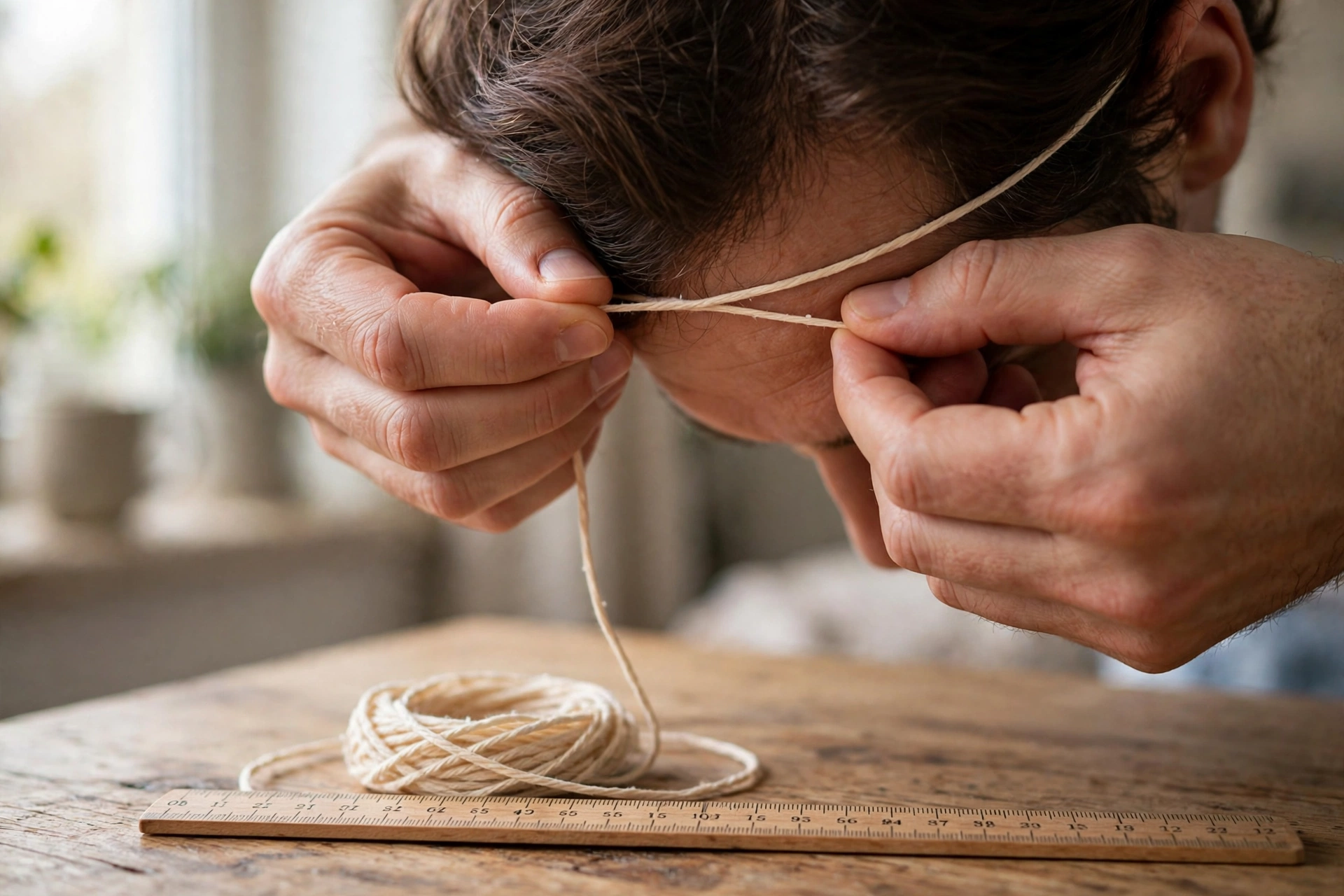
You can find your helmet size without a tape measure by wrapping a piece of string around your head, marking where it meets, and measuring the string with a ruler. The number you get is your head circumference, and you can match it to the size chart of the helmet you want to buy. It takes only a few minutes, and it is far more reliable than guessing your size from a hat size or from a helmet you used years ago.
A helmet that is the wrong size will not protect you properly. A helmet that is too big can slide over your eyes or come off in a fall, while a helmet that is too small will press on your head, cause headaches, and leave gaps where it should sit snugly. Measuring your head first is the simplest way to avoid both problems, and you do not need any special tools to do it. A piece of string, a shoelace, a phone charging cable, or even a strip of paper will work.
What do you need to measure your head without a tape measure?
You need three things: something flexible to wrap around your head, something to mark it with, and something to measure the length with. A length of string or ribbon is ideal, because it follows the curve of your head easily. A strip of paper cut from a newspaper or a paper bag works well too, as long as it does not stretch or tear. A belt or a scarf can work in a pinch, but they are harder to keep flat against your head.
For measuring, a ruler is the most common tool, and most people have one in a drawer. If you do not have a ruler, a standard bank card is about 8.5 centimetres long, and a sheet of A4 paper is 29.7 centimetres long, so you can use those as rough guides. A phone screen can also help, because many phones have a ruler app or a measurement tool, although a real ruler will give you a more accurate number.
How do you measure your head with string and a ruler?
Start by finding the widest part of your head. Wrap the string around your head just above your eyebrows and above your ears, passing over the bump at the back of your head. This is the same line a helmet will sit on, so it gives the truest measurement. Keep the string level all the way around, not tilted up at the back or dipping at the front.
Hold the string snugly against your skin, but do not pull it tight enough to dent the skin or compress your hair. Mark the point where the string meets itself with a pen, a knot, or by pinching it between your fingers. Then lay the string flat next to a ruler and read the length from the end to the mark. Measure twice to be sure, and if the two numbers differ, take the larger one, because a helmet that is slightly roomy can be adjusted, but one that is too tight cannot.

How do you turn the measurement into a helmet size?
Once you have your head circumference in centimetres, compare it with the size chart of the helmet brand you are looking at. Most charts list sizes in centimetres, such as small for 51 to 55 centimetres, medium for 55 to 59 centimetres, and large for 59 to 63 centimetres, although the exact ranges differ between brands. Always check the chart for the specific helmet, because two helmets labelled medium can fit quite differently.
If your measurement falls on the boundary between two sizes, the smaller size is usually the better choice, because helmet padding settles slightly with use and a snug fit is safer than a loose one. If you are between sizes and the helmet has an adjustment dial, try the smaller size first and see if the dial gives you enough room. If your head is an unusual shape, for example very round or very long, the size chart alone may not be enough, and trying helmets on in person is worth the trip.
What if you have no string, ruler, or paper?
If you have nothing at all to measure with, you can still get a rough idea of your size from a hat you already own. Check the label inside the hat for a size in centimetres or a letter size, and use that as a starting point. A baseball cap or a beanie that fits well can give a useful clue, although hats sit differently from helmets and stretch over time, so treat the number as a rough guide rather than an exact measurement.
Another option is to use your hands. Wrap your fingers around your head to feel where a helmet would sit, and compare that with a helmet a friend owns. If you can borrow a helmet that fits well, check its size label and use that as your reference. This is less accurate than measuring, but it is better than guessing blindly, and it can narrow down the size to try first when you order or visit a shop.
How do you check the fit once the helmet arrives?
When the helmet arrives, put it on and check that it sits level, low on your forehead, with the front edge about two finger widths above your eyebrows. It should feel snug all the way around, without a painful pressure point on the forehead or the sides. Shake your head gently from side to side and up and down. The helmet should move with your head, not slide around on its own.
Adjust the straps so they form a V just below each ear, and fasten the chin strap so only one or two fingers fit underneath. If the helmet wobbles, feels loose, or presses in one spot, try a different size or a different model, because heads come in different shapes and one brand may suit you better than another. Some modern helmets use a slip layer that lets the shell move slightly in an angled impact, an idea known as MIPS. That feature is worth having, but it does not fix a poor fit, so get the size right first.
How accurate is measuring with string and a ruler?
It is accurate enough to pick the right helmet size in most cases, as long as you keep the string level and do not pull it too tight. Measure twice and use the larger number. If you are between sizes, try the smaller one first, because helmet padding settles a little with use.
Can I use a phone charging cable instead of string?
Yes. Any flexible cord that does not stretch will work, including a charging cable, a shoelace, or a strip of paper. Wrap it around your head in the same way, mark the meeting point, and measure the length against a ruler.
What should I do if my measurement is between two sizes?
Try the smaller size first, especially if the helmet has an adjustment dial. A snug helmet is safer than a loose one. If the smaller size presses painfully or leaves a red mark after a few minutes, move up to the larger size and check the fit again.

Olivia
Writer at Helmet Today, covering helmet reviews, fit and riding safety.