A thin cap under a helmet can be fine, but a bulky cap can change safety — in general terms, anything that lifts the helmet, loosens the fit, or lets the helmet slide can reduce how well it protects you. A flat cycling cap with a short peak is the classic example of a cap that works under a helmet: it is thin, it sits flat, and it has been worn that way for decades. A thick baseball cap with a stiff peak and a button on top is a different matter.
The question is not whether a cap is allowed, but whether the helmet still fits properly with it on. This guide explains what changes, what to check, and when a cap should stay in your pocket instead.
How Does a Cap Change the Way a Helmet Fits?
A helmet is designed to sit directly against your head, with the comfort padding in contact with your scalp and hair. A cap puts a layer between the padding and your head, and that layer changes the fit in two ways: it adds thickness, which lifts the helmet, and it adds a smooth surface, which the helmet can slide against.
A lifted helmet covers less of the forehead and the back of the head, which are the areas the helmet is meant to protect. A helmet that slides easily can also rotate in a fall, which means it may not be in the right place when it needs to absorb the impact. The effect of a thin cap is small; the effect of a thick cap can be enough to matter.
The cap’s peak adds another issue. A stiff peak under the front of the helmet can push the helmet up and back, and in a fall the peak itself can press into the forehead. A soft, short cycling cap peak folds flat and does not do this, which is why cycling caps are designed the way they are.
What Kind of Cap Is Safe Under a Helmet?
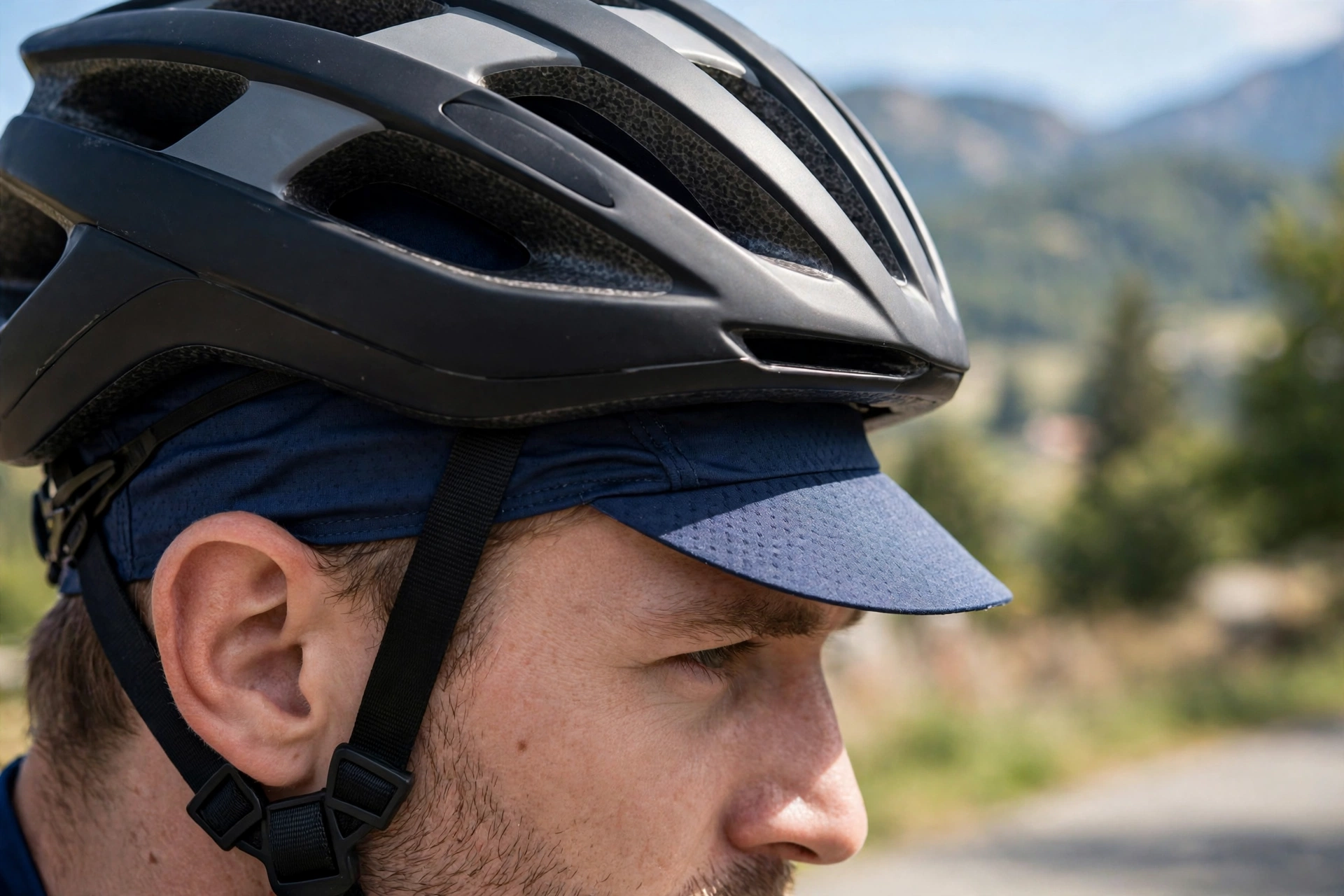
A cycling cap is the safest choice. It is thin, made from light cotton or synthetic fabric, with a short, soft peak that folds flat under the helmet. It sits close to the head, adds almost no thickness, and is designed to be worn under a helmet — for sun, rain, and sweat rather than warmth.
A thin skull cap or liner is just as good, and better in cold weather, because it covers the ears as well. Like a cycling cap, it should be thin and smooth, with no seams that bunch up under the helmet. If you can scrunch the cap into a small ball in your hand, it is probably thin enough.
Avoid a standard baseball cap. The stiff peak, the button on top, and the thick structured crown all create lumps and lift under a helmet. A beanie with a folded brim is also too bulky. If the cap has a hard part anywhere — a button, a stiff peak, a thick seam — it does not belong under a helmet.
How Do You Check the Fit with a Cap On?
Put the cap on, smooth it flat, and put the helmet on over it. Check the position first: the helmet should sit level, low on the forehead, with the front edge about two fingers above the eyebrows. If the helmet sits higher than it does without the cap, the cap is lifting it, and the fit has changed.
Then do the movement checks. Shake your head side to side, nod up and down, and try to twist the helmet with your hands. The helmet should stay put and move the skin on your forehead, not slide freely across the cap. If it slides more easily with the cap on, the cap is too smooth or too thick, and the grip has been lost.
Check the strap and the retention dial too. The dial should still have adjustment range left — if it is at its loosest and the helmet still feels tight, the cap is taking up too much room. Take the cap off and check the fit without it: the helmet should fit well on its own, because the cap is an extra, not a fit solution.
Does a Cap Affect Safety in a Crash?
In general terms, a thin cap has a very small effect, and many riders wear one under a helmet every day without issue. The helmet’s impact liner still does its job, and the cap is too thin to change how the helmet absorbs force in a meaningful way. That is the practical answer for a cycling cap or a thin liner.
A thick cap is different. By lifting the helmet and letting it slide, it can change the helmet’s position at the moment of impact, and a helmet that is not where it should be protects less well. The peak of a stiff cap can also create a pressure point on the forehead in a fall. These are not theoretical worries — they follow directly from how a helmet is meant to sit.
It is also worth remembering that a helmet should be replaced after a crash, whatever was underneath it. If you fall with a cap under your helmet, check the helmet for damage and replace it if there is any doubt. If you are comparing helmet features, reading about what MIPS is for helmets can help you understand one of the liner systems you may see, since some liners grip the head differently with a cap underneath.
When Should You Skip the Cap?
Skip the cap when it is thick, stiff, or lumpy — and when you cannot get the helmet to pass the fit checks with it on. If the helmet sits high, slides easily, or the retention dial runs out of range, the cap is not working, whatever the weather.
On hot days, a cap can also make you warmer than you need to be, and sweat pooling under a cap can make the helmet slip more. A helmet with good ventilation, or a sweatband designed for the purpose, may be a better choice than a cap in summer.
For sun protection, a cycling cap is genuinely useful — its peak shades the eyes and keeps rain off the face. For warmth, a thin skull cap does the job better. Choose the cap for the conditions, keep it thin and flat, and always check the fit with it on. If the fit is right, the cap is fine; if it is not, leave the cap behind.
Frequently Asked Questions
Q: Can I wear a baseball cap under my bike helmet?
A: In general terms, no — a baseball cap’s stiff peak, button, and structured crown lift the helmet and create pressure points. Use a thin cycling cap or skull cap instead.
Q: Does a cycling cap under a helmet reduce protection?
A: A thin cycling cap has a very small effect, because it sits flat and adds almost no thickness. Check the fit with the cap on: if the helmet still sits level and stays put, it is fine.
Q: Should I size up my helmet to fit a cap underneath?
A: No. The helmet should fit well on its own, and the cap should be thin enough not to change that fit. Sizing up for a cap leaves the helmet loose when you ride without it.

Olivia
Writer at Helmet Today, covering helmet reviews, fit and riding safety.