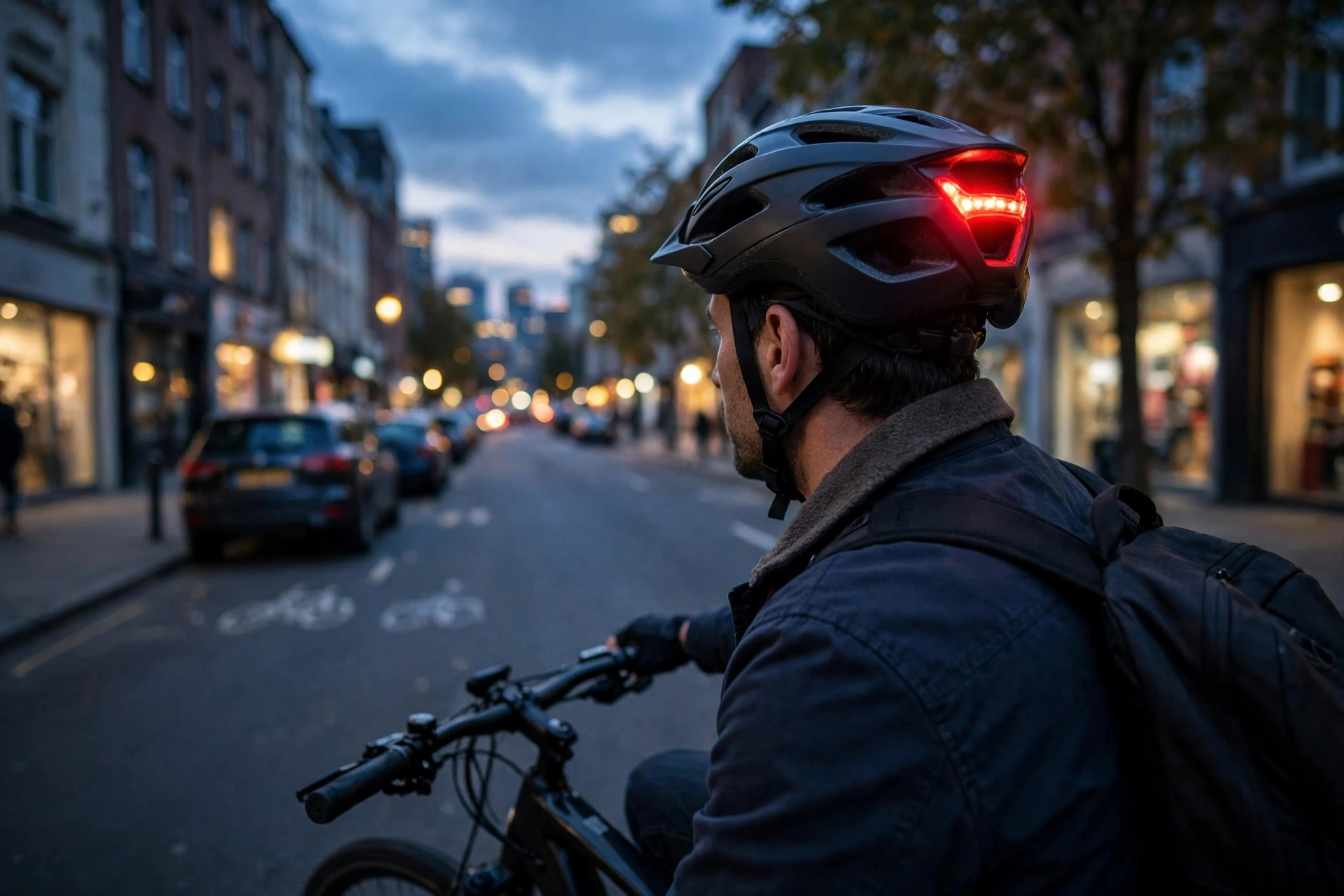
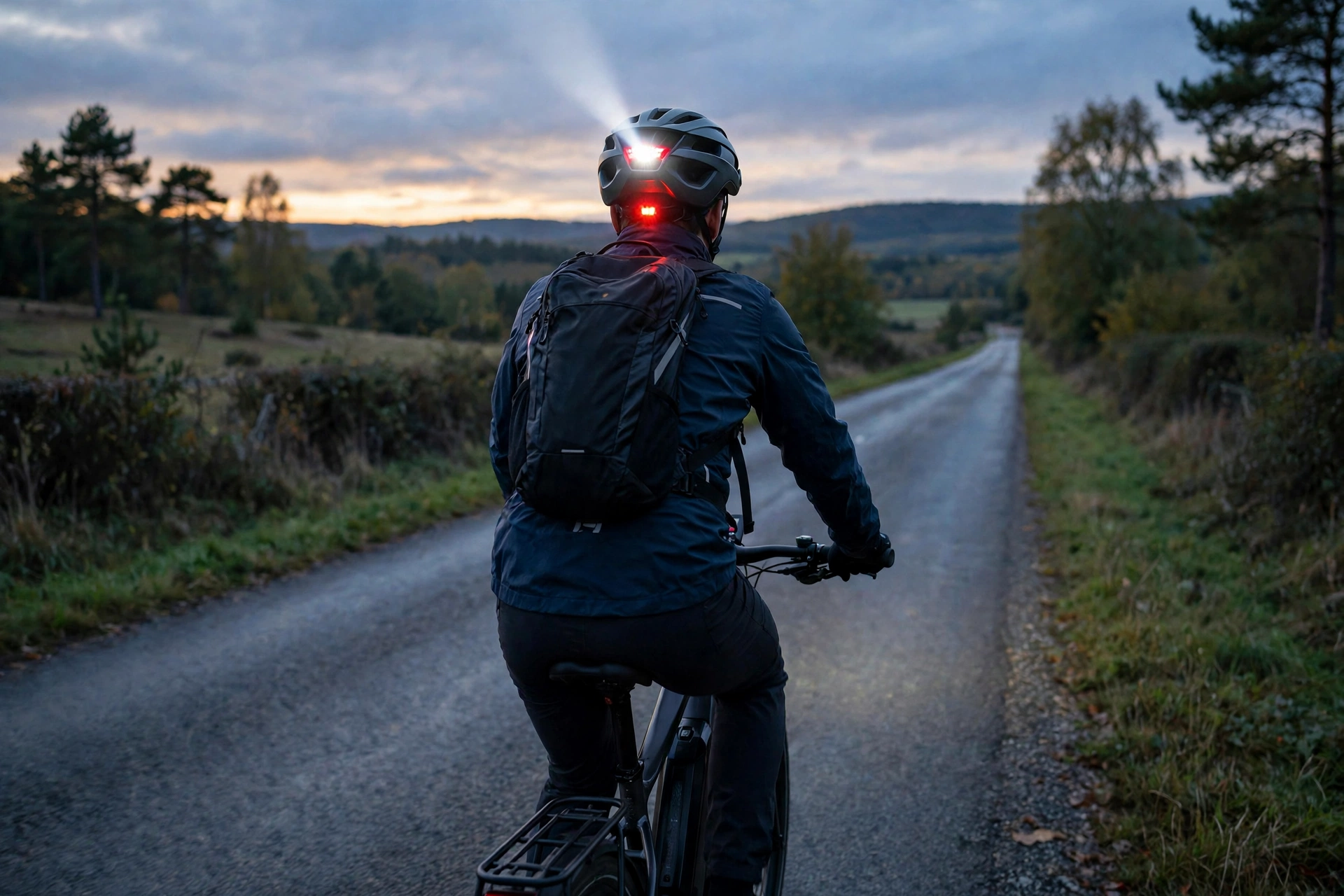
An e-bike helmet with built-in lights makes you visible from the front and rear without separate accessories, keeps lights at head height where drivers look, and turns on with the helmet instead of being forgotten at home. The rear light matters most for commuting, because it sits high, moves with your head, and is harder to block with a rack bag or jacket than a seatpost light.
Built-in lighting has moved from novelty to a genuinely useful commuter feature, especially for riders who travel in dawn, dusk, and winter darkness. This guide explains the benefits, the trade-offs, and how to judge whether a lighted helmet suits your riding.
Why Does Head-Height Lighting Make You More Visible?
Drivers scan for other road users at roughly eye and head height, and a light mounted on your helmet sits right in that scan path. A bike-mounted rear light can be surprisingly easy to hide: a saddlebag, a rack trunk, a long coat, or even a mudguard can block it from some angles. A helmet light rides above all of that clutter, so it stays visible in traffic queues and at junctions where a lower light might be masked by the vehicle behind you.
Movement also helps. Your head moves naturally as you check traffic, look over your shoulder, and scan junctions, and a moving light draws attention more effectively than a fixed one. Some helmet lights add side visibility as well, wrapping illumination around the sides of the shell, which helps at intersections where cross traffic sees your profile rather than your front or back.
There is also a redundancy benefit. If your main bike light fails, runs flat, or is stolen from a parked bike, the helmet light still gives you a basic level of visibility to get home. Safety-minded riders treat lighting the way they treat other protective systems — layered — in the same spirit as rotational liners described in our guide to what MIPS is and how it works: no single feature does everything, but each layer covers a gap.
What Are the Main Benefits of Built-In Helmet Lights?
The biggest benefit is that the lights are always with you. There is nothing to clip on, forget on a desk, or leave on another bike. If you ride more than one bike, or switch between your e-bike and a borrowed bike, your visibility travels with your helmet. For commuters who ride in variable light — bright morning, dark evening — that always-there quality changes behavior: you actually use the lights every ride instead of only on planned night rides.
Integration also means no rattling mounts, no brackets snapping, and no lights knocked out of alignment. The light units are sealed into the shell, positioned by the designer, and usually operated by one simple button, sometimes with steady and flashing modes. Many models charge by USB, so a weekly top-up at your desk keeps them ready.
A subtler benefit is signaling: turning your head toward a driver at a junction points your front light toward them, a natural way to confirm you have been seen before you pull out.
What Are the Downsides of Helmet Lights?
Weight is the first trade-off. Lights, batteries, and wiring add grams, usually at the back or top of the helmet. On short commutes most riders never notice, but on long rides a poorly balanced lighted helmet can feel heavier than a plain one. Try before you buy if possible, and favor designs that keep the battery low and close to the shell rather than perched high.
Battery management is the second. A bike light you forget to charge is annoying; a helmet light you forget to charge is still a helmet, so the failure is quieter — you may ride dark without realizing. Build a charging habit, such as plugging the helmet in beside your e-bike charger, and check the indicator before dark rides. Battery life varies a lot between steady and flash modes, so read the maker’s figures for the mode you will actually use.
Finally, helmet lights do not replace proper bike lights. In many places the law requires lights fitted to the bicycle itself, and a helmet light alone may not satisfy that requirement. Treat the helmet light as an additional layer that improves your visibility, not as a substitute for a good front and rear light on the bike, and never as a headlamp for seeing an unlit road or trail — most are designed to be seen, not to see by.
How Do You Choose a Good Lighted E-Bike Helmet?
Start with the helmet, not the lights. It must fit your head properly, feel comfortable for your full ride length, and carry a recognized bicycle helmet certification for your market; some e-bike models are also rated for higher-speed use. A badly fitting helmet with excellent lights is still a badly fitting helmet. Check sizing the same way you would for any helmet: measure, match the chart, and test that it stays level without rocking.
Then judge the light system. Look for a rear light that is genuinely visible in daylight as well as at dusk, simple controls you can operate with gloves, and a charge port you can reach without removing pads. Consider whether the light module is replaceable: on some helmets a failed light can be swapped, while on others the whole helmet ages with its battery. Water resistance matters too, because commuter helmets live in the rain; check that the maker states a rating or at least designs the ports with covers.
Also think about how you ride. A rider on lit city streets mainly needs conspicuity, which almost any integrated system provides. A rider on unlit rural roads needs powerful bike-mounted lights first, with the helmet light as backup and side visibility. Match the spending to the job rather than buying the brightest helmet and neglecting the bike lights.
How Should You Use Helmet Lights Day to Day?
Use the rear light in flashing mode in daylight and steady or flashing at night according to local rules — some jurisdictions regulate flashing lights, so follow what applies where you ride. In group rides, switch to a gentler mode, because a bright flashing light at head height distracts the rider behind you. Keep the lenses clean, too: road film dulls a small light quickly in winter, so wipe the covers when you wipe your visor or glasses, and store the helmet out of deep cold, since batteries lose capacity when frozen.
Most importantly, keep the habit loop closed: helmet on, lights on. Riders who treat the button press as part of fastening the strap get the full benefit of the feature. Riders who treat it as optional homework eventually ride with flat, dark lights — and a lighted helmet that is switched off is just a slightly heavier helmet.
Frequently Asked Questions
Q: Can a helmet light replace the lights on my e-bike?
A: Generally no. Many places legally require lights fitted to the bicycle, and helmet lights are usually designed for visibility rather than illuminating the road. Use them as an extra layer alongside proper bike lights.
Q: Do built-in lights make a helmet less safe in a crash?
A: A certified helmet must pass its safety tests with its light system fitted, so buy certified models from reputable brands and never modify a helmet by gluing or drilling aftermarket lights into the shell yourself.
Q: How long do helmet light batteries usually last?
A: It varies widely by model and mode, from a few hours on steady high settings to much longer on flash. Check the maker’s figures for the mode you will use, and build a regular charging habit.

Olivia
Writer at Helmet Today, covering helmet reviews, fit and riding safety.