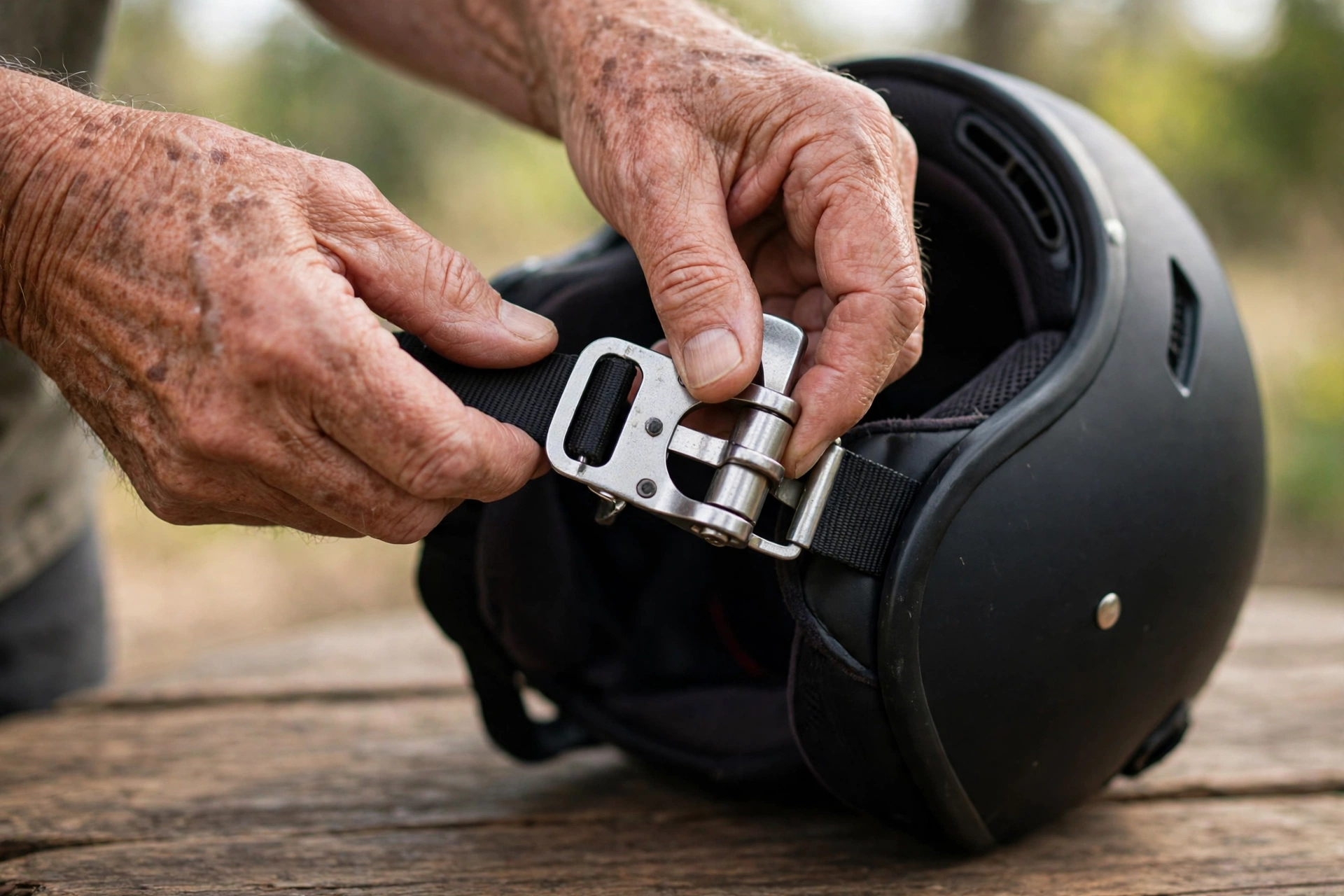
Easy-buckle helmets use large, simple chin-strap buckles — such as a micrometric ratchet, a magnetic buckle, or an oversized quick-release — that can be fastened and unfastened with one hand, with gloves on, and without fine finger strength. For older hands affected by arthritis, stiffness, or reduced grip, the right buckle can be the difference between a helmet you wear happily and one you dread putting on.
Every helmet needs a chin strap, and every chin strap needs a buckle. For most riders, the buckle is a small detail they barely think about. But for older riders, or anyone with stiff, painful, or weak hands, a small fiddly buckle can turn the start of every ride into a struggle. Cold weather makes it worse, and gloves make it harder still. This guide explains the buckle types that are easiest on older hands, and how to choose one that works for you.
What Makes a Helmet Buckle Hard to Use?
The most common buckle on motorcycle helmets is the double D-ring, and it is the hardest for older hands. It needs two hands, good finger strength, and a precise threading action: you have to pass the strap through two rings, pull it tight, and tuck the end away. With stiff fingers, the strap can slip, the rings can be hard to hold, and the whole job takes longer than it should. Many riders with arthritis find D-rings frustrating, even though they are simple and reliable once fastened.
Small plastic quick-release buckles can be just as awkward. They often need a firm squeeze in exactly the right place, and a small release button can be hard to find by feel, especially with gloves on. A buckle that is stiff when new can be almost impossible for a weak hand, and a buckle that is hidden under a chin curtain is harder still to reach.
What Is a Micrometric Ratchet Buckle?
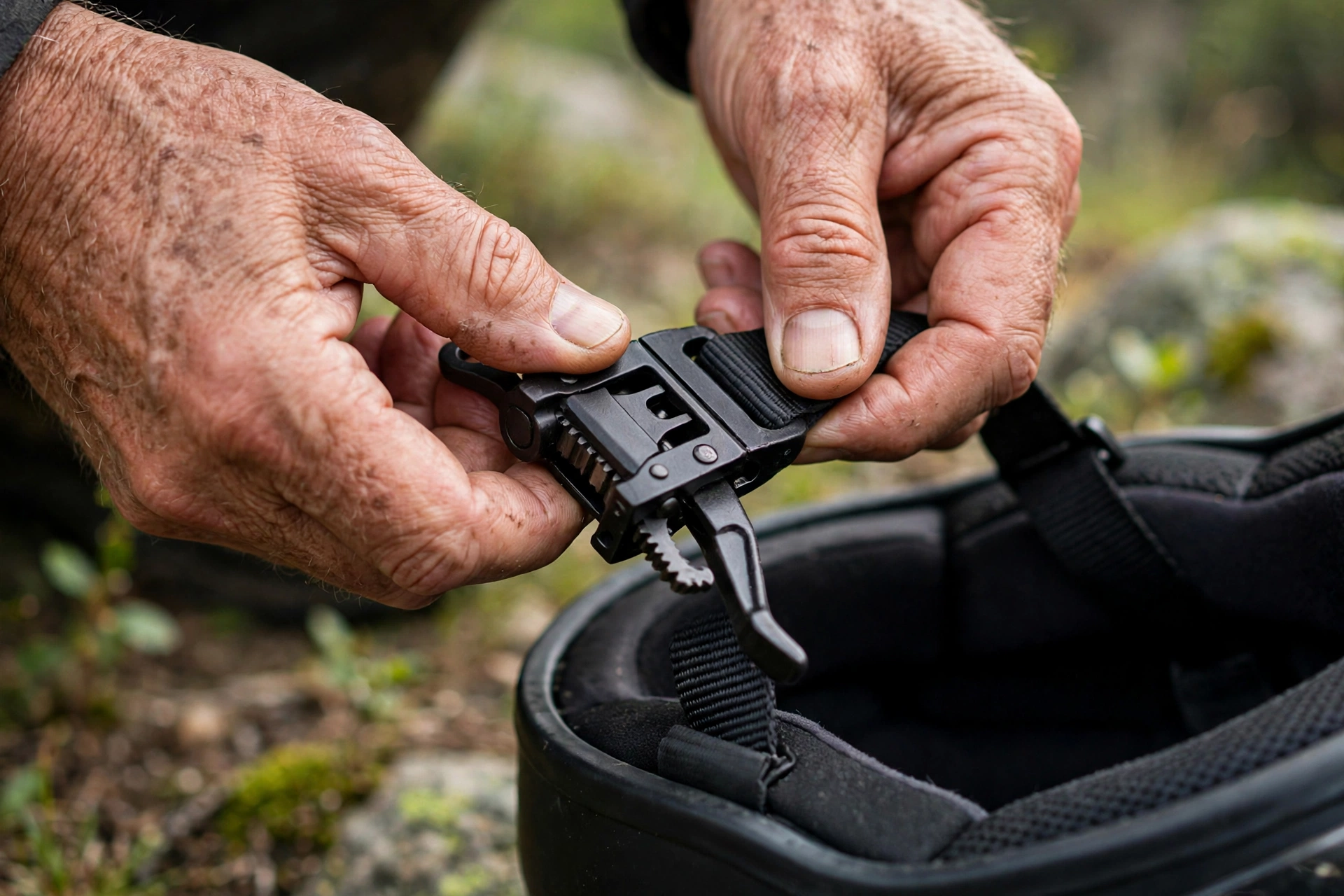
A micrometric ratchet buckle is the most common easy option, and it is fitted to many modern helmets. It works like a small ratchet: you slide the strap into the buckle and pull, and it clicks tighter in small steps. To release it, you pull a large lever or tab, and the strap comes free. The whole action can be done with one hand, and the large tab is easy to find by feel, even with gloves on.
The ratchet design has another advantage: it lets you adjust the strap in tiny steps, so you can get the fit just right. A strap that is too tight presses on your throat, and one that is too loose lets the helmet move, so being able to fine-tune it matters. With a ratchet buckle, you can tighten the strap a click or two after you have been riding for a while, without taking the helmet off.
What About Magnetic and Quick-Release Buckles?
Magnetic buckles are a newer option, and they are the easiest of all to fasten. The two halves of the buckle snap together with magnets, so you only need to bring them close and they click into place. There is no threading, no squeezing, and no precise alignment needed. For hands that struggle with fine movements, a magnetic buckle can feel like a small miracle — although not every helmet maker offers one, so you may need to look for it specifically.
Quick-release buckles with large levers are another good choice. These use a wide, flat release tab that you can press with the palm of your hand rather than with a fingertip, which suits hands that lack grip strength. The fastening action is a simple push together, and the release is a single press. Look for a buckle with a tab you can find by touch without looking, because you will often be fastening the strap by feel.
Whichever buckle you choose, test it yourself. Go to the shop, put your gloves on, and fasten and unfasten the buckle several times. Can you do it with one hand? Can you do it without looking? Can you do it quickly? If the answer is yes to all three, you have found a buckle that will work for you on the road, not just in the shop.
How Do You Test a Buckle Before You Buy?
Bring your riding gloves to the shop and test the buckle with them on. This is the single most useful test, because a buckle that works bare-handed may be impossible with gloves. Fasten the strap, adjust it until it feels right, then release it and fasten it again. Do this three or four times, and notice whether your hands tire or whether any step needs more strength than you have.
Check the strap length too. A strap that is too short is hard to thread or click in, while a strap that is too long leaves a loose end flapping in the wind. The strap should fasten with a comfortable amount of spare length, and any loose end should tuck away neatly under a keeper or a snap. If the strap is hard to manage, ask the shop if it can be adjusted or if a different size would help.
If you are learning about how helmets handle different kinds of impact, reading about what MIPS is for helmets can help you understand one of the technologies used in modern helmet design. The buckle is part of the helmet’s safety system, and the strap must hold the helmet on your head in a crash, so the buckle’s strength matters as much as its convenience.
Can You Change the Buckle on a Helmet You Already Own?
In general terms, it is better not to modify a helmet’s strap or buckle yourself. The chin strap is a safety-critical part of the helmet, and any change to it could affect how the helmet performs in a crash. Some helmet makers sell replacement straps and buckles that fit their own models, and a dealer can sometimes fit one for you — but only use parts made for your exact helmet model, and only have the work done by someone the maker approves.
If your current helmet has a buckle you cannot manage, the practical answer is usually a new helmet with an easier buckle, rather than a repair. A helmet with a ratchet or magnetic buckle, a comfortable fit, and a current safety standard is a better investment than struggling with a buckle that puts you off riding. Think of it as part of the cost of staying riding for longer.
Frequently Asked Questions
Q: Are D-ring buckles unsafe for older riders?
A: No — D-rings are simple and reliable, and they hold a helmet securely. They are simply harder to fasten with stiff or weak hands, which is why many older riders prefer a ratchet or magnetic buckle that is easier to use every day.
Q: Can I fasten a ratchet buckle with gloves on?
A: In general terms, yes. Ratchet buckles are designed to be worked with one hand, and the large release tab is easy to find by feel. Test it with your own gloves in the shop to be sure it suits your hands.
Q: Is a magnetic helmet buckle as strong as a D-ring?
A: Magnetic buckles fitted by helmet makers are designed and tested to hold the helmet on in a crash, just like other buckle types. Always use a buckle that came with the helmet or was made for that exact model by the manufacturer.

Olivia
Writer at Helmet Today, covering helmet reviews, fit and riding safety.