Yes, helmet intercoms work for ski groups — they let skiers and snowboarders talk to each other on the mountain, warn of hazards, regroup after a run, and stay in touch when the group splits across different pistes, without anyone having to stop, shout, or wave. A ski group intercom works much like a motorcycle group intercom, but the cold, the snow, and the way skiers move on a mountain bring their own challenges.
Ski groups often split up without meaning to. One skier takes a different piste, another stops to adjust a boot, a third waits at a lift, and within minutes the group is spread across the mountain. An intercom keeps everyone in touch, so the group can agree where to meet, warn each other about icy patches or crowded slopes, and call for help quickly if someone falls. This guide explains how ski group intercoms work and what to look for.
How Does a Helmet Intercom Work for Ski Groups?
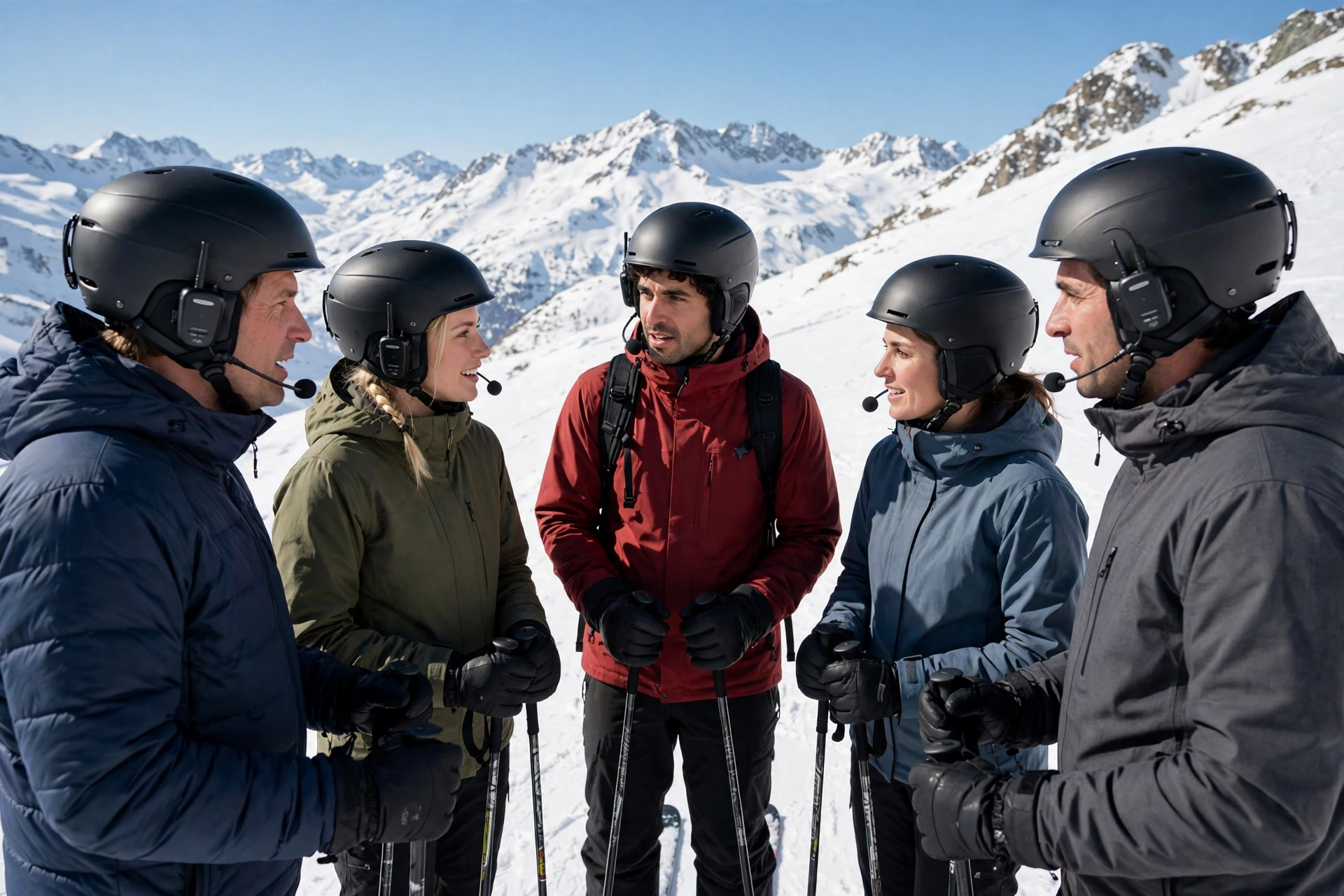
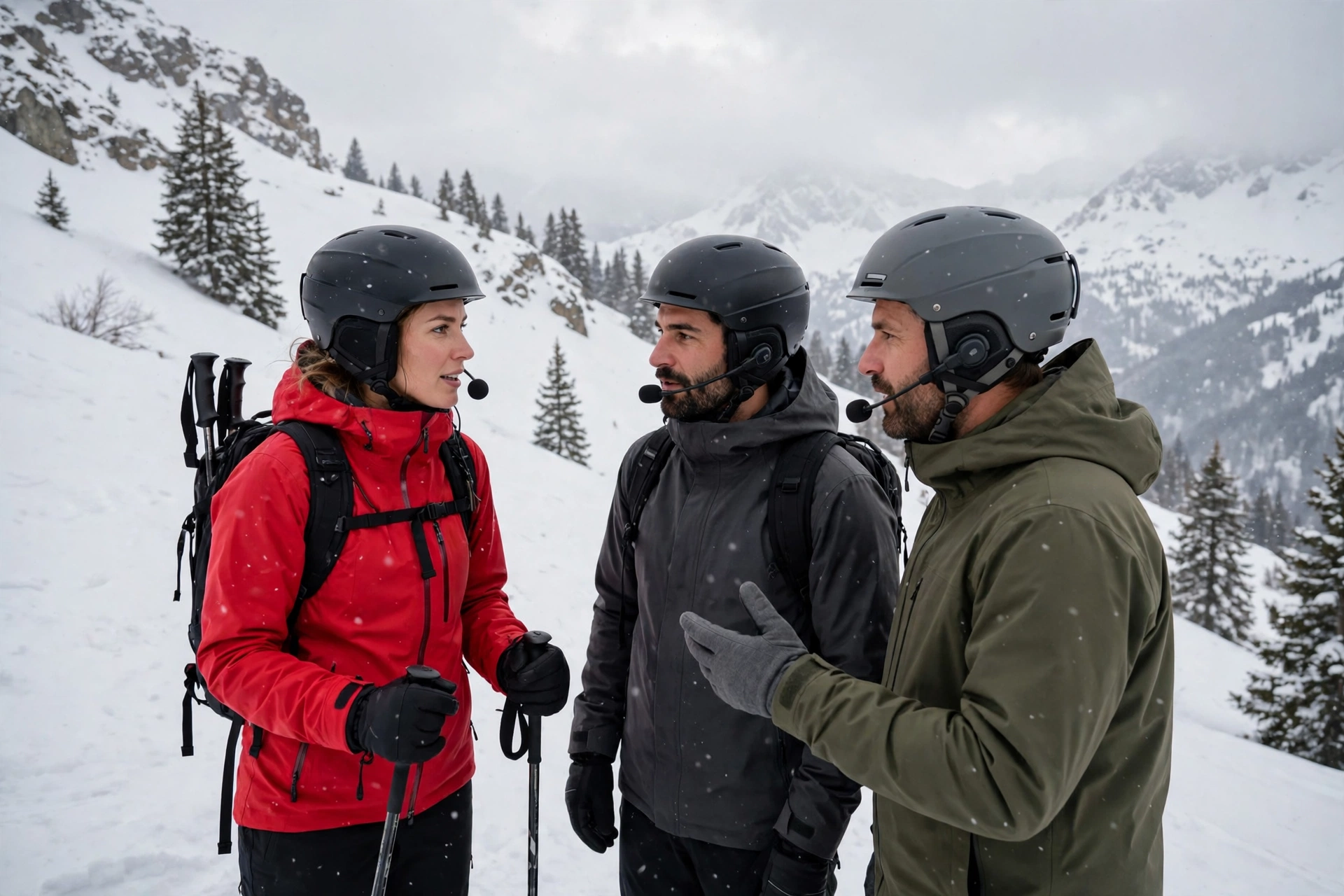
A ski group intercom links the helmets of everyone in the group into one shared conversation, usually over Bluetooth or mesh. Each skier has a small unit mounted on or inside the helmet, with speakers by the ears and a microphone near the mouth. When one skier speaks, the others hear it, and when nobody is speaking, the channel stays quiet so skiers can concentrate on the slope.
Mesh systems suit ski groups well, because skiers join and leave the conversation as they move around the mountain, and the mesh keeps the group linked as long as each skier is within range of another. Bluetooth systems work for small groups of two or three skiers who stay close together, but they can struggle when the group spreads out across a wide slope or a long run.
Most ski intercoms also play music and take phone calls, but on the mountain the intercom usually matters more than the music. Many skiers turn the music off on busy pistes so they can hear the intercom clearly and stay aware of other skiers around them. The exact features vary by model, so check what your unit can do before you buy.
What Are the Challenges of Using an Intercom While Skiing?
Cold is the biggest challenge. Batteries lose capacity in cold weather, so an intercom that lasts all day in mild conditions may run out sooner on a freezing mountain day. Keep the unit charged indoors overnight, and switch it off during long lunch breaks to save power. A unit kept warm inside a jacket pocket when not in use will hold its charge better than one left out in the cold.
Snow and moisture are the next challenge. A ski helmet intercom needs to cope with falling snow, spray from the piste, and the damp of a helmet that is taken on and off in a mountain restaurant. Choose a unit with good water resistance, keep the charging port covered, and dry the unit before you charge it. Never charge a wet unit.
Wind noise is also a problem on skis. At speed, wind over the microphone can make speech hard to hear, and a microphone that sits too far from the mouth will pick up more wind than voice. A microphone with a wind cover, placed close to the mouth inside the helmet, works best. Some skiers also find that a balaclava or a neck warmer over the microphone helps to cut wind noise, although it can muffle the voice if it covers the microphone completely.
How Many Skiers Can Join One Intercom Group?
The number depends on the system. Bluetooth groups usually handle two to four skiers comfortably, while mesh systems can link more — sometimes many more, depending on the model. For a family group of four or five, either system can work. For a ski school group, a club trip, or a large group of friends, mesh is usually the better choice.
Range on a mountain is different from range on a road. A slope is wide and open, so the signal can travel well in clear conditions, but a ridge, a stand of trees, or a building can block it. On a mesh system, the signal hops between skiers, so the group can stay connected across a wider area than any two units could manage alone. That matters on a mountain, where the group can spread out across a whole piste.
In practice, large ski groups often use the intercom in a simple way: the leader speaks, the group listens, and individual skiers speak only when they need to — to say they have stopped, to ask where to meet, or to report a problem. That keeps the channel clear and the battery lasting longer, because the units are not transmitting constantly.
How Do You Set Up a Ski Group Intercom?
Set up the group indoors before you go out, where it is warm and dry and you can hear each other. Charge all the units overnight, switch them on, and check that they are all on the same mesh channel or paired into the same group. Do a quick roll call: each skier says their name, and everyone checks they can hear each other clearly.
Fit the units carefully. The speakers should sit over the ears, inside the helmet’s ear pads, and the microphone should sit close to the mouth without pressing on the lips or getting in the way of a chin strap. Try the fit with gloves on, and check that the controls are easy to reach — small buttons are hard to use with thick ski gloves, so a unit with large, simple controls is worth choosing.
Is a Helmet Intercom Safe to Use While Skiing?
A helmet intercom is safe to use while skiing if it is used sensibly. The key is to keep conversations short and useful, and to keep your attention on the slope. Long chats, loud music, and fiddling with controls while skiing are all distractions, and on a busy piste a distracted skier is a danger to themselves and to others.
Keep the volume at a level where you can still hear what is happening around you — other skiers, a piste basher, or a warning shout. A skier who cannot hear the mountain is missing important information. Some skiers use the intercom only on quiet pistes and turn it off in crowded areas, which is a sensible approach.
If you are learning how helmets protect the head, reading about what MIPS is for helmets can help you understand one of the technologies used in modern helmet design. And remember that an intercom is a communication aid, not a safety device: it does not replace a helmet, good judgement, or skiing within your ability.
Frequently Asked Questions
Q: Do helmet intercoms work in cold weather?
A: Yes, but cold shortens battery life, so charge the unit indoors overnight and switch it off during long breaks to save power on a freezing mountain day.
Q: Can skiers and snowboarders use the same intercom group?
A: In general terms, yes. As long as everyone uses compatible units on the same system, skiers and snowboarders can talk in one group.
Q: Will snow damage a helmet intercom?
A: A unit with good water resistance should cope with snow and spray, but keep the charging port covered, dry the unit before charging, and never charge it while it is wet.

Olivia
Writer at Helmet Today, covering helmet reviews, fit and riding safety.