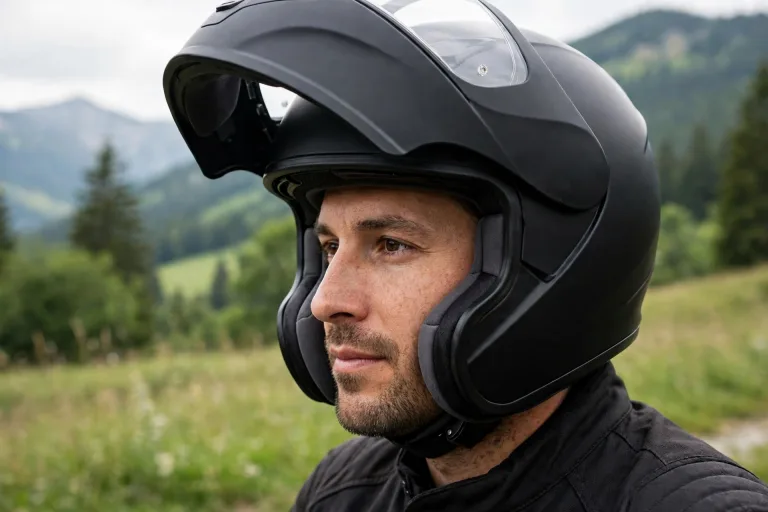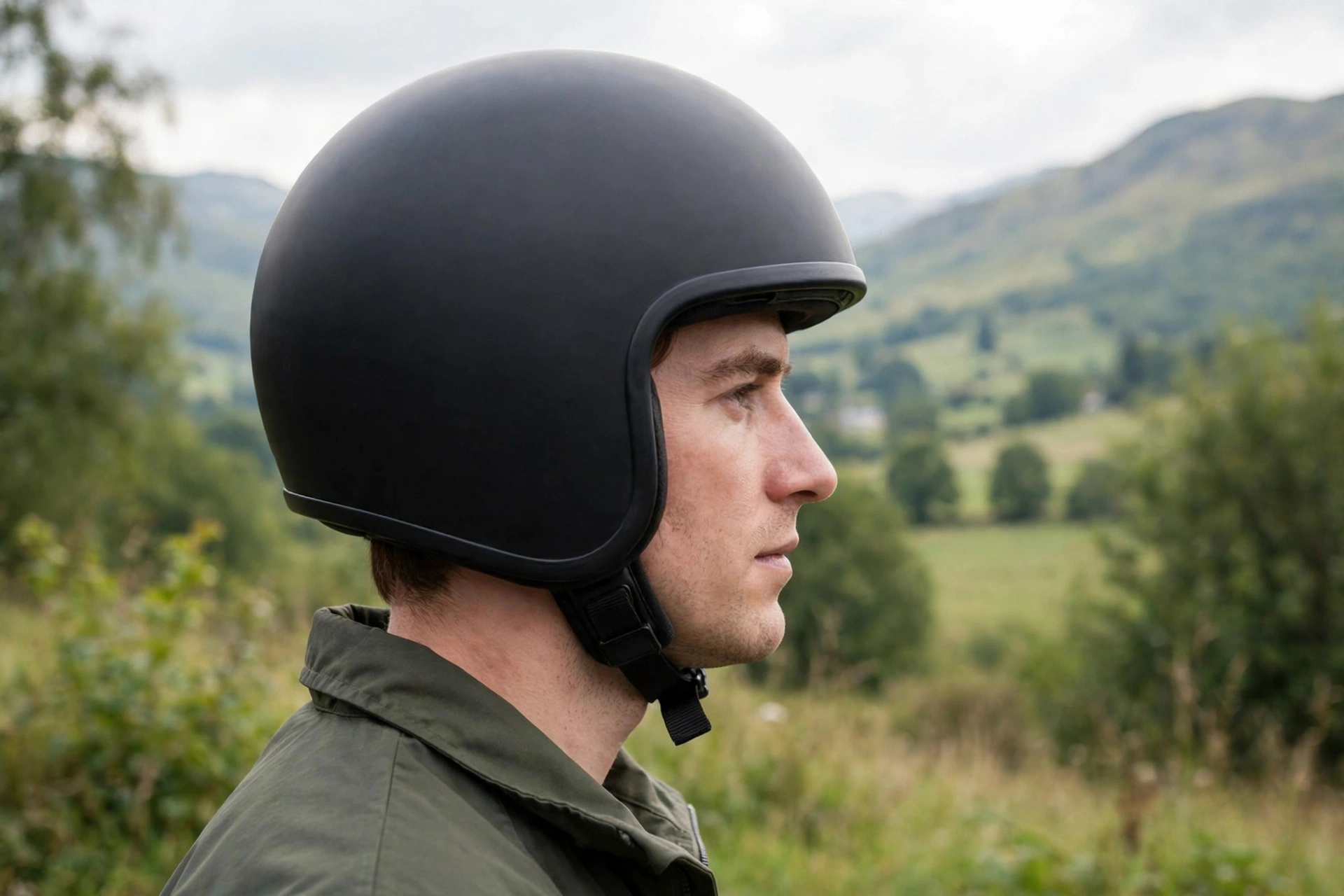
A helmet should sit level on your head, low enough to cover your forehead to about one or two finger-widths above your eyebrows, with the shell covering the top and sides of your head and the chin strap snug enough to keep it in place. In general terms, a helmet that sits level, feels snug all round, and stays put when you shake your head is sitting correctly. A helmet that rides too high leaves your forehead exposed, while one that tips too far forward can block your vision, so the position of the helmet matters just as much as the size. Getting the sit right is the first step in getting real protection from any helmet.
Many people put a helmet on and assume it is right because it feels comfortable, but comfort alone is not the test. A helmet can feel pleasant and still be sitting too high, too loose, or tilted to one side. Checking the sit of a helmet takes less than a minute, and the same checks work for any helmet.
Where should a helmet sit on your forehead?
A helmet should sit low on your forehead, roughly one or two finger-widths above your eyebrows, so that the front edge of the shell covers the forehead without dipping down into your line of sight. This is the position that protects the front of the head, which is one of the parts most likely to hit the ground in a fall. A helmet worn pushed back on the head, with the forehead fully exposed, is not doing its job, even if it feels comfortable.
To check the position, stand in front of a mirror and look at where the front edge of the helmet falls. It should sit in a straight line across your forehead, not tilted up at the front or sloped down over your eyes. If you can see your whole forehead and hairline below the helmet, the helmet is sitting too high. If the helmet presses on your eyebrows or you have to tilt your head back to see ahead, it is sitting too low.
How level should a helmet sit on your head?
A helmet should sit level on your head, with the front and the back at roughly the same height, and the shell covering the top of your head evenly on all sides. When you look at yourself from the side, the bottom edge of the helmet should run in a fairly straight line around your head, rather than sloping sharply up at the front or down at the back. A level helmet spreads an impact across the shell as it was designed to do, and it keeps the padding in contact with your head where it is needed.
A tilted helmet often means the size is wrong or the fit pads are not right. A helmet that tips forward may be too big, while one that tips back may be sitting on the wrong part of the head or may be the wrong shape for your head. In either case, the answer is to adjust the fit or try a different size, rather than to force the helmet into place with the strap alone.
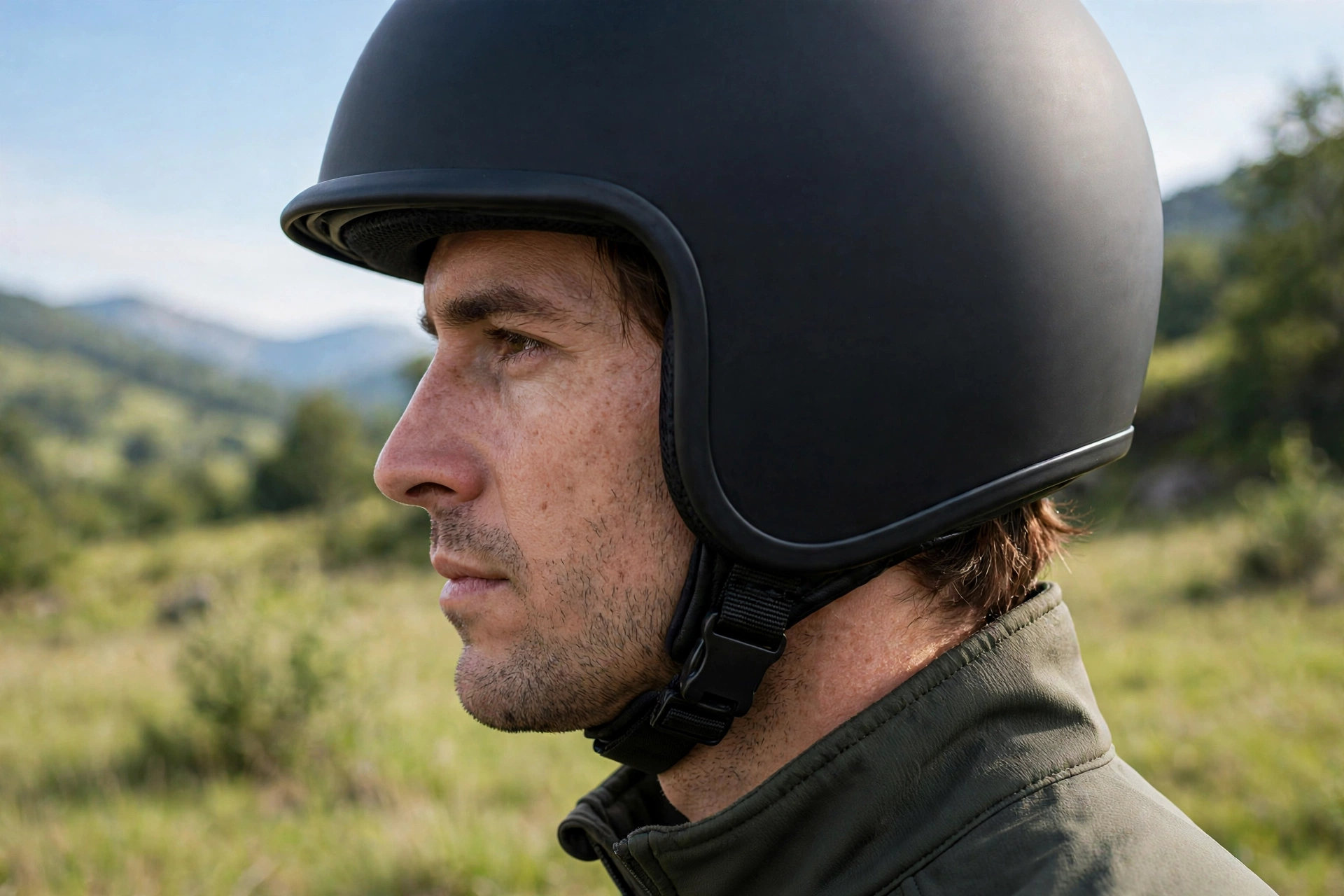
How snug should a helmet feel when it sits correctly?
A helmet that sits correctly should feel snug all the way round your head, with even pressure and no loose spots, but it should not cause pain or a headache. When you first put on a new helmet, it may feel tighter than you expect, and that is normal, because the lining will settle slightly with wear. The test is whether the helmet moves when you shake your head firmly from side to side and up and down: a well-fitting helmet should move with your head, not slide around on it.
Pressure points are a sign that something is wrong. If the helmet presses hard on one spot, such as your forehead or the back of your head, while feeling loose somewhere else, the shape of the helmet may not suit your head. Heads come in different shapes, and a helmet that suits one person may not suit another, even in the same size. Trying a different model, or adjusting the fit pads, is usually the answer.
How do the straps and buckle affect how a helmet sits?
The chin strap plays a big part in how a helmet sits, because it is what holds the helmet in place when you move or fall. The strap should be fastened snugly under your chin, tight enough that you can fit no more than one or two fingers between the strap and your chin, and the buckle should sit flat against your skin without digging in. A loose strap lets the helmet rock and lift, and a helmet that can lift off your head is not protecting you.
On a bike helmet, the side straps should form a neat V shape just below each ear, with the straps lying flat against your head. On a full-face motorcycle helmet, the strap should hold the helmet so that it does not roll forward over your eyes when you push up on the back of it. Fasten the strap every time you wear the helmet, and check it again after a few minutes, because straps can settle and loosen as you move.
What are the signs that a helmet is sitting wrong?
There are several clear signs that a helmet is sitting wrong. The most obvious is that the helmet moves when you shake your head, slides forward over your eyes when you look down, or rocks from side to side. A helmet that you can easily pull off your head while the strap is fastened is far too loose, and a helmet that leaves red marks or a sore spot after a short ride is pressing in the wrong place.
Other signs include a helmet that sits high on your forehead, one that covers your eyebrows, or one that tips to one side. A wrongly sitting helmet often grows uncomfortable, because your head and neck work harder to hold it steady. If you notice any of these signs, stop and adjust the fit before you ride, and consider whether the helmet is the right size and shape for you. Riders who want to understand more about the safety features inside a modern helmet may want to read about MIPS, a system designed to reduce rotational forces in a fall, which works best when the helmet is sitting correctly in the first place.
How far above my eyebrows should a helmet sit?
In general terms, a helmet should sit about one or two finger-widths above your eyebrows, covering your forehead while leaving your vision clear. If your whole forehead is showing, the helmet is too high.
Should a new helmet feel tight?
Yes, in general terms a new helmet should feel snug, and it may feel tighter than an old one because the lining has not settled yet. It should feel evenly snug, not painful, and it should not leave sore spots.
Can I fix a helmet that sits too high?
You can often improve the fit by adjusting the straps, the fit pads, or the sizing system, but if the helmet still sits high or moves around, it is likely the wrong size or shape for your head, and trying a different helmet is the safer choice.

Olivia
Writer at Helmet Today, covering helmet reviews, fit and riding safety.