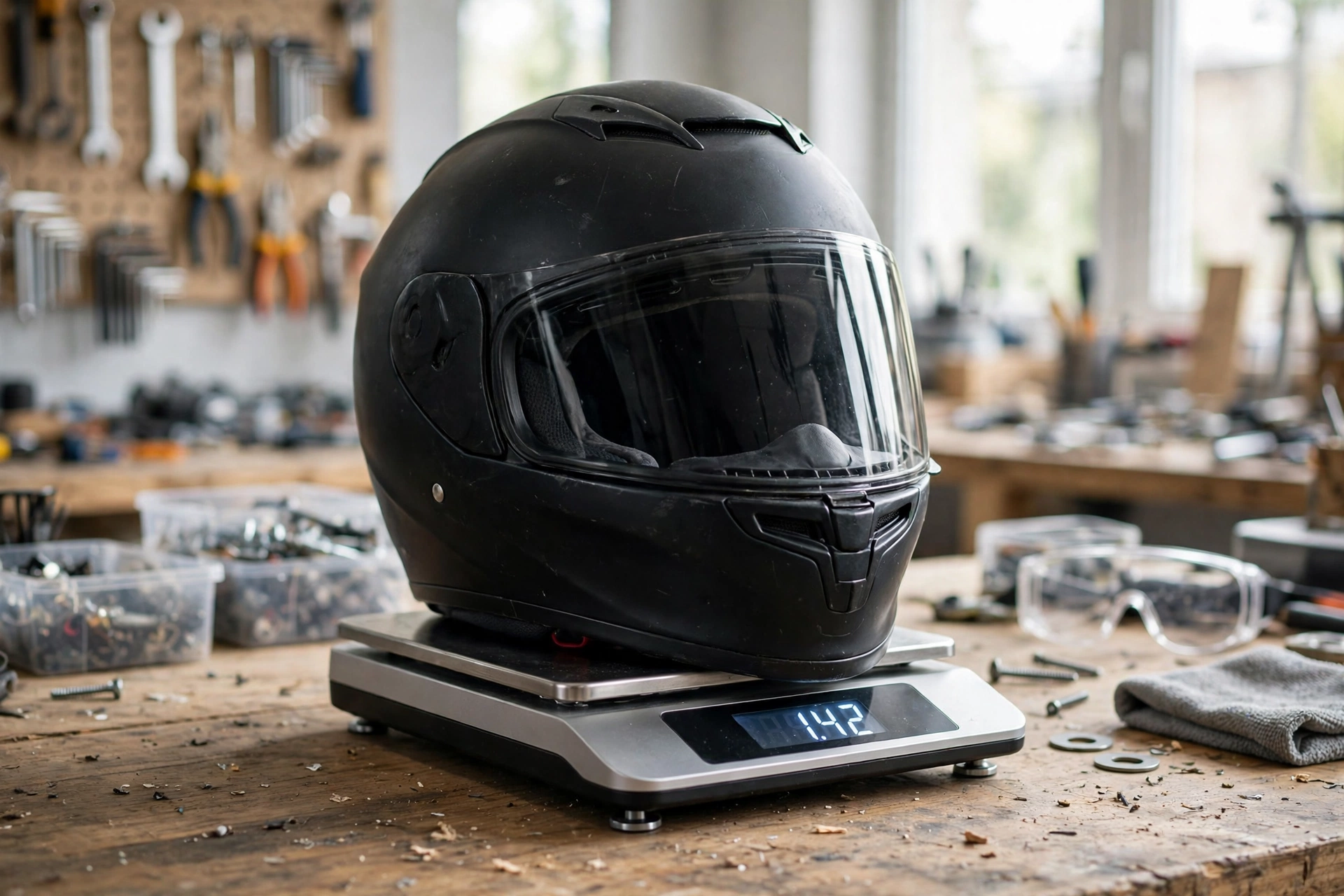
To measure a helmet’s weight correctly, place the helmet on its own on a set of kitchen scales or a postal scale, with nothing attached to it, and read the weight in grams. That sounds simple, but small mistakes — such as leaving the visor, camera mount, or peak attached, or weighing the helmet in its bag — can give you a number that is misleading when you compare helmets.
Helmet weight is one of the first things many riders check when they are choosing a new helmet, and it is easy to see why. A lighter helmet is usually more comfortable on a long ride, and it puts less strain on your neck. But the number on the box is not always the number you will get at home, and different makers may measure weight in different ways. This guide explains how to weigh a helmet properly, what affects the result, and how to use the number to make a fair comparison.
What Equipment Do You Need to Weigh a Helmet?
You need a set of scales that can measure in grams and that is accurate enough for a helmet. Kitchen scales work well for most helmets, because they usually measure in one-gram steps and can handle up to a few kilograms. A postal scale is another good option. Bathroom scales are not suitable, because they are designed for much heavier loads and are not accurate enough at helmet weights.
Before you weigh anything, check that your scales are reading correctly. Place a known weight on them — for example, a bag of sugar or a sealed bottle of water with a known weight — and see whether the reading matches. If the scales are off by more than a few grams, they may need new batteries, or they may need to be placed on a flat, hard surface rather than on carpet or a soft bench.
Make sure the scales are set to zero with nothing on them, and that the display is set to grams rather than ounces or pounds. If you plan to compare your result with the maker’s listed weight, grams are the most useful unit, because most helmet makers list weight in grams. Write the number down as soon as you read it, so you do not have to rely on memory.
How Do You Weigh a Helmet Step by Step?
Start by removing everything that is not part of the helmet itself. Take off the visor or peak if it can be removed, and remove any camera mount, light mount, or other accessory that you have fitted. If the helmet has a removable liner or cheek pads, leave those in place, because they are part of the helmet as it is normally worn. Only remove parts that the maker lists as optional accessories.
Next, place the helmet gently on the centre of the scales, with the opening facing down so that it sits steadily. Do not hold it in place with your hand, and do not let it rest against a wall or another object, because that can take some of the weight off the scales and give you a false reading. Wait a few seconds for the display to settle, then read the number.
Weigh the helmet two or three times, lifting it off and putting it back on between each reading. If the readings are the same, you can trust the number. If they differ by more than a few grams, check that the scales are on a flat surface and that the helmet is sitting in the same position each time. Take the most common reading, or the average of the readings, as your result.
Why Do Listed Weights and Real Weights Sometimes Differ?
There are several reasons why the weight you measure at home may not match the number on the box. The most common reason is size. Helmet makers usually list the weight for one size only, often a medium, and larger sizes weigh more because they use more material. If you wear a large or extra-large helmet, your helmet will weigh more than the listed figure, and that is normal.
Another reason is the way the maker measured the weight. Some makers weigh the helmet without the visor, while others include it. Some weigh a sample helmet that has no paint or graphics, while the helmet you buy has a painted finish that adds a few grams. In general terms, small differences of a few tens of grams are normal and are not a sign that anything is wrong.
How Should You Compare the Weight of Two Helmets?
To make a fair comparison, weigh both helmets in the same way, on the same scales, on the same day. Remove the same kinds of accessories from each one, and weigh them in the same size if you can. If one helmet is a medium and the other is a large, the comparison will not be fair, because the larger helmet will naturally weigh more.
It also helps to wear both helmets, not just weigh them. Two helmets with the same weight can feel very different on your head, because the balance of the helmet matters as much as the total weight. A helmet that is well balanced, with its weight spread evenly, will usually feel lighter than one that is front-heavy or back-heavy. Try each helmet on, fasten the strap, and move your head from side to side to see how it feels.
When you compare weights, remember that weight is only one part of the picture. Fit, ventilation, the safety standard, and comfort matter just as much, if not more. If you are learning about how helmets handle different kinds of impact, reading about what MIPS is for helmets can help you understand one of the technologies used in modern helmet design. A helmet that is slightly heavier but fits better and ventilates well may be the better choice for a long ride.
What Mistakes Should You Avoid When Weighing a Helmet?
One common mistake is weighing the helmet with its bag, box, or carry case still attached. The bag can add a noticeable amount of weight, and it will make the reading useless for comparison. Always weigh the helmet on its own, with nothing else on the scales.
Another mistake is weighing the helmet while holding it, or while it is leaning against something. Even a light touch from your hand can take weight off the scales, and the reading will come out lower than the true weight. Let the helmet sit on its own, and keep your hands away while you read the display.
Frequently Asked Questions
Q: Should I weigh a helmet with the visor on or off?
A: In general terms, weigh it the way you will wear it, but note what you included. If you compare two helmets, weigh both with the visor on, or both with it off, so the comparison is fair.
Q: How accurate do kitchen scales need to be for weighing a helmet?
A: Kitchen scales that measure in one-gram steps are accurate enough for most purposes. A difference of a few grams will not change your decision, so do not worry about tiny variations between readings.
Q: Does a helmet get heavier as it gets older?
A: In general terms, no. A helmet does not gain weight with age, but it can feel heavier if the padding wears out and the fit loosens. If an old helmet feels heavier than it used to, check the padding and the fit before blaming the weight.

Olivia
Writer at Helmet Today, covering helmet reviews, fit and riding safety.