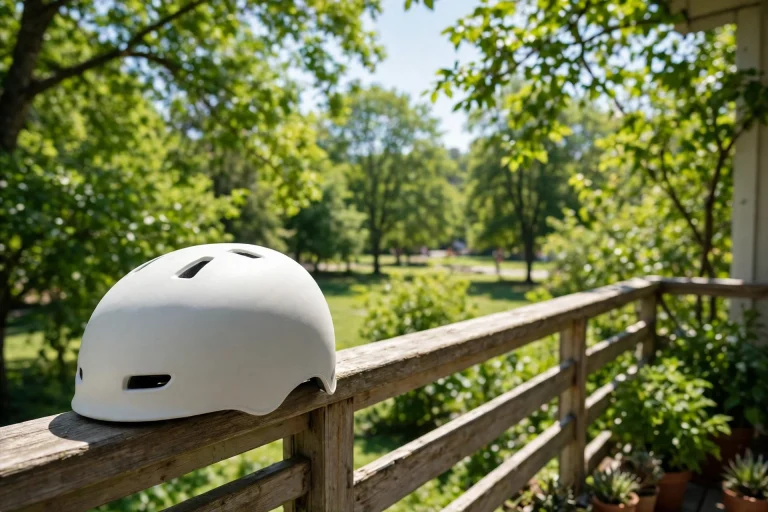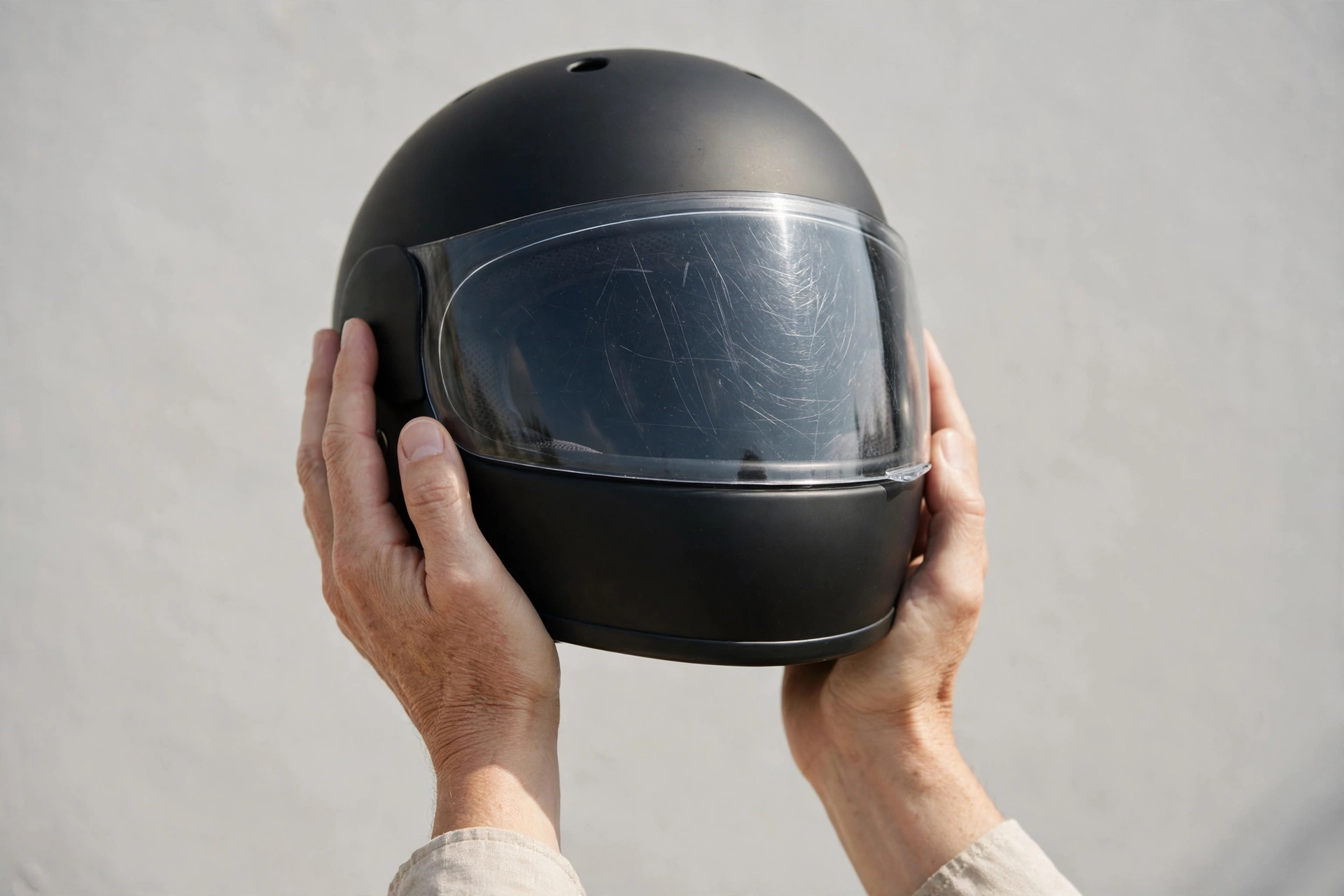
To protect a helmet from scratches in daily use, store it in a soft bag or on a shelf away from hard objects, carry it by the strap rather than letting it knock against keys and zips, and clean it gently with a soft cloth and mild soap. Scratches are usually caused by small everyday knocks rather than crashes, so a few simple habits are often enough to keep a helmet looking good for a long time.
A helmet gets handled many times a day: it is picked up, put down, hung on a hook, tucked under an arm, and packed into a bag or a car boot. Each of those moments is a chance for the shell or the visor to rub against something hard. A scratched shell is mostly a cosmetic problem, but a scratched visor can be a real nuisance, because it can blur your view and catch the light. Looking after the helmet is therefore about protecting your view as well as its appearance.
What causes scratches on a helmet in daily use?
Scratches on a helmet are usually caused by contact with hard or rough surfaces. The most common causes are putting the helmet down on concrete, gravel, or a rough table, letting it slide around in a car boot next to tools or shopping, and hanging it on a hook where it knocks against a wall or another helmet. Keys, zips, and buckles in a bag can also leave fine marks on the shell and the visor.
Dust and grit are another cause. If the helmet is wiped with a dry cloth when it is dusty, the grit acts like sandpaper and leaves fine swirls across the surface. The same happens if a dirty glove is used to wipe the visor while riding. In general terms, most daily scratches are small and shallow, but they add up over time, and a helmet that is looked after from the start will stay clearer and smarter than one that is tossed around without a second thought.
How should you store a helmet to avoid scratches?
A helmet should be stored in a clean, dry place, on a shelf or in a soft helmet bag, away from hard objects that could mark the shell. A helmet bag is the simplest protection: it keeps dust off the helmet, stops it knocking against other things, and keeps the visor covered. If you do not have a bag, a clean cloth draped over the helmet works well as a cover.
Do not store the helmet on the floor, on a concrete step, or on top of a pile of tools, and do not hang it by the strap on a sharp hook where it can swing and bang against a wall. Keep it out of direct sunlight and away from heat, such as a radiator or a hot car, because heat can damage the materials inside over time. If the helmet has a visor, store it with the visor closed or covered, so the outside of the visor is not left exposed to dust and knocks.
How do you carry a helmet without scratching it?
Carry a helmet by the chin strap or in a helmet bag, and keep it away from keys, zips, and other hard items. If you carry the helmet under your arm, keep the visor facing inwards towards your body, so the outside of the visor is not rubbing against a jacket zip or a bag buckle. If you put the helmet in a bag, use a soft bag or wrap it in a cloth first, and do not pack heavy items on top of it.
On a motorcycle, a helmet lock or a top box is a better place for the helmet than hanging it on a mirror or a handlebar, where it can swing and knock against the bike. In a car, put the helmet on a seat or in the footwell with a cloth under it, rather than in the boot with loose tools or shopping.
How do you clean a helmet without scratching it?
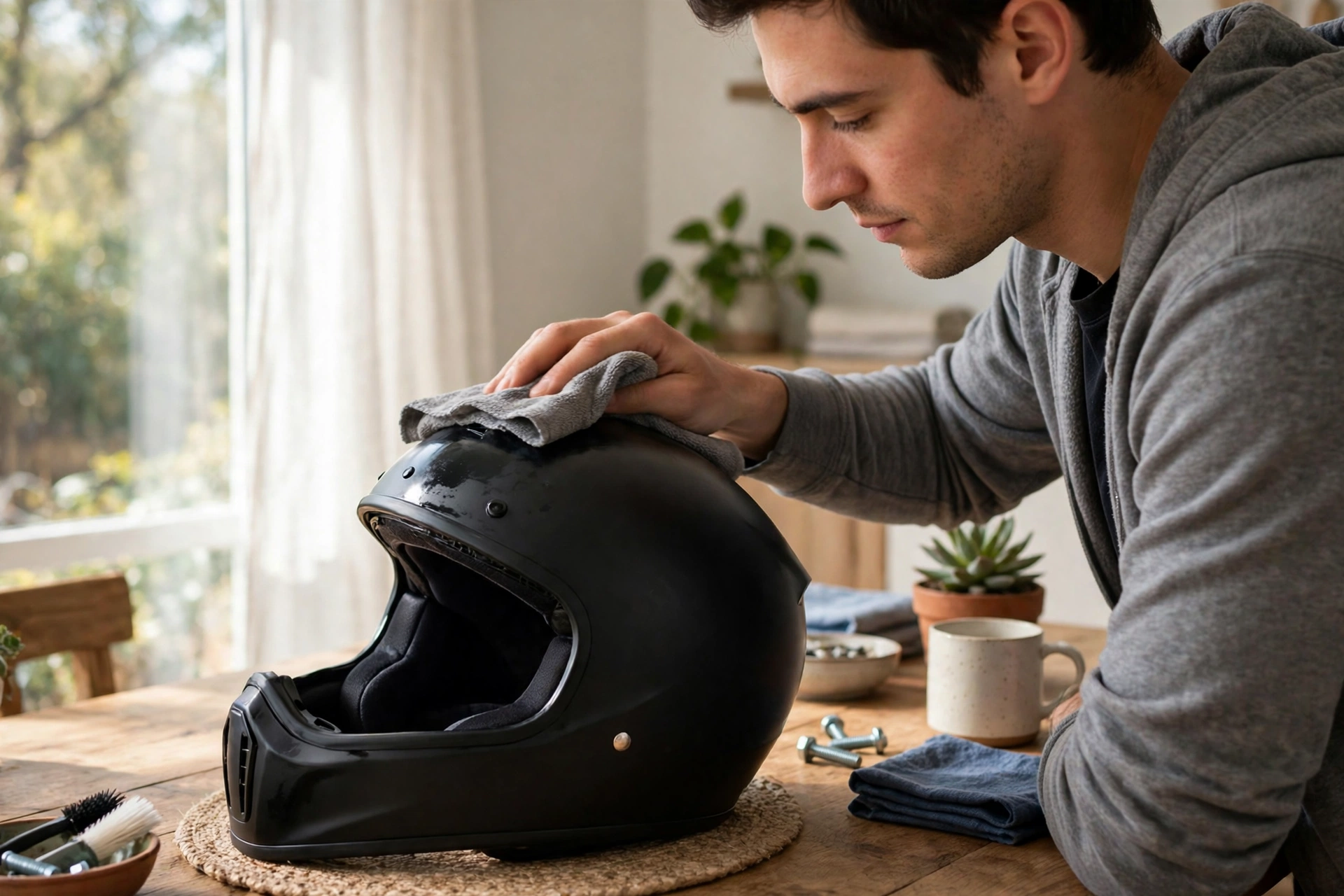
To clean a helmet without scratching it, rinse off dust and grit with clean water first, then wash the shell gently with a soft cloth and mild soap, and rinse again. Never wipe a dusty helmet with a dry cloth, because the dust will scratch the surface. Use a soft microfibre cloth rather than a rough sponge or a paper towel, and work in gentle circles rather than pressing hard.
Clean the visor in the same way, with clean water and a soft cloth, and let it dry naturally or pat it dry with a clean microfibre cloth. Do not use strong cleaners, solvents, or abrasive polishes on the shell or the visor, as they can damage the surface and the coatings. If insects or dried dirt are stuck to the visor, soak a damp cloth over them for a few minutes to soften them, rather than scraping them off. Some helmets include a system designed to reduce rotational forces in a fall, such as MIPS, and that system sits inside the helmet, so gentle cleaning of the shell and lining will not affect it.
Can scratches on a helmet be removed?
Light scratches on a helmet shell can sometimes be made less visible with a gentle polish made for helmet shells, but deep scratches cannot be polished out and should be left alone. Trying to buff out a deep scratch can thin the shell or damage its finish, and it may make the mark look worse rather than better. If the scratch is only in the clear coat and the shell underneath is undamaged, a polish may improve how it looks, but it will not restore the helmet to new.
When do scratches mean a helmet should be replaced?
Scratches on their own do not usually mean a helmet should be replaced, as long as the shell is not cracked and the helmet has not taken a hard knock. Fine surface marks from daily use are cosmetic, and they do not affect how the helmet protects your head. What matters is the condition of the shell and the lining inside, not whether the paintwork is perfect.
Replace the helmet if the shell is cracked, dented, or deeply gouged, if the lining is damaged or loose, or if the strap and buckle are worn. In general terms, a helmet that has taken a hard knock in a fall should also be replaced, even if it looks fine on the outside, because the inner lining may have been compressed. Check the helmet regularly, and if you are unsure whether damage is only cosmetic, ask a dealer or the maker for advice.
How do I stop my helmet visor from getting scratched?
Keep the visor closed or covered when the helmet is stored, carry the helmet so the visor faces inwards, and clean the visor only with clean water and a soft cloth after rinsing off dust first.
Can I use car polish on a scratched helmet?
In general terms, no, do not use car polish or abrasive products on a helmet shell or visor. Use only a gentle product made for helmets, and never polish a visor, as it can make the view worse.
Do scratches affect how safe a helmet is?
Fine surface scratches do not usually affect safety, but a cracked, dented, or deeply gouged shell can. If the damage is more than a surface mark, have the helmet checked and replace it if needed.

Olivia
Writer at Helmet Today, covering helmet reviews, fit and riding safety.