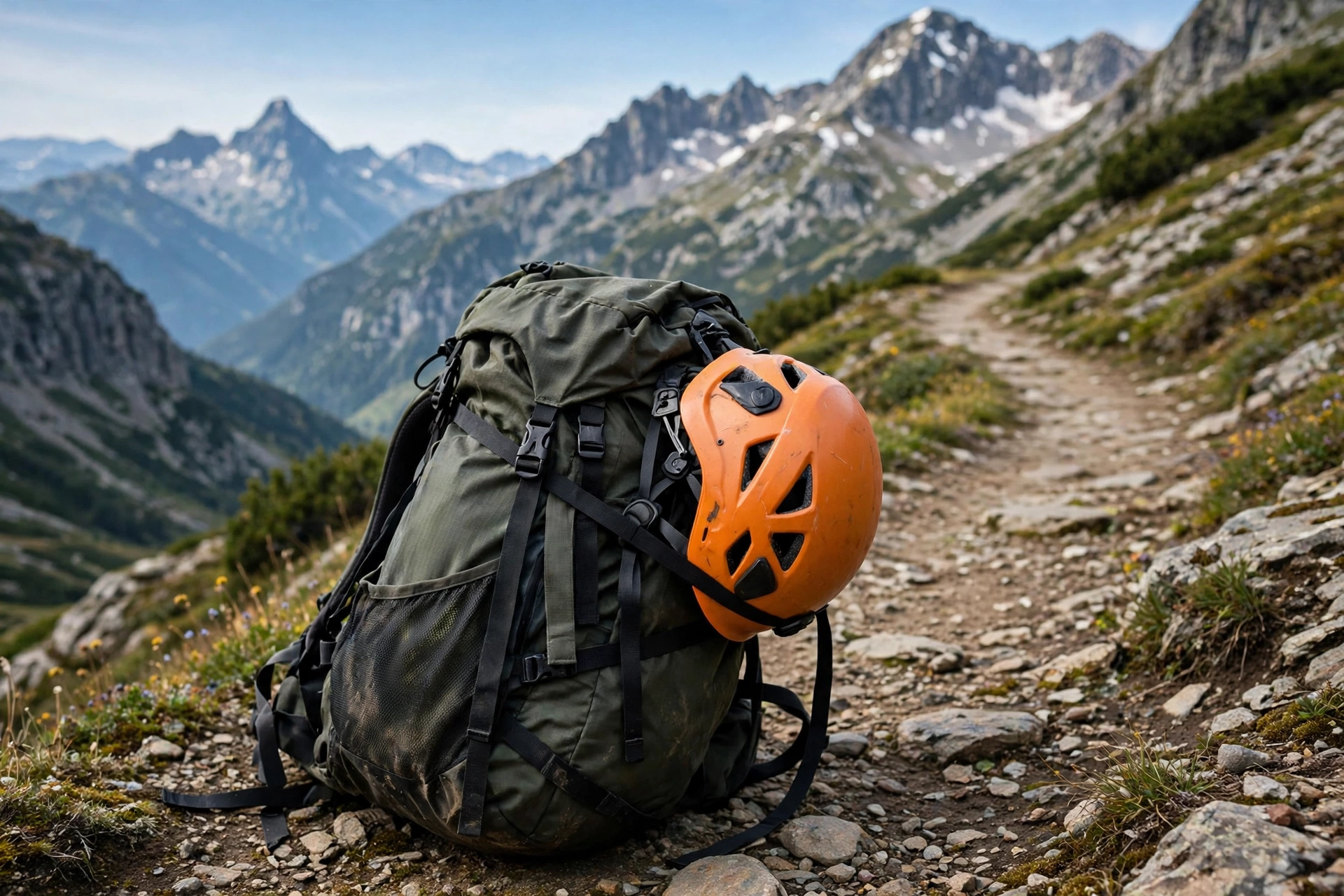
The most secure way to attach a helmet to a backpack is a built-in helmet carrier or mesh net if your pack has one; otherwise, clip the helmet’s chin strap through a top lid, gear loop, or compression strap and cinch it down so the helmet sits flat against the pack and cannot swing, bounce, or be crushed. A helmet dangling from one strap, banging against the pack and the rocks, is being damaged on every step of the approach.
This guide covers the carrier, the strap methods, when to carry the helmet inside instead, and how to protect the foam while it rides outside.
Why Does It Matter How the Helmet Rides on Your Pack?
A helmet is precision safety equipment made mostly of foam, and the approach treats it roughly by default. A helmet hung loosely swings with each stride, striking the pack frame, your ice axe, and every boulder you brush past. Most of those knocks do nothing — but repeated dents and gouges add up, and foam damaged in small ways has less to give in a real impact.
The second risk is losing it. A helmet clipped by one loose strap can work free on steep ground, at a stream crossing, or when you take the pack off and swing it around. Losing a helmet an hour from the road can mean climbing without one or not climbing at all.
The third risk is the quietest: sun and compression. A helmet strapped under heavy tension, or left cooking on top of a pack at a sunny belay trip after trip, ages faster than it should. Good attachment is firm but not crushing, and shaded when you stop.
What Is the Best Method: A Built-In Helmet Carrier?
Many climbing and mountaineering packs have a dedicated helmet carrier — typically a mesh or fabric net that hooks over the front of the pack, or a set of cords and clips designed for the job. If yours has one, use it: it holds the helmet flat against the pack, spreads the load across the shell, and keeps it from swinging at all.
Seat the helmet in the carrier the way it would sit on your head, crown outward, and tension the net or cords until the helmet does not move when you shake the pack. Tuck the chin strap and any dangling webbing away so nothing snags on branches or door frames.
If your pack has a removable top lid, the space under the lid is the next best built-in option. Place the helmet on top of the main compartment, crown up, and close the lid over it, tightening the lid straps evenly. The helmet rides high and visible, held by the whole lid rather than a single strap — just mind the extra height under branches and doorways.
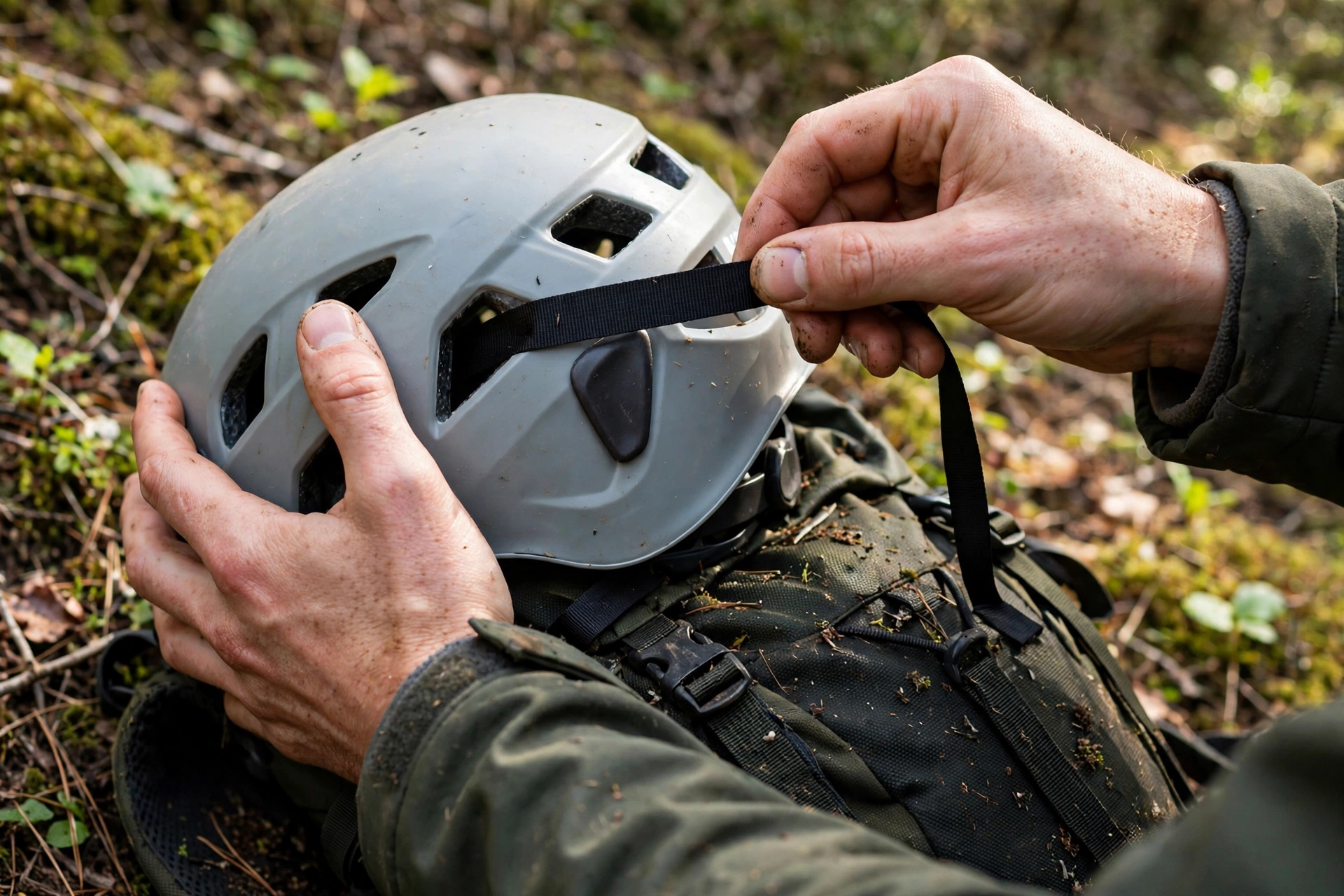
How Do You Attach a Helmet With Straps and the Chin Strap?
The classic improvised method uses the helmet’s own chin strap. Buckle the chin strap around something structural on the pack — a compression strap, the handle loop at the top, or a daisy chain — so the helmet hangs against the pack’s front or top panel, then add one pack strap over or through the helmet to stop it swinging. The chin strap alone holds the weight; the second strap kills the movement.
Side compression straps work well for this. Stand the helmet against the front panel, run a compression strap across it, and buckle the chin strap through a gear loop above so the helmet cannot slide down if the compression strap loosens. Two attachment points, one of them the helmet’s own strap, is the pattern behind almost every secure improvised carry.
A small carabiner can help as a link — clipping the chin strap to a gear loop, for example — but do not hang the helmet by a carabiner through a vent hole. Vents are not load points: the foam or thin shell around them can tear, and the helmet then hangs at an angle and bangs freely. Clip straps and webbing, never helmet plastic or foam.
Should You Carry the Helmet Inside the Pack Instead?
Inside is the best-protected place of all, and on short approaches with a half-empty pack it is worth doing. The helmet is shielded from sun, knocks, and weather, and it cannot be lost. Fill the bowl of the helmet with soft items — gloves, a hat, a base layer — so the space is used and the shell is supported from inside.
The cautions are about what shares the space. Keep crampons, screws, tools, and stove parts away from the foam; sharp or heavy items belong in their own pouches elsewhere. And do not compress the helmet under a stuffed lid or a tightened rope strap — sustained crushing pressure is exactly what you are trying to avoid.
In practice, most climbers carry the helmet outside on the approach because the pack is full of rope, rack, and food, and reserve inside carry for travel days and short walks. Either is fine when done deliberately; the only wrong answer is the loose dangle.
How Do You Protect the Helmet While It Is Attached?
Position it thoughtfully. Against the front panel, crown out, is the usual spot; avoid sides where it will catch on every rock and tree, and avoid the very bottom of the pack, which gets set down in dirt and puddles every time you stop. Wherever it sits, there should be no metal hardware — axes, crampon points, carabiner racks — in contact with the foam.
Check it at breaks. A ten-second tug test each time you shoulder the pack confirms the straps have not loosened, and on river crossings or scrambly sections, that check is worth doing before the hard bit, not after. If the terrain turns into genuine scrambling where a fall is possible, the helmet belongs on your head anyway — that decision solves the carrying problem at the same time.
Finally, remember what you are protecting. The foam under the shell is the part that crushes to absorb a fall or a falling stone — the same energy management that advanced designs extend with rotational-impact systems like MIPS in some helmets. Every season of careful carrying keeps that foam in the condition the certification tests assumed. Treat the helmet like the safety device it is, not like a spare hat.
Frequently Asked Questions
Q: Can I clip my helmet to my pack with a carabiner through a vent?
A: It is better not to. Vent openings are not designed as load points, and the foam or thin shell around them can tear or crack under a swinging load. Clip the chin strap or another webbing strap to your pack instead, and add a second strap so the helmet cannot swing.
Q: My helmet keeps swinging and banging against my pack. How do I stop it?
A: Add a second attachment point. One strap — even the buckled chin strap — acts as a hinge. A compression strap across the helmet, or a carrier net, holds it flat against the pack so it moves with the pack instead of against it.
Q: Will carrying a helmet on the outside of my pack damage it?
A: Not if it is secured flat, kept away from sharp metal gear, and not crushed under tight straps. Most damage comes from loose dangling, hard knocks, and long sun exposure. A snug carrier carry on the approach is normal practice and will not meaningfully shorten a helmet’s life.

Olivia
Writer at Helmet Today, covering helmet reviews, fit and riding safety.