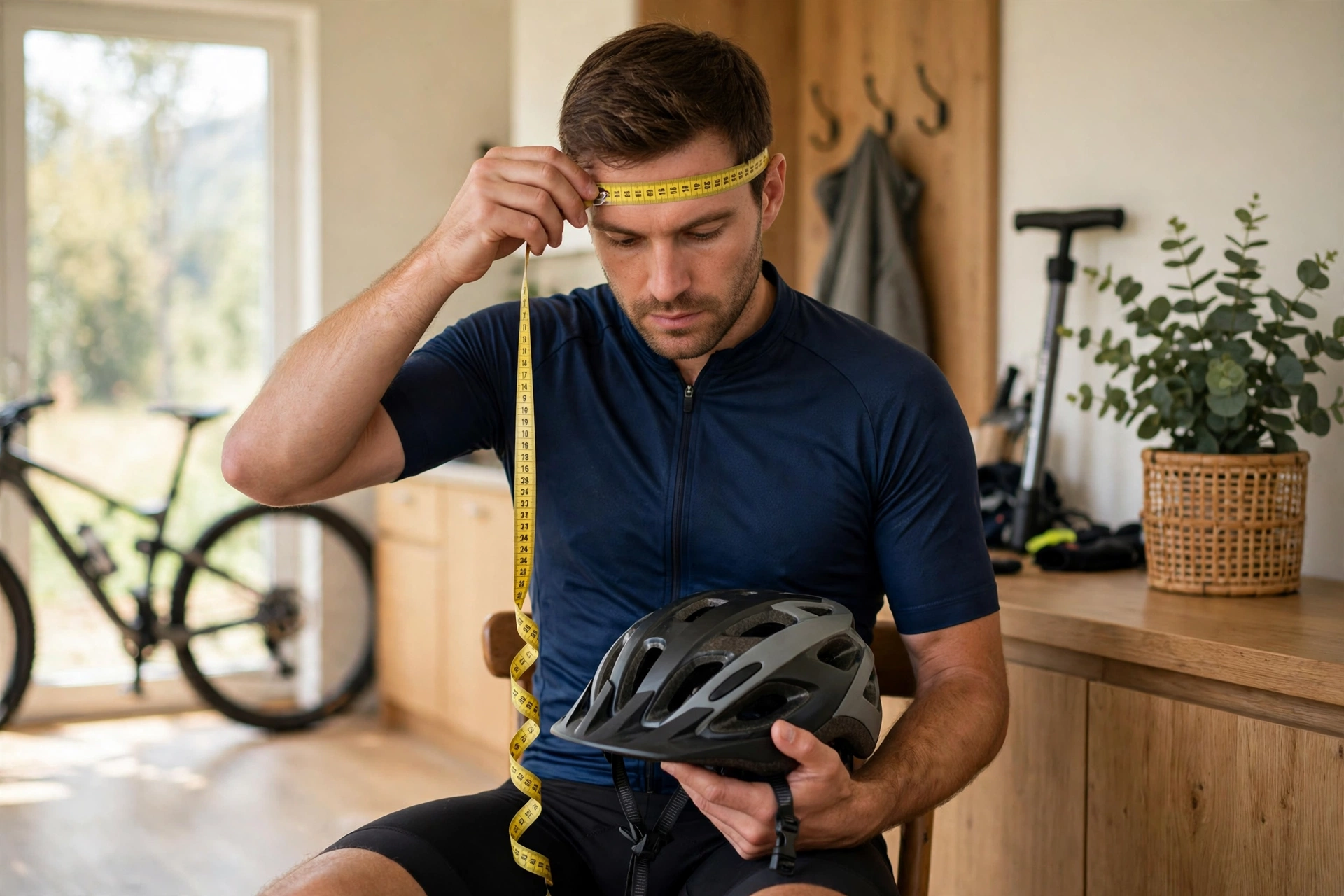
In general terms, MTB helmet sizing is not just about circumference — head shape matters too, and a helmet that matches your head shape (round or oval) will fit more comfortably and stay in place better than one that only matches your size number. Two riders with the same head measurement can need different helmets, because one has a rounder head and the other a longer, narrower one.
Most sizing guides stop at measuring your head, which leaves many riders puzzled when a helmet in their size still pinches or rocks. This guide covers both halves of sizing: the measurement and the shape, and how to use both when choosing a trail helmet.
How Do You Measure Your Head for an MTB Helmet?
Use a flexible tape measure around the widest part of your head, roughly a finger’s width above your eyebrows and ears, and around the back of your head at its fullest point. Keep the tape level and snug but not tight. Take the measurement twice to be sure, and use the larger number if the two differ.
Compare your measurement with the brand’s size chart, not a generic chart. Sizes vary between brands: one brand’s medium may be another’s large, and the ranges for each size overlap differently. Always check the specific brand you are buying, and remember that the chart is a starting point, not a guarantee of fit.
If you fall between sizes, the usual advice is to try the smaller size first, since pads compress slightly with use and a helmet that starts snug often settles into a good fit. But if the smaller size presses painfully or leaves red marks quickly, the larger size with thicker pads may be better. Trying both is the only reliable way to decide.
How Can You Tell Whether Your Head Is Round or Oval?
Look at your head shape from above. A rounder head is nearly as wide as it is long, while an oval or longer head is noticeably longer front-to-back than side-to-side. Most people fall somewhere in between, but leaning one way or the other affects which helmets feel right.
A practical test is to notice where helmets pinch. If helmets tend to press hard on the sides of your head while feeling loose front-to-back, your head is likely rounder than the helmet’s internal shape. If helmets press on your forehead and the back of your head while feeling loose at the sides, your head is likely longer and narrower than the helmet.
You can also ask someone to look at your head from above, or take a photo from directly overhead. It does not need to be precise — you are looking for a general tendency, not a medical measurement. Even a rough sense of your shape helps narrow down which brands and models are likely to fit.

Why Do Some Helmets Pinch Even in the Right Size?
Pinching happens when the helmet’s internal shape does not match your head shape. A helmet designed around a longer, narrower shape will squeeze the sides of a rounder head, creating pressure points at the temples. A helmet designed for a rounder head will press the forehead and back of a longer head while feeling loose at the sides.
Pressure points are more than a comfort issue. A helmet that pinches in one spot and gaps in another does not distribute force evenly, and it is more likely to shift in a crash. It is also a helmet you will be tempted to wear loosely or leave at home, which defeats its purpose entirely.
Brands differ in their internal shapes, and some brands offer models in different fits. If you consistently find one brand pinches, try another before assuming the size is wrong. The size may be right and the shape wrong — a distinction that saves a lot of frustrating returns.
What Features Help Different Head Shapes?
Adjustable retention systems help a lot. A rear dial that tightens evenly, with a cradle that adjusts vertically, can compensate for moderate shape differences by pulling the helmet snugly around the back of the head. This does not fix a major shape mismatch, but it makes borderline fits workable.
Interchangeable pads are the other useful feature. Thicker pads at the sides can fill out a helmet that is loose laterally, while thinner pads can relieve pressure where a helmet pinches. Many helmets include spare pads, and brands often sell pad sets separately, so you can fine-tune the fit without changing helmet.
Some helmets also come in different shell sizes within the same labelled size, or offer a specific round or oval fit. If you know your head leans strongly one way, look for models marketed with that fit, and read reviews from riders who mention head shape — they are often the most useful buying signal.
How Should You Try a Helmet Before Buying?
Wear the helmet for at least ten minutes in the shop, if you can. Pressure points often take a few minutes to appear, and a helmet that feels fine for thirty seconds can pinch painfully after ten minutes. Walk around, shake your head gently, and check for hot spots at the temples, forehead, and back of the head.
Do the standard fit tests: the helmet should sit level, cover your forehead, and resist being pushed up, back, or twisted. Fasten the chin strap and open your mouth — it should pull snug. If the helmet passes these tests and feels comfortable after ten minutes, the size and shape are both likely right.
Try it with the glasses or eyewear you ride in, and with your usual hairstyle. Glasses arms can create pressure points under a helmet, and hair volume changes fit. A helmet that fits in the shop with your real riding setup will fit on the trail too.
What If You Can Only Buy Online?
Buy from a retailer with a good returns policy, and order two sizes or two models if you can. Compare them at home using the same ten-minute test, and return the loser. This costs a little effort but is far better than keeping a helmet that pinches.
Read the brand’s size chart carefully, measure your head twice, and look for reviews that mention head shape and fit. If reviewers with round heads praise a model and you have a round head, that is a meaningful signal. If a model is consistently described as narrow, and you have a wider head, steer clear.
Finally, remember that fit is the foundation of protection. A helmet that matches your size and shape stays in place, and that stability matters for every protection feature it carries, including systems that reduce twisting forces. This guide to what MIPS means for helmets explains how one such system works.
Frequently Asked Questions
Q: Is head shape really more important than size?
A: Neither alone is enough — you need both. Size gets you in the right range, and shape decides which helmet in that range actually fits comfortably and stays put.
Q: Can pads fix a helmet that is the wrong shape?
A: In general terms, pads can fix small mismatches, but not large ones. If a helmet pinches badly or rocks despite pad swaps, it is the wrong shape or size, not a pad problem.
Q: Do all brands fit head shapes differently?
A: Yes, brands use different internal shapes, and models within a brand can differ too. That is why trying several brands matters more than trusting a size chart alone.

Olivia
Writer at Helmet Today, covering helmet reviews, fit and riding safety.