
Yes, helmets do have expiry dates in a practical sense, because the materials inside a helmet wear out over time, and in general terms most makers suggest replacing a helmet after around three to five years of regular use, or sooner if it has taken a hard impact. The date is rarely printed as a simple expiry date on the helmet, so riders need to know where to look and what signs to watch for.
The idea of a helmet expiring surprises many riders, because a helmet can look fine on the outside long after its protective materials have started to age. The shell may still be shiny, the colour may still be bright, and the straps may still work, while the foam liner inside has slowly become harder, less springy, and less able to absorb the force of a fall. That hidden ageing is the reason makers give a recommended lifespan rather than waiting for the helmet to look worn out.
Do helmets have a printed expiry date?
Most helmets do not have a printed expiry date in the way food or medicine does. Instead, most helmets have a date of manufacture, which is usually stamped or printed on a label inside the helmet, on the liner, or on a sticker under the padding. That date tells you when the helmet was made, and you can count forward from it to work out how old the helmet is. Some makers also print a recommended replacement period in the instruction leaflet that comes with the helmet.
A few helmets, especially work helmets and industrial hard hats, do carry a clearer date, because workplace safety rules often require a dated helmet and a set replacement schedule. For sports helmets, though, the date of manufacture is the usual marker. If you cannot find a date inside your helmet, check the paperwork that came with it, or look on the maker’s website, where the model and its year of manufacture are often listed.
Why do helmets expire?
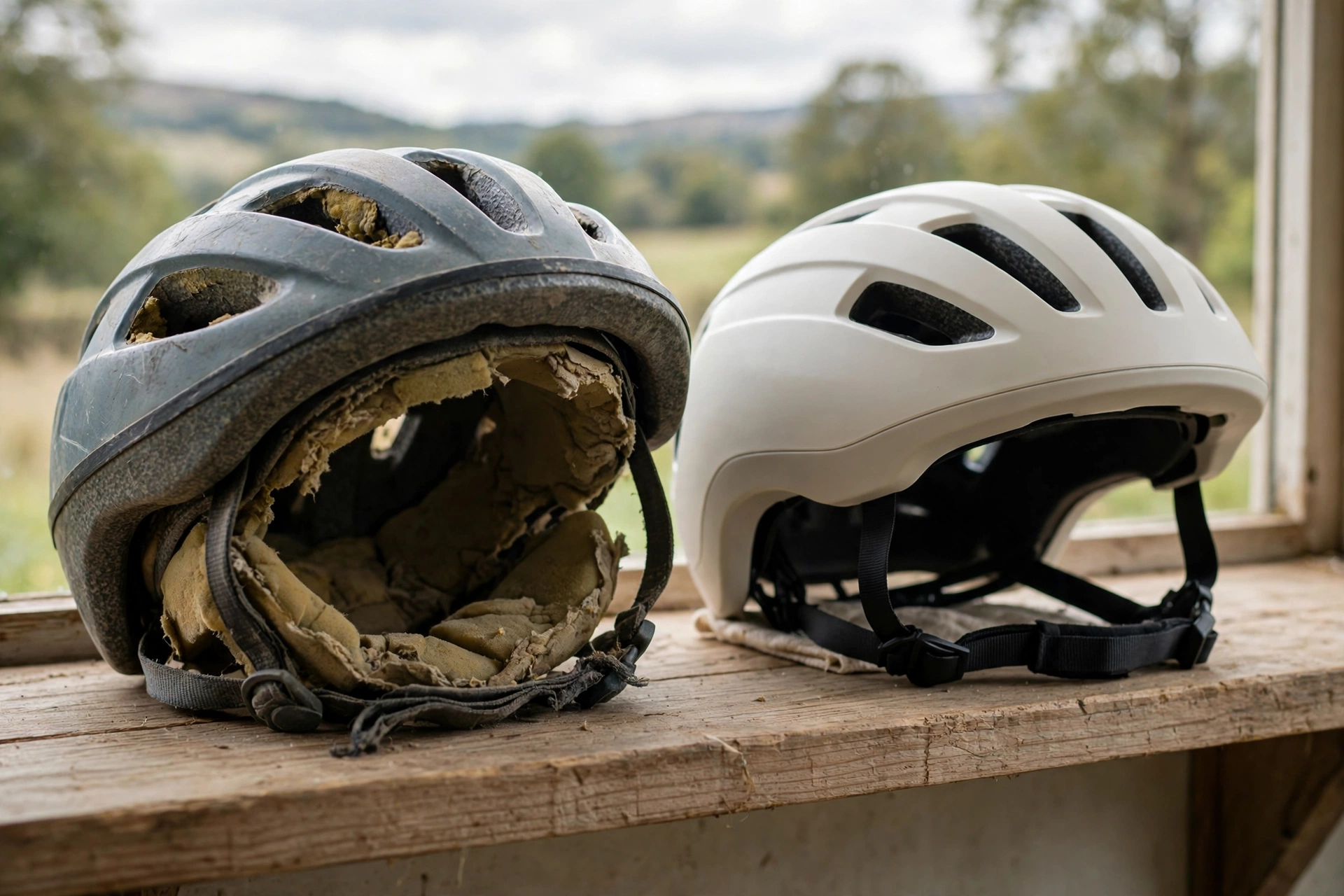
Helmets expire because the materials that protect your head change with age. The foam liner, which is usually made from a material such as expanded polystyrene, slowly loses its springiness as it is exposed to air, heat, sweat, and sunlight. A liner that has hardened or become brittle cannot compress in the same way in a fall, so it absorbs less of the force, and more of that force reaches the head.
Sweat is a quiet cause of ageing. The salts and oils in sweat soak into the pads and the liner over time, and they can break down the foam and the glue that holds the helmet together. Sunlight adds to the damage, because ultraviolet light weakens the shell and the webbing, and heat from a hot car or a sunny windowsill can warp the shell and dry out the liner. A helmet that has lived in a hot car for several summers will age faster than one stored in a cool, dry cupboard.
How long does a helmet last?
In general terms, most makers suggest replacing a sports helmet after three to five years of regular use, and that figure is a useful guide for cyclists, skaters, and other riders. A helmet worn only a few times a year and stored well may last longer than that, while a helmet worn every day, soaked in sweat, and left in the sun may need replacing sooner. The three-to-five-year figure is a guide, not a hard rule, and the condition of the helmet matters as much as its age.
Work helmets and hard hats often have a shorter recommended life, and many workplaces replace them on a fixed schedule, because a hard hat that fails on a building site can have serious consequences. Motorcycle helmets are usually given a similar three-to-five-year guide, though some makers suggest a longer period for a helmet that is well cared for. Whatever the type, the maker of your helmet is the best source for its recommended lifespan, so check the leaflet or the maker’s website for your exact model.
What are the signs a helmet has expired?
The signs that a helmet has expired are often easy to spot once you look for them. The liner may feel hard, brittle, or crumbly instead of firm and springy, and the pads may be flat, torn, or loose. The shell may show fading, fine cracks, or a chalky surface, and the straps may be stiff, frayed, or faded. Any of these signs means the helmet is ageing, even if it still feels comfortable to wear.
Smell is another clue. A helmet that smells strongly even after cleaning has absorbed years of sweat into the liner and the pads, and that is a sign of a helmet that has had a long life. A buckle that sticks or slips, a fit system that no longer holds, or a visor that no longer sits properly are further signs that the helmet is wearing out. A helmet that has become loose, even when adjusted to its smallest setting, has probably lost its shape and should be replaced.
How can you make a helmet last longer?
You can make a helmet last longer by looking after it well. Store it in a cool, dry place, out of direct sunlight, and never leave it in a hot car or on a sunny windowsill for long periods. Clean the pads and the liner now and then with mild soap and water, let the helmet dry naturally, and keep it in a bag or on a shelf where it will not be knocked about. Good storage slows the ageing of the foam and the shell.
Even with good care, though, a helmet will not last forever, and there comes a point when replacement is the right choice. Riders choosing a new helmet may also want to learn about features that can help in a fall, including a system designed to reduce rotational forces, such as MIPS, which is found in many modern helmets. A helmet replaced on time is a helmet you can trust, and knowing the age of your helmet is the first step.
Where is the manufacture date on a helmet?
The manufacture date is usually printed on a label or stamped inside the helmet, on the liner or under the padding. Some makers also list it in the instruction leaflet or on their website for your model.
Does an unused helmet still expire?
Yes, in general terms an unused helmet still ages, because the foam and the shell change slowly even in storage. A helmet that has sat unused for many years may still need replacing, so check its date before you rely on it.
Can I keep using a helmet past five years if it looks fine?
You can, but it is not the safest choice, because the liner may have hardened in ways you cannot see. If the helmet is past the maker’s recommended life, replacing it is the safer option.

Olivia
Writer at Helmet Today, covering helmet reviews, fit and riding safety.