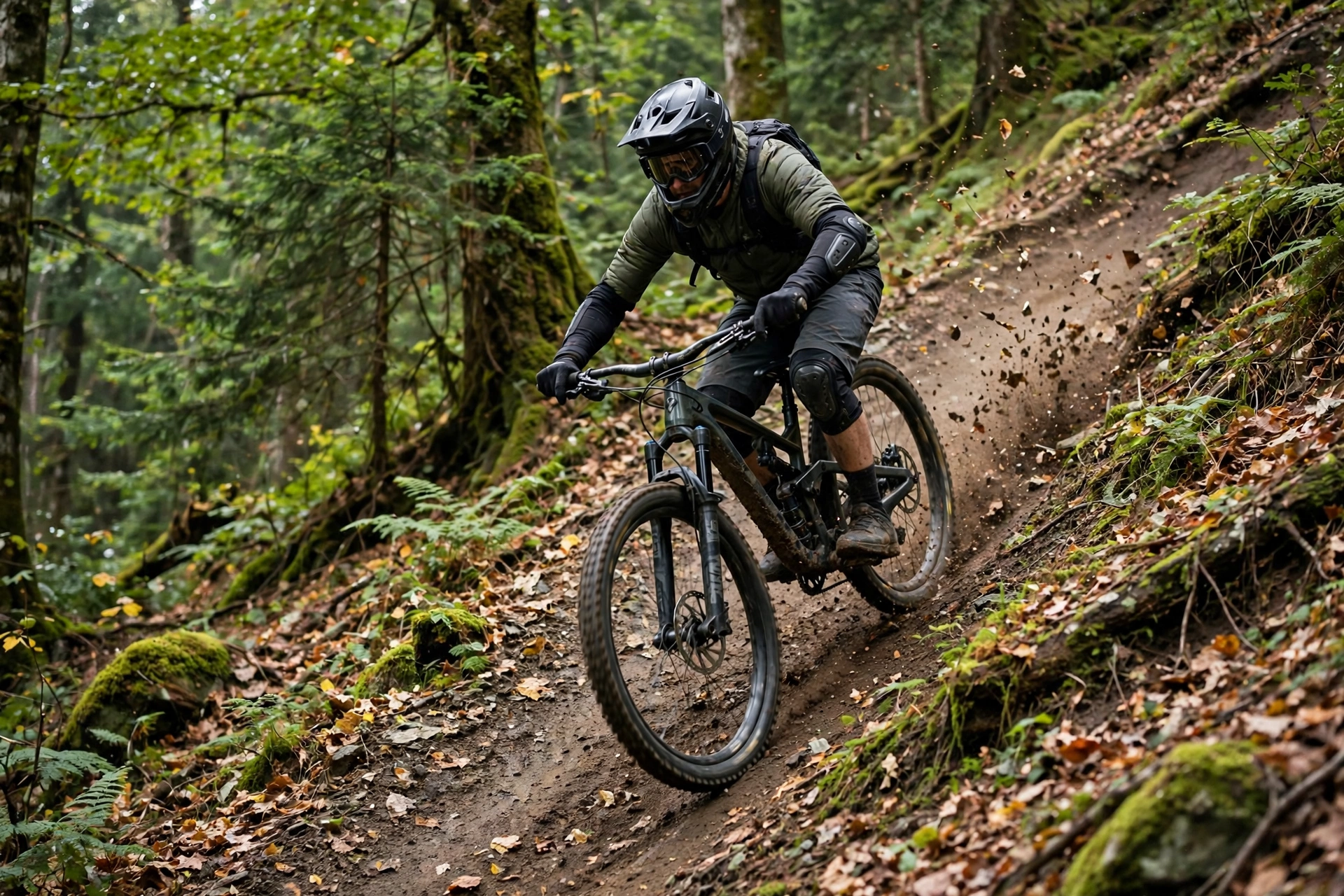
Helmet aerodynamics for downhill mountain biking is about balancing speed, cooling and protection on steep, fast descents — a good downhill helmet cuts drag without blocking airflow, so the rider stays fast, cool and able to see the trail clearly. In general terms, downhill aerodynamics is different from road aerodynamics: speeds are lower, the air is often dusty or humid, and the rider’s head moves constantly as they scan the trail. The shape has to work in rough, changing air, not in a clean wind tunnel.
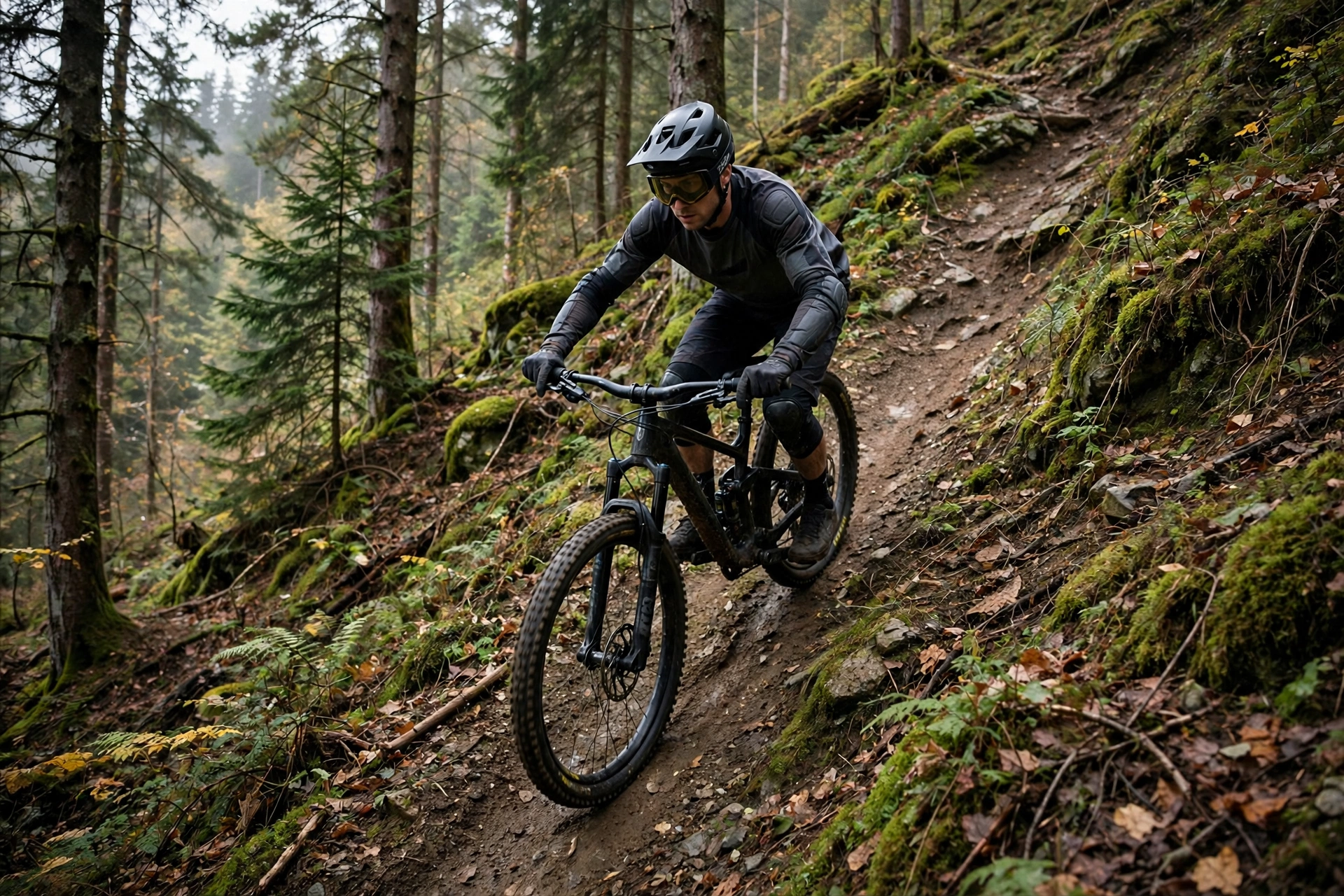
Downhill riders descend steep, technical trails at speeds that would be alarming on a road bike, jumping, dropping and cornering through trees and over rocks. The helmet is a full face design with a chin bar, a peak and large vents, and every one of those features affects how air flows around the head. This guide explains how aerodynamics works for downhill helmets, how shape and vents interact, and what to look for when choosing one.
How Does Speed Shape a Downhill Helmet?
Downhill speeds are high for a mountain bike, but they are lower than motorway speeds, so drag is less of a problem than it is for a road cyclist or a motorcyclist. The helmet does not need a long aerodynamic tail, and a shape that works well at moderate speed matters more than one tuned for very high speed. What matters most is that the helmet stays stable and does not catch the wind in a way that pulls the head around.
The peak is the most obvious aerodynamic feature. It shields the eyes from sun, rain and branches, and it shapes the air flowing over the top of the helmet. A well-designed peak is angled so that air flows over it smoothly, while a peak that is too large or too flat can act like a sail, catching the wind and pushing the helmet back or to one side. Many downhill helmets have an adjustable peak, so riders can set the angle that works best for their speed and position.
The chin bar also affects airflow. A long, protruding chin bar can catch the wind and create drag, but it is essential for protection in a crash. Makers shape the chin bar to be as slim as possible while still protecting the jaw, and they often add vents to the front of it so air can pass through rather than piling up against it.
How Do Vents Work at Downhill Speeds?
Downhill riding is hard physical work, even though the bike is going downhill. The rider is constantly moving, braking and absorbing impacts, and the body generates a great deal of heat. Without good ventilation, the inside of a full face helmet becomes hot and sweaty, the visor or goggles fog up, and concentration drops. Vents are therefore essential, even though every vent opening adds a little drag.
Good downhill helmets use large vents at the front, where the air is cleanest, and exhaust vents at the rear, where the air leaves. The air is drawn through the helmet by the rider’s speed, passing over the head and out the back. Internal channels guide this airflow, so it cools the whole head rather than just one spot. The best designs move a lot of air without creating noisy turbulence.
At lower speeds, on a slow technical section or a climb to the start, the airflow drops and the helmet relies on the size of the vents rather than the speed. Large, open vents work better in these conditions than small, narrow ones.
What Is the Trade-Off Between Aero and Cooling?
Every vent is a break in the smooth surface of the shell, and air passing over it creates turbulence and drag. A helmet with no vents would be the most aerodynamic, but it would also be unbearably hot. A helmet with huge vents everywhere would be very cool but slower and noisier. Downhill helmet design is a compromise between these two extremes.
Makers manage the compromise by shaping the vents carefully. A vent with a smooth, rounded opening and a flush cover creates less turbulence than a vent with a sharp edge or a raised lip. Some helmets use mesh covers that keep out mud and debris while letting air through, which keeps the airflow smoother. The position matters too: vents on the top of the helmet, where the air flows fastest, have a bigger effect on drag than vents on the sides.
How Does Helmet Shape Affect Stability on a Descent?
Stability is just as important as drag. A helmet that catches the wind unevenly can twist or lift, especially when the rider turns their head to look through a corner. This is tiring and distracting, and on a technical descent it can be dangerous. A well-shaped helmet stays neutral in the wind, so the rider can look where they need to without fighting the helmet.
The peak is the main cause of instability. If the peak is too large, it can lift the front of the helmet at speed, pulling the rider’s head back. If it is angled wrongly, it can catch a crosswind and twist the helmet sideways. An adjustable peak helps, and many riders set it lower for fast, open trails and higher for slow, wooded sections where branches are a bigger worry than wind.
Fit also affects stability. A helmet that fits snugly and stays put on the head is far more stable than a loose one that shifts around. The retention system — the dial or cradle at the back — should hold the helmet firmly without pressing uncomfortably.
What Should You Look for in a Downhill Helmet?
Start with the shape and the peak. Look for a full face helmet with a peak that can be adjusted, a chin bar that is shaped to let air through, and a smooth overall profile without sharp protrusions. The helmet should feel balanced on your head, not heavy at the front or back.
Next, check the ventilation. Look for large front vents, clear internal channels and rear exhausts, and try the helmet on to see whether you can feel air moving through it. If you ride with goggles, check that the goggles sit comfortably with the helmet and that the vents do not blow directly onto the goggle lens, which causes fogging.
Finally, check the fit and the safety features. A downhill helmet should fit snugly, stay stable when you shake your head, and meet the standard required for the trails or races you ride. If you are learning about the safety technology inside the helmet itself, reading about what MIPS is for helmets can help you understand how modern helmets handle rotational forces in a crash.
Frequently Asked Questions
Q: Does a downhill helmet’s peak slow you down?
A: In general terms, a well-designed peak adds very little drag at downhill speeds, because the speeds are moderate and the peak is shaped to let air flow over it. A very large or flat peak can catch the wind and pull the helmet, so an adjustable peak is worth having.
Q: Why do downhill helmets have such big vents?
A: Downhill riding is hard physical work in a full face helmet, so the rider generates a lot of heat. Large vents move enough air to keep the head cool, even at low speed on technical sections.
Q: Is an aerodynamic downhill helmet less protective?
A: No. Aerodynamic shaping changes the outside of the shell, not the protection inside it. A helmet that meets the right standard protects the same whether it is sleek or not.

Olivia
Writer at Helmet Today, covering helmet reviews, fit and riding safety.