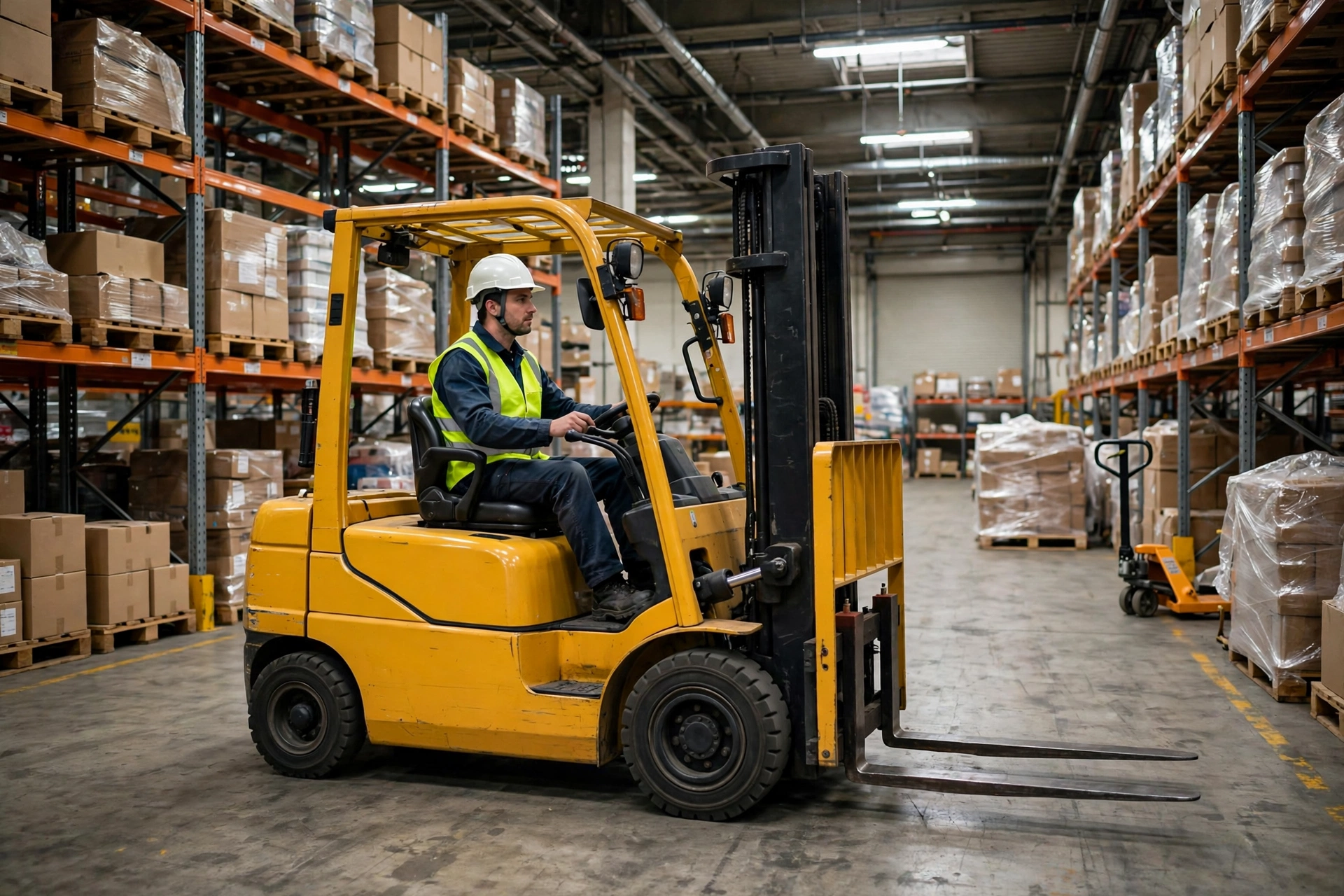
A helmet for forklift drivers is a safety helmet, usually a hard hat, worn to protect the head from falling objects, low beams, and knocks while driving and working around a forklift. In general terms, a forklift driver works in a busy space full of racking, pallets, and stacked goods, where something can fall from a shelf or a load can shift without warning. A safety helmet gives the driver a hard shell over the head, and that shell takes the force of an impact that would otherwise reach the skull.
Forklift driving looks like a seated job, but the cab is open to the warehouse around it, and the driver often climbs in and out, checks loads, and walks through storage areas. The helmet is part of the driver’s normal protective equipment, along with high-visibility clothing and safety footwear. It is worn because the risk comes from the workplace itself, not just from driving the truck.
Do forklift drivers have to wear a helmet?
Whether a forklift driver has to wear a helmet depends on the workplace and its safety rules, and in general terms many warehouses and yards do require one. The employer is responsible for assessing the risks on site, and where there is a risk of falling objects or head injuries, a safety helmet is usually part of the required kit. The driver should follow the rules for their own site, even if drivers at another site work without one.
Some sites require a helmet only in certain areas, such as under high racking or near loading bays, while others require one everywhere on the floor. In general terms, a driver who works outdoors, in a yard with cranes or stacked containers, is more likely to need a helmet all the time. If the site rules are unclear, the safest step is to ask the supervisor and wear the helmet until the answer is clear.
What type of helmet is best for forklift drivers?
The best helmet for a forklift driver is usually a standard industrial safety helmet, often called a hard hat, that fits well and is comfortable to wear for a full shift. These helmets have a hard outer shell and a suspension system inside that holds the shell away from the head, and that gap helps to absorb the force of an impact. In general terms, a light helmet with good ventilation suits a driver who spends hours in the cab, while a helmet with a short brim suits a driver who needs a clear view upwards when stacking loads.
Some helmets come with slots for ear defenders, a visor, or a chin strap, and those extras can be useful in noisy or dusty workplaces. A chin strap is worth considering for drivers who work outdoors in wind, or who climb on and off the truck often, because it stops the helmet falling off at the wrong moment. Choose a helmet in a bright colour so the driver is easy to see among the racking and the moving trucks.
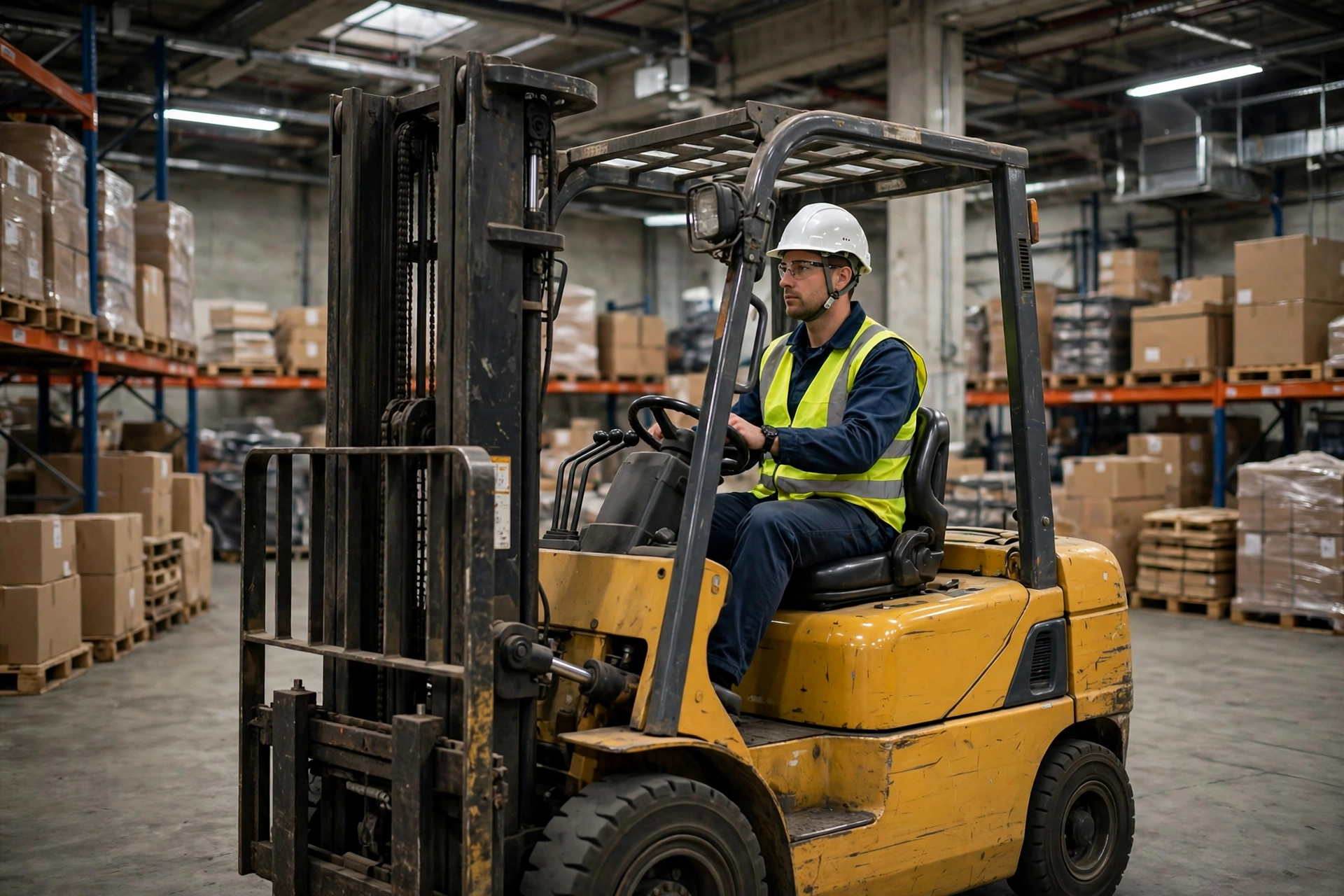
How should a forklift driver wear a safety helmet?
A forklift driver should wear a safety helmet level on the head, with the suspension adjusted so the helmet sits firmly without rocking or slipping. The brim should sit just above the eyebrows, and the helmet should not tip forward over the eyes or slide back when the driver looks up at a load. In general terms, a helmet that is worn tilted back or pushed up like a cap is not doing its job, because the shell is no longer over the part of the head it is meant to protect.
The chin strap, if the helmet has one, should be fastened snugly enough to hold the helmet in place, but not so tight that it is uncomfortable. Hair should be tucked inside, and nothing should be stored between the shell and the suspension, because even a small object in that gap can change how the helmet works in an impact. Some helmets include a system designed to reduce rotational forces in a fall, such as MIPS, and that feature works as part of the helmet’s own design, so the driver should wear the helmet exactly as the maker describes.
When should a forklift driver replace their helmet?
A forklift driver should replace their helmet if it has taken a heavy knock, if the shell is cracked, dented, or faded, or if the inside suspension is worn or damaged. In general terms, a helmet that has absorbed an impact has done its job, and it should not be kept in use, even if the damage looks small. The shell can be weakened in ways that are hard to see, and a weakened shell may not protect the head in a second impact.
Helmets also wear out with time, heat, and sunlight, so a helmet that has been left in a hot cab or in strong sun for long periods may need replacing sooner. Check the helmet regularly for cracks, soft spots, and frayed straps, and follow the maker’s guidance on how long the helmet should stay in service. If the helmet no longer fits well, or if the suspension has lost its spring, it is time for a new one. A helmet is cheap compared with the injury it prevents, so there is no reason to stretch its life.
Can a forklift driver wear a helmet inside the cab?
Yes, a forklift driver can wear a helmet inside the cab, and in general terms most drivers who are required to wear one keep it on for the whole shift. Some cabs have an overhead guard, which is the metal frame above the driver, and that guard is designed to stop falling objects from reaching the driver. The helmet is an extra layer of protection on top of that guard, for objects that come from the side or for knocks when the driver climbs in and out.
A helmet can feel awkward in a low cab, so the driver should check that it does not catch on the overhead guard or block the view of the load. If the helmet makes it hard to see or to turn the head, the driver should try a lower-profile helmet or adjust the seat before giving up on the helmet. Comfort matters, because a helmet that is taken off and left on the seat is no protection at all.
Is a hard hat the same as a safety helmet?
In general terms, yes, the two terms are used for the same type of industrial head protection. A hard hat is the common name for a safety helmet with a hard shell and a suspension system inside, worn on construction sites, in warehouses, and in yards.
Can a forklift driver wear a bump cap instead of a helmet?
A bump cap protects against light knocks on low beams and pipes, but it is not a substitute for a safety helmet where there is a risk of falling objects. If the site requires a safety helmet, a bump cap does not meet that requirement.
How do I clean a forklift driver’s helmet?
Clean the shell with mild soap and warm water, and let it dry away from direct heat. Do not use strong solvents or paint the shell, because both can weaken the material. Check the suspension at the same time, and replace any worn parts.

Olivia
Writer at Helmet Today, covering helmet reviews, fit and riding safety.