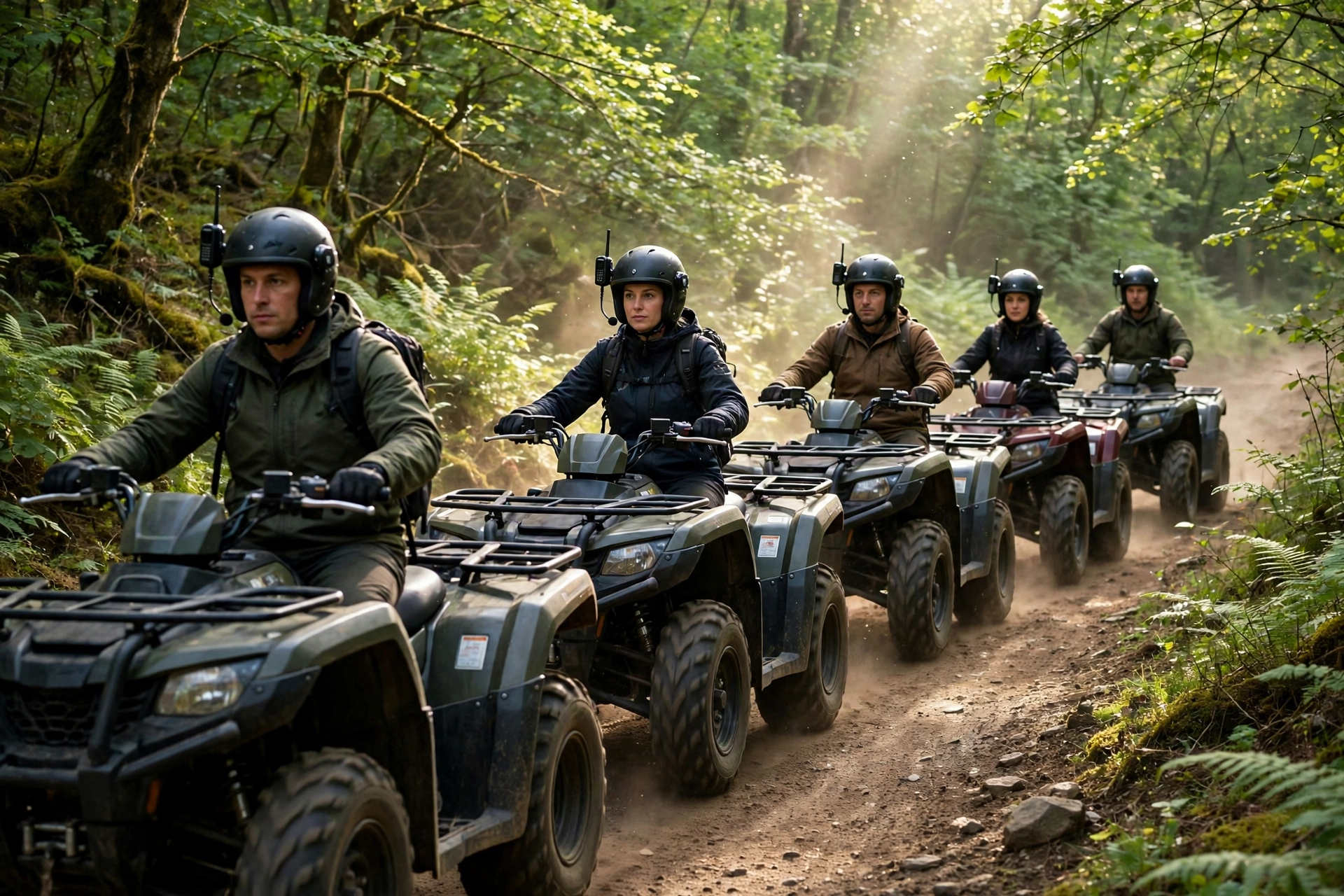
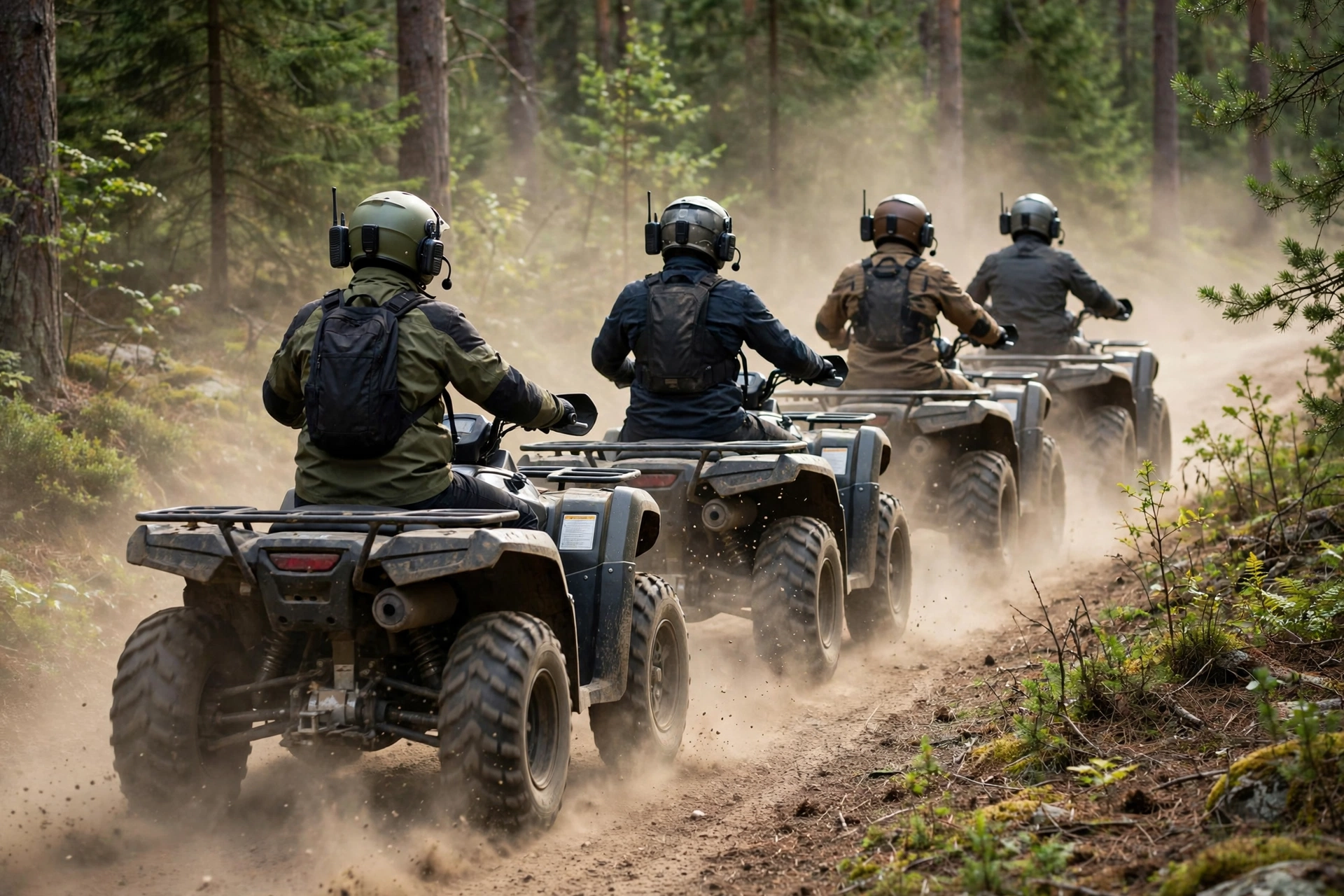
Yes, a helmet intercom works well for ATV and UTV groups — it lets riders talk to each other across a trail without stopping, waving or shouting over engine noise. In general terms, a group intercom turns a line of separate riders into one connected group, so the leader can warn about obstacles, a rider at the back can call for help, and everyone can agree on turns and stops. For trail riding with friends or family, it changes the whole experience.
ATV and UTV riding is often a group activity, but the machines are loud, the trails are dusty, and riders spread out over rough ground. Without an intercom, communication means stopping, removing gloves and helmets, or shouting across the noise. A helmet intercom solves that by putting a speaker and microphone inside each rider’s helmet and linking the group wirelessly. This guide explains how it works for ATV and UTV groups, what to look for, and how to set it up.
How Does a Group Intercom Work on the Trail?
A group intercom links several helmet units together so everyone can hear each other at the same time. Most systems use either Bluetooth or mesh technology. Bluetooth systems pair units in a chain, with each rider connected to the next, while mesh systems let every unit join one shared network. Mesh tends to work better for larger groups because riders can drop out and rejoin without breaking the whole chain.
On the trail, the leader usually sets the pace and calls out hazards — a deep rut, a fallen branch, a water crossing or a sharp turn. Riders further back can pass the warning along or report a problem, such as a machine that will not start or a rider who has fallen behind. Because everyone hears the same conversation, the group stays coordinated without anyone having to stop.
Most systems also let riders share music or take a phone call, though on a busy trail most groups keep the channel clear for riding talk. Some units have a push-to-talk option, while others keep the microphone open so riders can speak naturally. Open microphones are easier, but they can also pick up engine noise, so a good noise-reduction system matters on an ATV or UTV.
How Many Riders Can Join One Group?
The number of riders depends on the system. Smaller Bluetooth units may support two to four riders, which suits a family or a small group of friends. Larger mesh systems can link many more riders at once, which suits club rides and organised trail days where a dozen or more machines are out together.
In practice, bigger is not always better. A very large group can become noisy, with too many voices talking at once. Many experienced groups split into smaller sub-groups of four to six riders, each with its own channel, and use a lead rider to coordinate between them. This keeps conversations useful and stops the channel from becoming a distraction.
Before you buy, check the group size your system supports and how it handles riders joining late or leaving early. A good system lets a new rider join the group without everyone else having to stop and re-pair. It should also reconnect automatically if a rider drops out of range and then comes back, which happens often on winding trails.
What Makes ATV and UTV Riding Different for Intercoms?
ATV and UTV riding puts different demands on an intercom than road riding. The machines are louder, the speeds are lower, and the terrain is rougher. Dust is a constant problem on dry trails, and mud and water crossings are common. An intercom for this kind of riding needs to be tough, well sealed and easy to operate with gloves on.
Engine noise is the biggest challenge. A four-stroke ATV engine at full throttle is loud enough to drown out a weak microphone, so the microphone needs good wind and noise shielding. A boom microphone that sits close to the mouth usually works better than a fixed microphone, because it picks up your voice clearly while staying away from the worst of the engine noise.
Range matters too. On a winding forest trail, riders can lose sight of each other around bends and over hills, so the intercom needs enough range to stay connected through trees and rough ground. Mesh systems usually cope better here, because the signal can hop from one rider to the next, extending the group’s total reach beyond what a single pair of units could manage alone.
How Do You Set Up Intercoms for a Group Ride?
Set up the group before you leave, not on the trail. Charge every unit fully the night before, update the firmware if the maker has released a new version, and pair all the units together at home or at the trailhead while everyone is standing close together. Test that every rider can hear and be heard before the engines start.
Agree on simple rules for the channel. The leader speaks first on hazards and turns, and other riders keep their messages short. Riders should say who they are when they speak, especially in a larger group where voices can sound alike through a speaker. A short radio-style habit — “This is Sam, I need a stop” — keeps things clear.
Carry a backup plan. Batteries run down, units fail, and a rider may forget to charge. Agree on hand signals for stop, turn and hazard before the ride, and make sure everyone knows the meeting point if the group gets separated. The intercom is a great tool, but it should not be the only way the group communicates.
What Should You Look for When Buying for a Group?
Start with group size and range. Choose a system that comfortably covers your usual group, with some spare capacity for guests. Check the range figure the maker quotes, but remember it is measured in open ground — trees, hills and buildings will reduce it. Mesh systems are usually the better choice for groups of four or more.
Next, look at battery life. A full day on the trail can last many hours, so a unit that runs out after a few hours will leave riders silent by the afternoon. Look for a unit with a long battery life and, if possible, a way to charge on the go from the ATV or UTV itself. A unit that can charge while riding solves the problem entirely.
Finally, check the fit with your helmet. ATV helmets vary in shape, and not every intercom clamp fits every shell. If you are learning about the safety technology inside the helmet itself, reading about what MIPS is for helmets can help you understand how modern helmets handle rotational forces in a crash. A good intercom should mount firmly, sit comfortably, and not press on your ears during a long day on the trail.
Frequently Asked Questions
Q: Do all riders need the same brand of intercom?
A: In general terms, yes — group intercoms work best when everyone uses the same brand and model, because pairing across brands is often limited or unreliable. Check compatibility before mixing brands.
Q: Can a passenger in a UTV use the group intercom?
A: Yes. A passenger wearing a helmet with an intercom unit can join the group chat just like a driver, which is handy for spotting hazards and navigating from the passenger seat.
Q: Will dust and mud damage a helmet intercom on the trail?
A: A well-sealed unit should cope with dust and splashes, but heavy mud can block the microphone and speaker. Wipe the unit clean after dusty or muddy rides and keep the charging port cover closed.

Olivia
Writer at Helmet Today, covering helmet reviews, fit and riding safety.