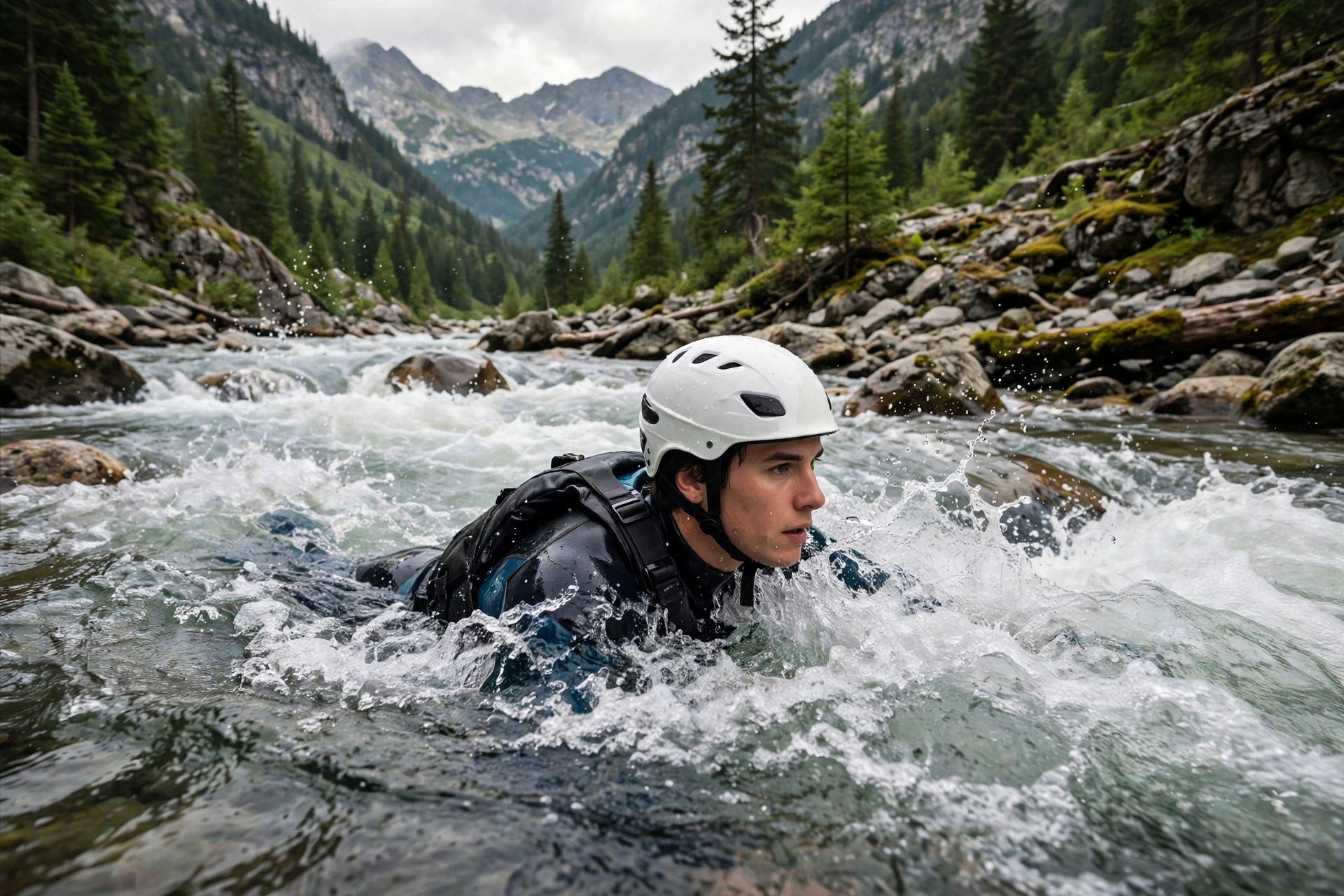
A helmet for whitewater swimming is a light, close-fitting water helmet worn by a swimmer moving through rapids, to protect the head from rocks, the riverbed, and floating debris. In general terms, the swimmer is moving with the current through fast, shallow water, and the head is the part of the body most likely to strike a rock. The helmet is the swimmer’s main piece of safety equipment, alongside a life jacket and a throw rope on the bank.
Whitewater swimming is not the same as swimming in a pool or a calm lake. The swimmer is carried downstream by the current, feet first, steering with their arms and legs through rapids, waves, and narrow channels. The water is shallow in places, the rocks are hard and often just below the surface, and the current can push a swimmer sideways into a boulder or pin them against an obstacle.
What is a helmet for whitewater swimming?
A helmet for whitewater swimming is a water sports helmet, similar to the helmets worn by kayakers and rafters, with a hard outer shell, a foam lining that absorbs impact, and a secure chin strap. In general terms, it is made to work when wet: the lining drains quickly, the shell resists water, and the strap stays fastened even when the swimmer is being tumbled by the current. It sits close to the head so that the water cannot catch it and pull it off, and it covers the forehead, the temples, and the back of the head.
The helmet is designed for repeated small impacts rather than a single big crash. A swimmer in rapids may bump their head several times on a single run, against rocks that are sometimes sharp and sometimes smooth. The foam lining spreads the force of each bump, and the shell keeps the rock from cutting the skin.
Why do whitewater swimmers wear a helmet?
Whitewater swimmers wear a helmet because the head is exposed to rocks at every stage of a run, and the current decides where the swimmer goes rather than the swimmer. In general terms, even a careful swimmer in an easy rapid can be pushed into a rock by a sudden wave or a change in the current, and the swimmer cannot always see what is under the surface. A helmet turns a knock that could cut the scalp or cause a concussion into a bump that the swimmer can shake off and keep swimming through.
The helmet also protects the swimmer at the moments when they are most vulnerable: entering the water, crossing a shallow ledge, and being washed into a pool below a drop. At a drop, the water can push the swimmer down and forward into the rocks at the bottom, and a swimmer who is upside down or turned sideways has no way to protect their head with their hands.
What kind of helmet is used for whitewater swimming?
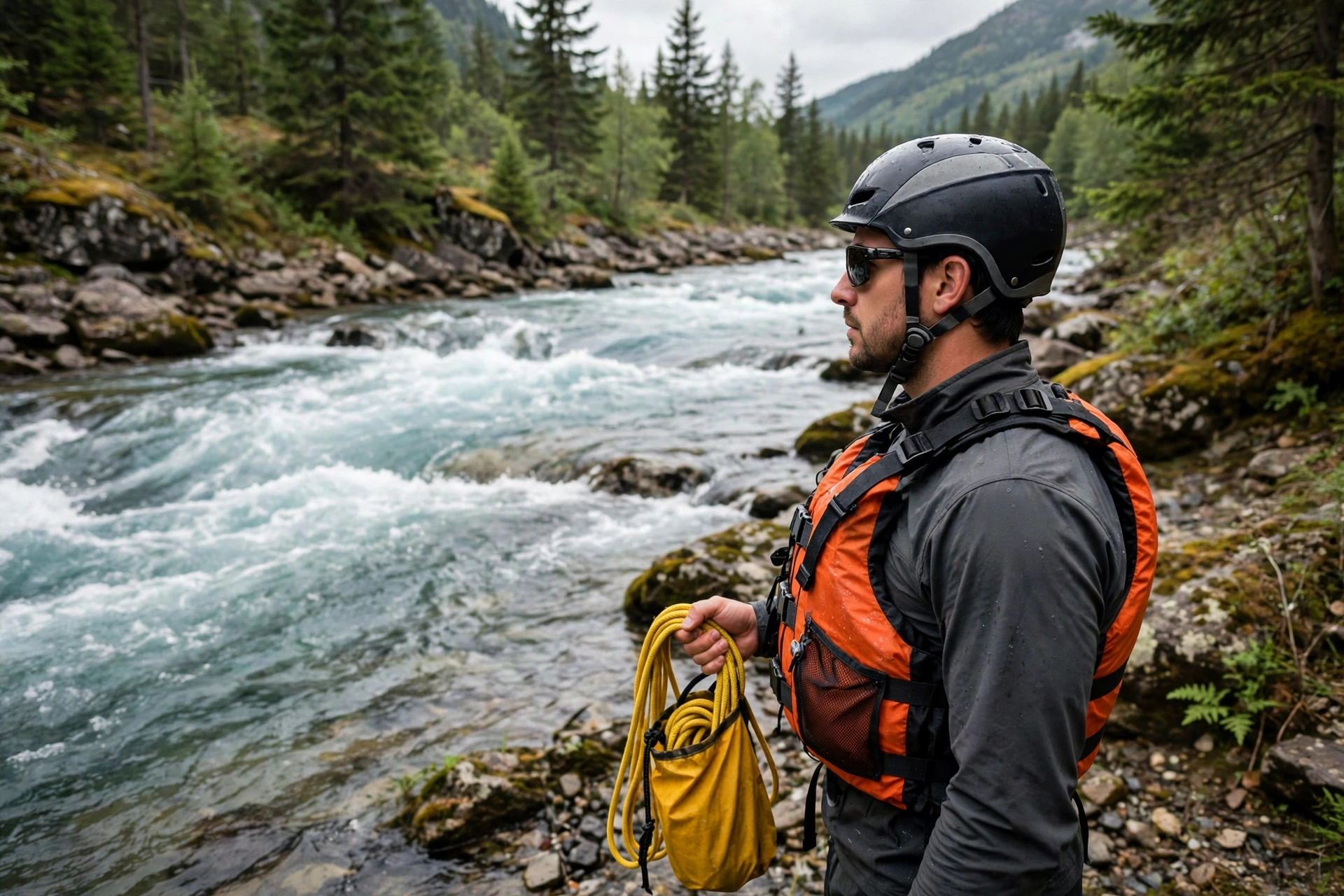
The helmet used for whitewater swimming is a purpose-made whitewater or kayaking helmet, chosen for the grade of water being swum. In general terms, a helmet with a full shell and good coverage suits harder rapids, while a lighter helmet with more ventilation suits easier water on a warm day. The shell should be made from a tough material that resists cracking on a sharp rock, and the lining should be a foam that absorbs impact rather than a soft padding that only adds comfort.
The fit is checked in the same way as for any water helmet: the helmet should sit level on the head, cover the forehead, and stay put when the wearer shakes their head or nods. The chin strap should be snug enough that the helmet cannot be pulled off by the water, and the rear adjustment should be tightened so that the helmet does not slide forward over the eyes when the swimmer is pushed under. Some helmets include a system designed to reduce rotational forces in a fall, such as MIPS, which is a useful extra for a swimmer who may be rolled sideways by the current and struck at an angle.
How should a whitewater swimming helmet fit?
A whitewater swimming helmet should fit snugly, with no gaps between the lining and the head and no pressure points that become painful after a few minutes. In general terms, the wearer should try the helmet on with wet hair if possible, since hair behaves differently when wet and a helmet that fits on dry hair can loosen in the river. The helmet should not move when the wearer shakes their head from side to side, and it should not press on the ears or the forehead in a way that distracts the swimmer.
The strap deserves the same attention as the shell. A chin strap that is left loose is almost as bad as no helmet at all, because the water can catch the helmet and pull it off the head in the first rapid. The buckle should sit snugly under the chin, and any loose strap ends should be tucked away so that they cannot catch on a branch or a rock. A swimmer who shares a helmet with someone else should re-check the fit every time, since a helmet adjusted for one head size will not protect another head properly.
When should a whitewater helmet be replaced?
A whitewater helmet should be replaced after a hard impact, after visible damage, or when the fit and the lining no longer hold the head securely. In general terms, a helmet that has taken a heavy blow against a rock may have damage in the foam lining that is not visible from the outside, so a swimmer who has had a serious knock should treat the helmet as suspect and have it checked or replaced. Cracks in the shell, a strap that slips, or a lining that has gone soft and loose are all signs that the helmet is no longer doing its job.
Do you need a helmet for whitewater swimming?
Yes, in general terms a helmet is essential for whitewater swimming, since the current can push a swimmer into rocks at any point in a run, and the helmet protects the head from the knocks that are one of the main risks in rapids.
Can you use a kayaking helmet for whitewater swimming?
Yes, whitewater swimming helmets and kayaking helmets are very similar, and a kayaking helmet that fits well and covers the forehead, temples, and back of the head is a good choice for a whitewater swimmer.
How tight should a whitewater swimming helmet be?
It should fit snugly, sit level on the head, and stay in place when the head is shaken, with the chin strap fastened so the water cannot pull it off. It should be checked with wet hair if possible, since a helmet can loosen in the river.

Olivia
Writer at Helmet Today, covering helmet reviews, fit and riding safety.