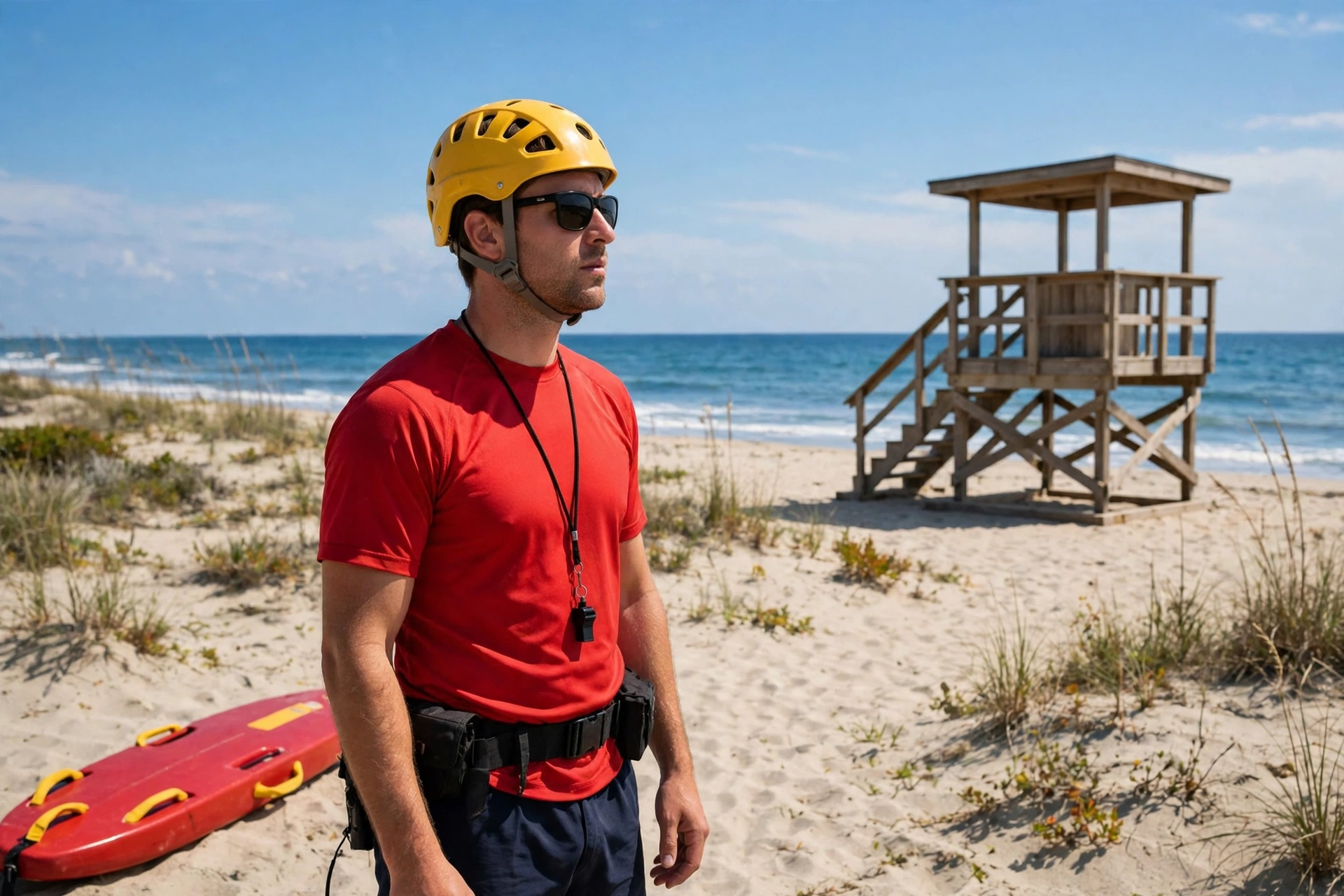
A helmet for lifeguards is a light water helmet worn to protect the head during rescues, surf entries, and work around rocks, boats, and rescue boards. In general terms, lifeguards spend their days in and around the water, often moving fast in rough conditions, so a helmet is a practical piece of protection for the moments when a rescue turns physical. It guards against knocks from boards, boats, and the sea floor, and it helps the lifeguard keep working when conditions get rough.
Lifeguards are easy to picture in a tower with a pair of binoculars, but much of their work happens in the water. A lifeguard may have to run into the surf, swim through breaking waves, handle a rescue board in a shore break, or pull a swimmer from rocks. In those moments, the head is exposed to boards, fins, rocks, and the sea floor. A helmet will not make a rescue safe on its own, and it does not replace training, fitness, or good judgement about the sea, but it lowers the chance that a knock to the head becomes a serious injury.
What is a lifeguard’s helmet?
A lifeguard’s helmet is usually a light water sports helmet with a hard outer shell, a soft lining that drains water, and a chin strap that holds it firmly in place. In general terms, it covers the top and sides of the head, sits low on the forehead, and leaves the face open so the lifeguard can see, speak, and hear clearly. Many helmets have ear coverage or ear flaps, and some have a small brim to keep sun and spray out of the eyes.
The helmet is often bright in colour, with reflective details, so that the lifeguard is easy to spot in the water and on the beach. It is made to be worn for long shifts in sun and salt water, so it should be light, well-vented, and comfortable enough to wear while running, swimming, and lifting. Some helmets are close to a surf helmet, while others are made for general water rescue work, with a little more coverage for use around rocks and boats.
Why do lifeguards wear helmets?
Lifeguards wear helmets because rescues often happen in the roughest part of the beach, where boards, rocks, and breaking waves meet. A lifeguard entering the surf with a rescue board may be knocked by the board in a wave, a lifeguard working near rocks may slip on a wet surface, and a lifeguard pulling a swimmer from the water may be struck by a fin or a board. In general terms, a helmet protects against the knocks that come with moving fast in a moving sea.
The helmet also matters because a lifeguard who is injured cannot help anyone else. A knock to the head that leaves a lifeguard dazed or hurt puts both the lifeguard and the swimmer at risk, so protecting the lifeguard’s head is part of protecting the public. For that reason, many lifeguard services now include a helmet in the standard kit for surf and rock rescues, even if it is not worn for every hour of a quiet shift.

When should a lifeguard wear a helmet?
In general terms, a lifeguard should wear a helmet for surf entries, rescues in rough water, and any work around rocks, boats, or rescue boards. These are the moments when the head is most at risk, because the lifeguard is moving fast, the water is moving too, and hard objects are close by. A helmet is also sensible during training exercises that practise rescues in the surf, since the same knocks can happen in practice as in a real rescue.
On a calm day, when the lifeguard is watching from the tower and the sea is gentle, a helmet may not be needed, and the lifeguard service will decide what the kit should be for each shift. The key is to wear the helmet for the risky parts of the job, rather than treating it as something to wear all day or never. A lifeguard who puts the helmet on before entering the surf is making a simple, sensible choice.
What should a lifeguard look for in a helmet?
A lifeguard should look for a helmet that fits well, stays in place in the surf, and does not block hearing or vision. In general terms, the helmet should sit level on the head, cover the forehead down to just above the eyebrows, and hold firm when shaken gently from side to side. The chin strap should be easy to fasten with wet hands, and the lining should drain water rather than soak it up and become heavy.
Visibility matters too, since a lifeguard needs to be seen by the team and by the public. A bright colour and reflective details help, and a helmet that works with sunglasses and a radio headset is a bonus. Some helmets include a system designed to reduce rotational forces in a fall, such as MIPS, which is a feature worth considering, although a good fit, a shell made for water use, and clear hearing remain the most important things for a lifeguard.
How do lifeguards look after their helmets?
A lifeguard’s helmet should be rinsed in fresh water after every shift, to wash out salt and sand that can wear down the straps and lining. In general terms, the helmet should be left to dry in the shade, away from direct sunlight and away from heat, because strong sun and heat can weaken the shell and the straps over time. The lining should be allowed to dry fully before the helmet is stored, so that it does not develop an unpleasant smell.
The helmet should be checked regularly for cracks in the shell, frayed straps, and a lining that has gone flat or loose. A helmet that has taken a hard knock should be looked at closely, and if the shell is cracked or the lining is damaged, the helmet should be replaced rather than patched up. Lifeguards who work every day will wear a helmet out faster than a casual water user, so it is worth keeping a spare ready and replacing the helmet when the fit or the protection starts to feel less reliable.
Do all lifeguards wear helmets?
No, in general terms it depends on the service and the conditions. Many lifeguards wear a helmet for surf entries and rescues in rough water, while tower duty on a calm day may not need one. The service usually decides what the kit should be for each shift.
Can a lifeguard wear a surf helmet?
Yes, a surf helmet is often a good choice for a lifeguard, since it is made for the same kind of water, waves, and knocks. The key is that the helmet fits well, drains water, and stays in place during a rescue.
Does a helmet make it harder to hear swimmers?
A well-fitting water helmet should not block hearing much, although ear flaps can muffle sound a little. Lifeguards usually adjust to it quickly, and the protection is worth the small change in hearing.

Olivia
Writer at Helmet Today, covering helmet reviews, fit and riding safety.