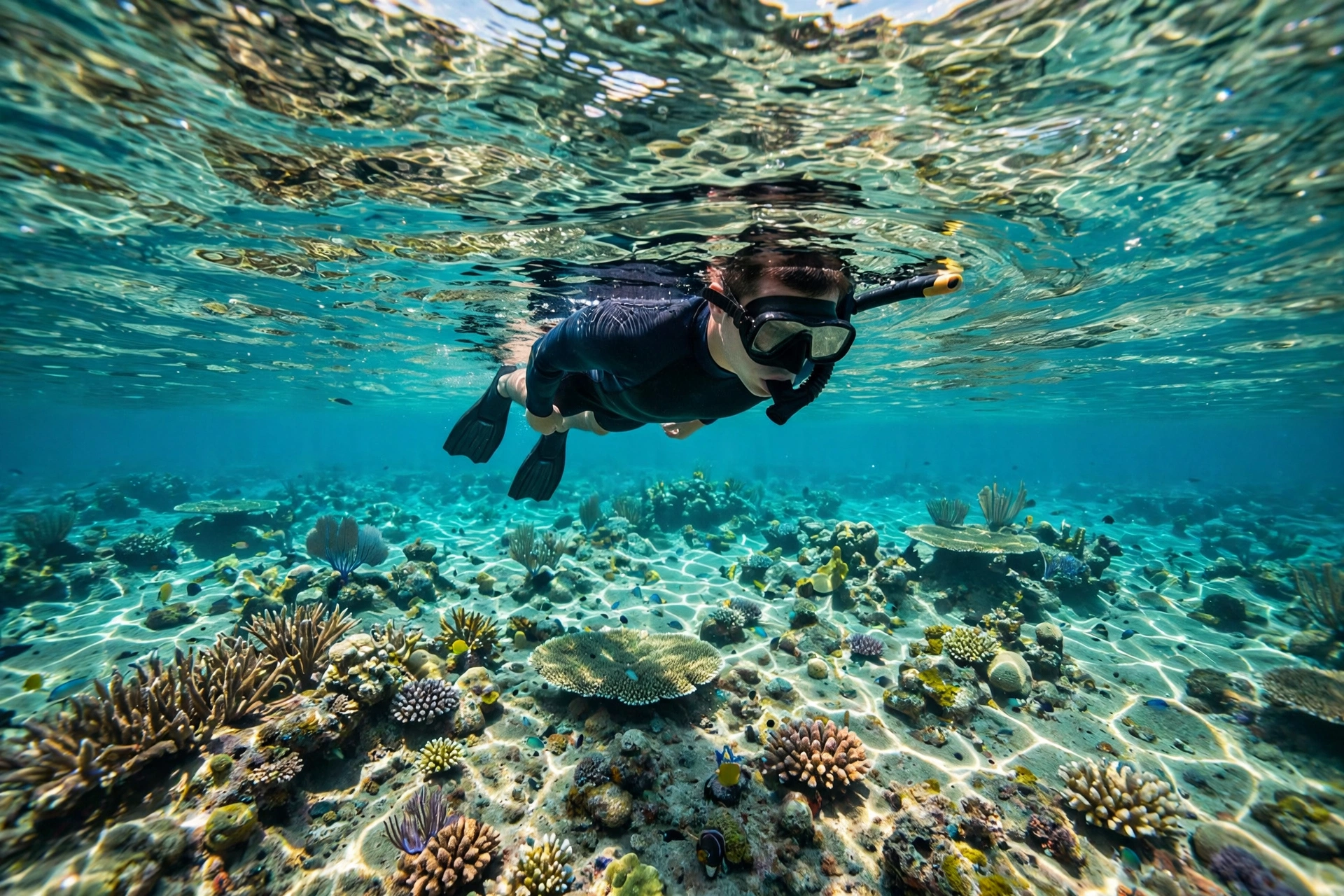
Do snorkellers wear helmets? In general terms, most snorkellers do not wear helmets, and a helmet is not part of the usual snorkelling kit. Snorkelling is normally a calm, slow activity in open water, where the main risks are sunburn, currents, and tiredness rather than blows to the head. A mask, snorkel, and fins are the standard kit, and most snorkellers, from beginners to experienced swimmers, get in the water without any head protection at all.
That said, there are some situations where a helmet can make sense for a snorkeller. Rocky entries, shallow reefs, crowded dive sites, and strong surge can all bring a swimmer’s head into contact with rock or coral, or with another person’s fins. In general terms, a light helmet is a sensible extra in those settings, even though it is unusual. Understanding when a helmet helps, and when it only gets in the way, is the key to deciding whether to wear one.
Why do most snorkellers not wear helmets?
Most snorkellers do not wear helmets because the activity does not usually involve hard impacts. A snorkeller floats face-down on the surface, moving slowly, and the head is mostly underwater or just above it. In general terms, there is little for the head to hit in open water, and a helmet would add weight, drag, and warmth without adding much protection. It would also make it harder to clear the mask and snorkel, and it could interfere with the strap that holds the mask in place.
Comfort is another reason. Snorkelling is meant to be relaxing, and a helmet that traps heat or presses on the head takes away from that. In general terms, snorkellers prefer to keep their kit light and simple, and a helmet feels like an unnecessary extra on a calm reef swim.
When might a snorkeller want a helmet?
A snorkeller might want a helmet when the entry or the site itself has hard surfaces close to the water. In general terms, a rocky shore entry, a shallow reef with surge, or a site with strong waves can push a swimmer against rock or coral, and a light helmet can soften that contact. The same applies at crowded sites, where another swimmer’s fins or a boat’s ladder can be a hazard. A helmet is also worth considering for snorkellers with a medical reason to protect the head, or for children, who may be less aware of their surroundings in the water.
Some organised snorkelling trips in caves, under piers, or around wrecks also suggest helmets, because the swimmer may pass under low, hard structures. In general terms, if a guide or operator recommends a helmet for a particular site, it is wise to wear one. The helmet does not need to be heavy or specialist — a light water-sports helmet that drains well and fits over a thin hood or cap is usually enough. The point is to match the protection to the site, rather than wearing a helmet everywhere out of habit.

What kind of helmet suits a snorkeller?
A helmet for snorkelling should be light, quick to drain, and comfortable in the water. In general terms, a light water-sports or kayaking helmet is the best match, because it is designed to get wet, it has drainage holes, and it sits snugly without covering the ears or the mask strap. A heavy helmet, or one with thick padding that soaks up water, would be uncomfortable and could make the head feel heavy in the water. A helmet with a good chin strap is important, so it stays on if a wave hits.
Fit matters in the water more than on land. A helmet that is too loose can shift and cover the mask, while one that is too tight will press on the head and cause discomfort. In general terms, the snorkeller should try the helmet on with the mask, to check that the mask strap sits comfortably and the mask seals properly. The helmet should also be rinsed in fresh water after use, to remove salt and sand, and left to dry in the shade. Some water-sports helmets include a system designed to reduce rotational forces in a fall, such as MIPS, although for snorkelling the main needs are lightness, drainage, and a secure fit.
What are the downsides of wearing a helmet while snorkelling?
The main downside of a helmet while snorkelling is comfort and convenience. A helmet adds weight to the head, traps warmth, and can make the mask strap harder to adjust. In general terms, it can also make it harder to hear a guide or a buddy, and it can catch on the snorkel tube if it is not fitted carefully. For a calm reef swim in open water, these drawbacks outweigh the small amount of protection a helmet adds, which is why most snorkellers leave it behind.
There is also a practical point about buoyancy and movement. A helmet changes the balance of the head in the water slightly, and a bulky helmet can create drag when swimming. In general terms, a snorkeller who wears a helmet should choose the lightest one that does the job, and should test it in shallow water first, to make sure the mask, snorkel, and helmet all work together. If the helmet makes the swim awkward or uncomfortable, it may be better to choose a different site or entry point rather than struggling with kit that does not suit the activity.
How can a snorkeller protect their head without a helmet?
A snorkeller can protect their head without a helmet by choosing the site and entry with care. In general terms, entering the water from a sandy beach or a boat ladder is safer than scrambling over rocks, and swimming in open water away from the reef edge reduces the chance of contact with coral. Keeping a little distance from other swimmers avoids fin kicks, and watching the waves and surge before entering helps the snorkeller pick a calm moment to get in.
Good habits in the water help too. A snorkeller should keep their arms slightly out for balance in shallow water, avoid ducking down into surge near rocks, and stay aware of boats and other traffic. In general terms, a swim cap or a thin neoprene hood can protect against sunburn and jellyfish stings, and it also gives a small amount of cushioning against a light knock. For most snorkelling, these simple habits, plus a sensible choice of site, are enough. A helmet is a useful extra for rocky or crowded sites, but it is not needed for every swim.
Do snorkellers normally wear helmets?
No, in general terms most snorkellers do not wear helmets. A mask, snorkel, and fins are the usual kit, and a helmet is only added for rocky entries, shallow reefs, or other sites with hard surfaces nearby.
Is it safe to snorkel without a helmet?
Yes, in general terms snorkelling without a helmet is safe in open water with a calm entry, as long as the snorkeller chooses the site carefully and stays aware of currents, boats, and other swimmers.
What helmet should a snorkeller wear?
A light water-sports helmet that drains well and fits snugly is the best choice. It should be tried on with the mask, to make sure the mask seals properly and the strap sits comfortably.

Olivia
Writer at Helmet Today, covering helmet reviews, fit and riding safety.