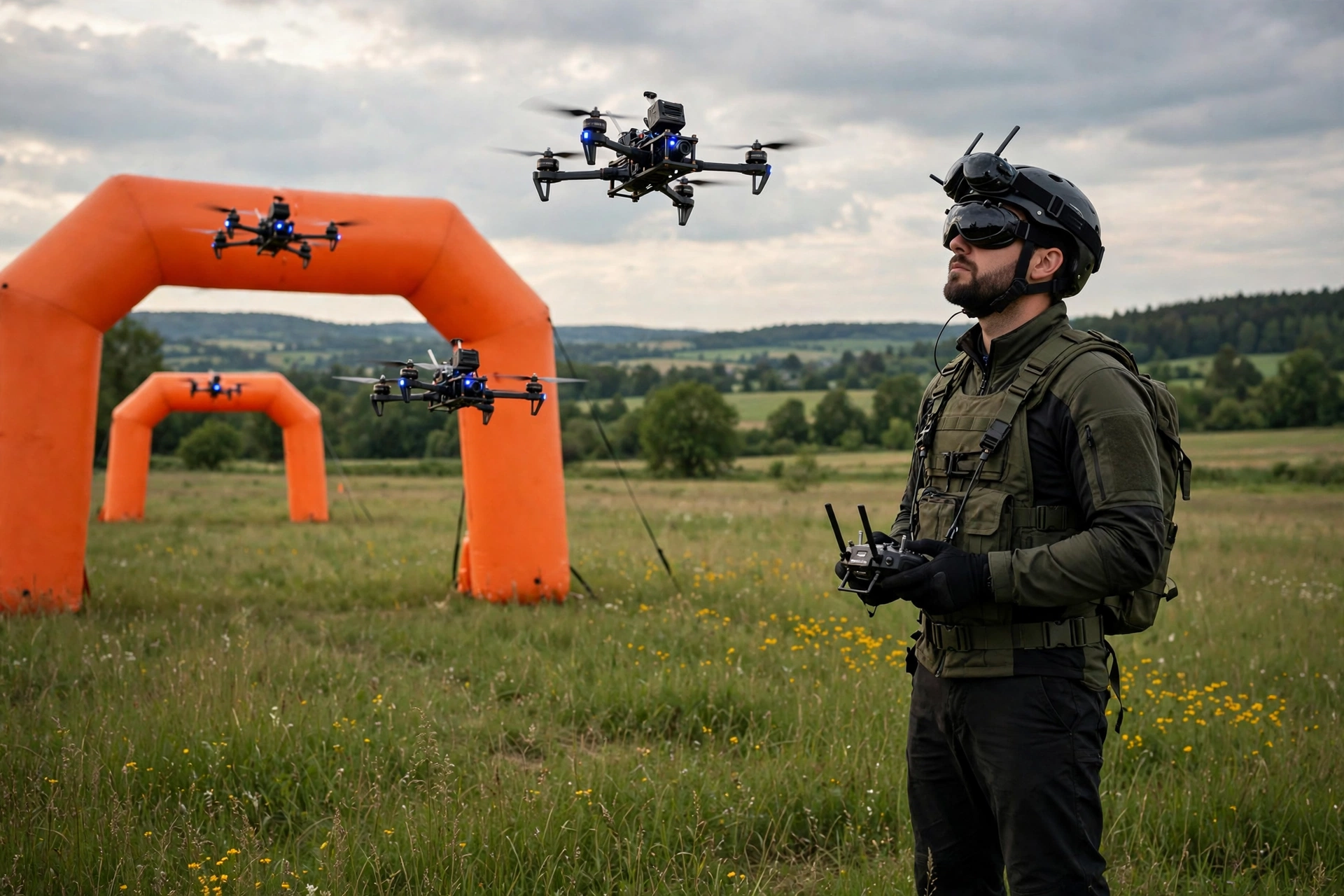
A helmet for drone racing is a light, protective helmet worn by a drone racing pilot, to shield the head from a crashing drone, a spinning propeller, or a fall while walking a race course. In general terms, the pilot stands on the ground while the drone flies, so the risk is not a high-speed crash of the pilot’s own body but a fast, sharp object coming back towards them. The helmet is a simple safeguard for a sport where small aircraft fly close to people at high speed.
Drone racing, often called FPV racing, is a sport in which pilots fly small quadcopter drones through gates and around obstacles on a course, steering by a live video feed from a camera on the drone. A drone that loses control can fly back towards the pilot line, hit a gate and bounce off, or drop from the air, and its propellers are spinning fast enough to cut skin. The helmet protects the pilot’s head while their eyes are covered by goggles and their attention is on the screen in front of them.
What is a helmet for drone racing?
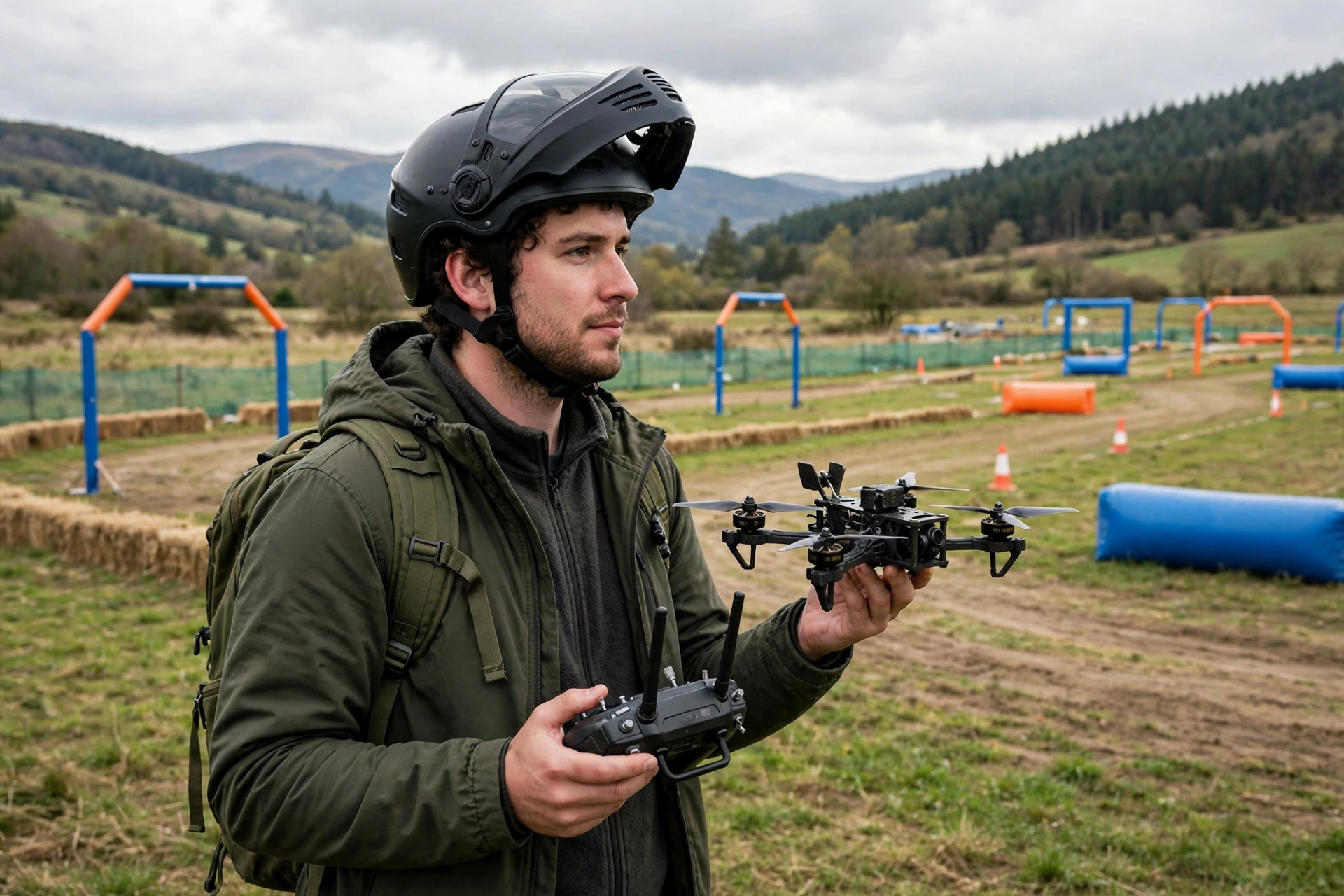
A helmet for drone racing is, in practice, a light sports helmet, often a skate or bike helmet, chosen for comfort and coverage rather than for a single racing standard. In general terms, there is no widely used helmet made only for drone racing, so pilots use a helmet that fits well, covers the top and sides of the head, and stays in place while they stand, walk, and turn to follow their drone. It should be light enough to wear for a whole race day without tiring the neck, and ventilated enough to stay comfortable in the sun.
The helmet is part of a small set of protective gear that also includes the FPV goggles themselves, which shield the eyes, and sometimes gloves for handling a drone with spinning propellers. The helmet covers what the goggles do not: the top, the sides, and the back of the head.
Why do drone racing pilots wear a helmet?
Drone racing pilots wear a helmet because a racing drone is a fast, hard object with exposed propellers, and it can come back towards the pilot line without warning. In general terms, a drone that clips a gate, loses a propeller, or loses its radio link can tumble out of the air in any direction, and a pilot wearing FPV goggles cannot see it coming. The goggles block the pilot’s view of the real world, so the helmet is the protection for a hazard the pilot cannot watch for.
The risk is not limited to the pilot’s own drone. At a race, several drones fly at once, and a pilot may be standing near other pilots, spotters, and spectators. A drone from another heat can cross the pilot line, and a drone being tested on the bench can lift off unexpectedly.
What kind of helmet suits drone racing?
A light, well-ventilated skate or bike helmet suits drone racing best. In general terms, it should have a hard outer shell, a foam lining that absorbs impact, and a strap that keeps it in place while the pilot turns their head to follow the drone. A helmet with a smooth, rounded shell is a good choice, since a drone or a propeller is more likely to glance off a smooth surface than to catch on a vent or a ridge. Bright colours help the pilot to be seen by other pilots and by spotters on the course.
The helmet must work with the FPV goggles, which is the one fitting issue that is unique to drone racing. The goggles sit over the eyes and rest against the forehead, and the helmet’s front edge must not push the goggles down onto the nose or lift them away from the face. The pilot should try the helmet and the goggles together before a race, adjusting the helmet’s fit and the goggle strap until both sit comfortably. Some helmets include a system designed to reduce rotational forces in a fall, such as MIPS, which is a useful extra for a pilot who may be struck by a tumbling drone at an angle.
Does a helmet interfere with FPV goggles?
A well-fitting helmet does not interfere with FPV goggles, but a poorly chosen one can. In general terms, the problem is usually at the forehead, where the helmet’s front edge meets the top of the goggles, or at the strap, where the goggle strap and the helmet strap compete for the same space at the back of the head.
The fix is to fit the two together rather than separately. The pilot should put the helmet on first, adjust it so that it sits level and snug, and then put the goggles on and adjust their strap over or under the helmet strap, whichever feels more secure. A helmet with a rear adjustment dial makes this easier, since the fit can be fine-tuned after the goggles are in place.
How should a drone racing helmet be chosen?
A drone racing helmet should be chosen by fit first, then by weight, ventilation, and compatibility with goggles. In general terms, the pilot should measure around the head just above the eyebrows, match that measurement to the helmet’s size range, and try the helmet on with the goggles before buying. The helmet should sit level, cover the forehead, and stay in place when the head is shaken gently, and the chin strap should be snug enough that the helmet cannot be knocked off by a glancing blow.
Comfort matters more in drone racing than in many sports, because the pilot wears the helmet for hours at a race meeting, often in the sun, while standing and concentrating hard. A helmet that is heavy, hot, or pinching will be taken off between heats, and a helmet that is off the head protects no one.
Do drone racing pilots need a helmet?
Yes, in general terms a light helmet is a sensible safeguard for drone racing, since a fast drone with spinning propellers can come back towards the pilot line while the pilot’s view is covered by FPV goggles.
What type of helmet is best for drone racing?
A light, well-ventilated skate or bike helmet that fits snugly and works with FPV goggles is the best choice. There is no widely used helmet made only for drone racing, so fit and goggle compatibility matter most.
Can you wear FPV goggles with a helmet?
Yes, a well-fitting helmet works fine with FPV goggles, but the two should be tried on together before a race, since a helmet that sits too low can press the goggles down onto the nose.

Olivia
Writer at Helmet Today, covering helmet reviews, fit and riding safety.