
A helmet should fit a woman the same way it should fit anyone: level on the head, low on the forehead, and snug all round without pressing hard anywhere. It should stay in place when you shake your head, the straps should form a neat V below each ear, and the chin strap should be snug enough that only one or two fingers fit underneath. If a helmet meets those checks, it fits, whatever the label on the box says.
What Is Different About Women’s Helmet Fit?
In general terms, women’s helmets are designed with a few small differences in mind. The shell is often a little narrower and the sizing tends to run smaller, with more options at the lower end of the size range. Many women’s models also have a fit system at the back that sits higher or leaves a gap for a ponytail, so long hair can pass through without pushing the helmet forward or making it sit crooked. Some also come with extra padding or a slightly different shape around the back of the head.
These differences can help, but they are not rules. Head shapes vary far more between individuals than they do between men and women, so a woman with a rounder head may fit better in a unisex model, while a man with a smaller head may fit a women’s model perfectly well. The label is a starting point, not a requirement. If a helmet feels right, it fits, and if it does not, no amount of pink trim or a women’s label will fix it. Colour has no effect on safety or fit, so choose the helmet that fits best and worry about the colour second.
How Do You Measure Your Head for a Helmet?
Measuring your head takes less than a minute and it is the single most useful step before you buy a helmet. Wrap a soft tape measure around your head just above your eyebrows and your ears, at the widest point, and keep it level all the way round. Take the measurement twice to be sure, and write it down. Then compare it with the size chart for the helmet you are looking at, because sizing varies between brands and a medium in one brand can be a large in another.
If you fall between two sizes, the usual advice is to try the smaller size first. A helmet should feel snug when it is new, and the padding will settle slightly with use. A helmet that feels loose on day one will only feel looser later, while a snug one will usually bed in and become comfortable. If the smaller size presses hard in one spot or gives you a headache within a few minutes, move up to the larger size and use the fit system to take up the slack. It is also worth measuring with your hair the way you usually wear it when you ride, because a bulky ponytail can change the fit.
How Should a Helmet Sit on Your Head?
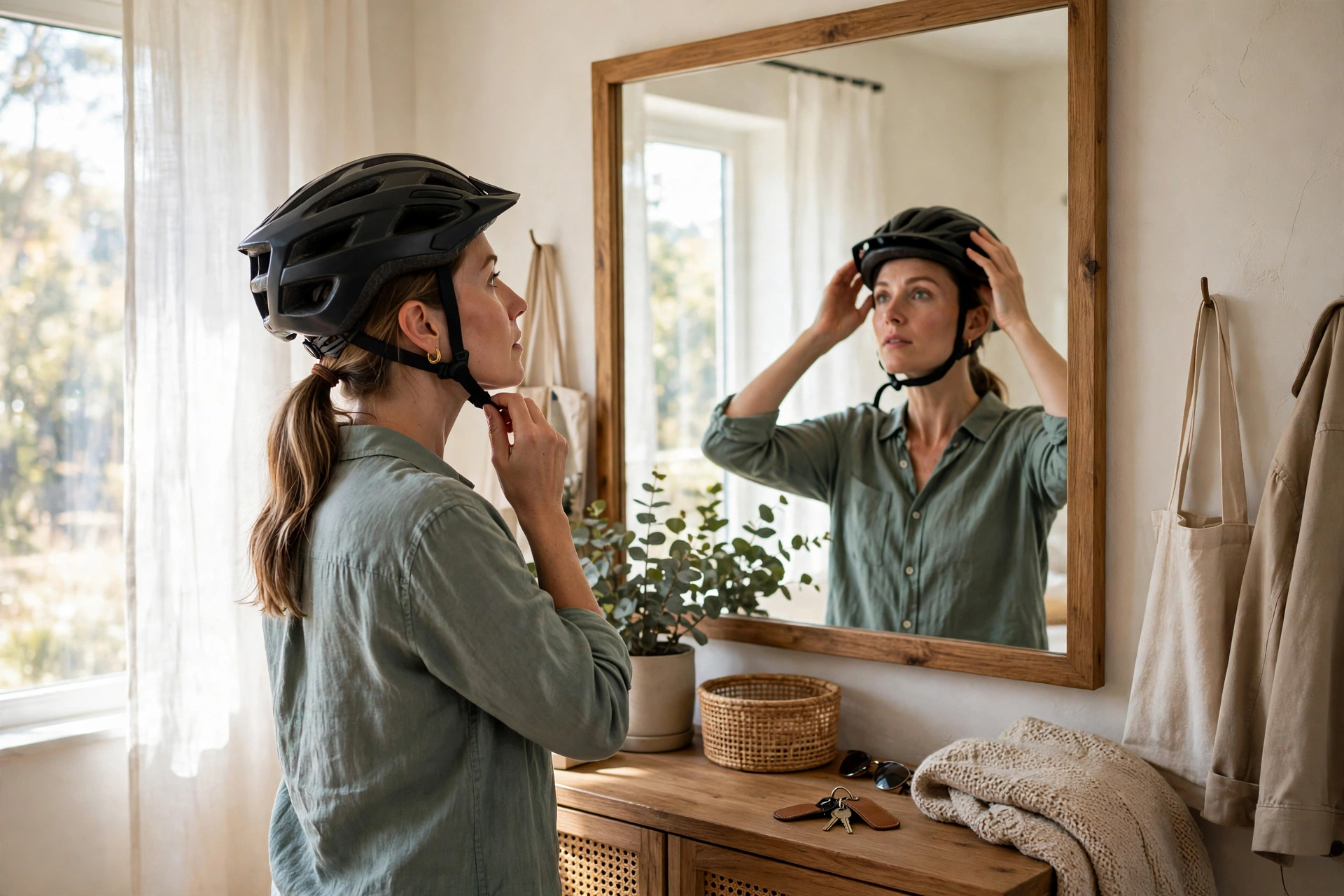
A helmet should sit level on your head, not tilted back like a cap and not pulled down over your eyes. The front edge should sit low on your forehead, about two fingers’ width above your eyebrows. If you can see the front of the helmet when you look up, it is probably sitting too low. If your forehead is fully exposed, it is sitting too high, and it will not protect you properly in a fall.
The helmet should feel snug all round, with even pressure and no gaps. Press the front of the helmet gently: it should not rock backward. Press the back: it should not tip forward over your eyes. Shake your head from side to side and up and down. A well-fitting helmet will move your skin slightly with it, rather than sliding around on its own. If it wobbles, it is too big, or the fit system needs tightening. Comfort matters as much as position: a helmet that pinches or gives you a headache after ten minutes is not the right helmet for you, even if it passes the position checks.
What Should You Check Before You Buy?
Before you buy, check that the helmet meets a recognised safety standard for the activity you will use it for. A cycling helmet, a motorcycle helmet, and a ski helmet are all tested differently, so make sure the helmet you choose is made for your sport. The label or packaging should state the standard clearly. A helmet with no standard marking, or one sold as a toy or a fashion item, is not a safe choice for riding.
Look at the fit system too. Most modern helmets have a dial or cradle at the back that lets you tighten or loosen the fit, and a good one will adjust smoothly with one hand. Check that the straps are easy to adjust and that the buckle is simple to open and close, even with gloves on. Ventilation is worth checking as well: more vents usually mean a cooler head on a warm day. Some helmets include MIPS, a low-friction layer inside the helmet designed to reduce rotational forces in certain angled impacts. It is a feature many riders look for, but it is not essential, and it does not replace a good fit.
How Do You Adjust the Straps and Fit System?
Start with the fit system at the back of the helmet. Put the helmet on, sit it level, and turn the dial until the cradle feels snug all round. It should hold the helmet in place without squeezing. Then adjust the side straps so that they meet in a neat V shape just below each ear, with the buckle sitting just under the chin. The straps should lie flat against your face without twisting, and the chin strap should be snug enough that you can fit only one or two fingers between the strap and your chin.
Once the straps are set, do the shake test again. Open your mouth wide: you should feel the helmet pull down slightly on your head, which shows the chin strap is doing its job. If the helmet still moves, tighten the fit system a little more or adjust the straps until it stays put. It can take a few tries to get everything right, so do not rush it. Finally, always fasten the chin strap: a helmet that is not strapped on will fly off in a fall before it can do any good.
Should women buy a women’s specific helmet?
Not necessarily. Women’s helmets are often narrower and smaller, with room for a ponytail, which suits many women, but plenty of women fit better in a unisex model. Try both and choose the one that sits level, feels snug, and stays in place.
How tight should a helmet feel on a woman?
Snug all round, with even pressure and no hard spots. It should move your skin slightly when you shake your head, not slide on its own. If it gives you a headache within a few minutes, try a different size or shape.
Can you wear a helmet with a ponytail?
Yes. Many helmets leave room for a low ponytail, and some fit systems are designed with a gap for one. Try the helmet on with your ponytail in place, and adjust the straps so the helmet still sits level.

Olivia
Writer at Helmet Today, covering helmet reviews, fit and riding safety.