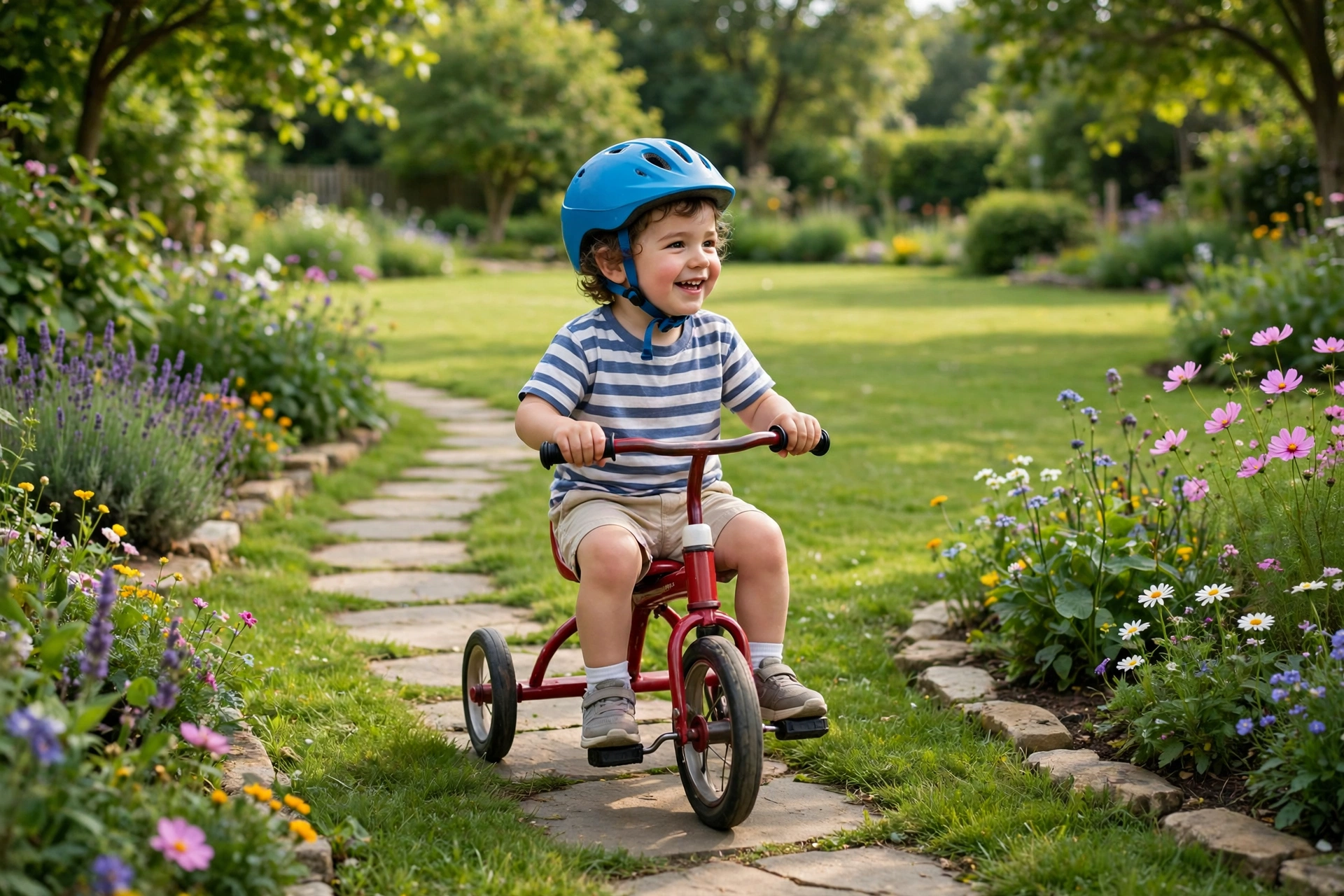
Yes, in general terms a child should wear a helmet on a tricycle. Tricycles feel slow and stable, but young riders still tip over, bump into kerbs, and fall sideways, and a small child’s head sits close to the ground and is hard to protect with outstretched hands. A well-fitting kids’ helmet adds a simple layer of protection for everyday rides, and it builds the habit of wearing a helmet before a child moves on to a balance bike or a first pedal bike.
Do Kids Need a Helmet on a Tricycle?
In general terms, yes, a helmet is a good idea for a child on a tricycle. The speeds are low, but most tricycle falls happen at low speed too: a wheel catches on a paving slab, the trike tips on a slope, or the child leans too far to one side while turning. Because a tricycle does not lean like a bicycle, children sometimes feel confident enough to go faster than their steering skills allow, and that is often when a tumble happens.
There is also the question of where children ride tricycles. Gardens, driveways, pavements, and playgrounds all have hard surfaces, and a fall onto concrete or tarmac can hurt even from a low height. A helmet is designed to absorb some of the force of an impact and spread it over a wider area, which can reduce the chance of a head injury. It is not a guarantee of safety, and it does not replace watching your child, but it is one more layer between a small head and a hard surface.
At What Age Should a Child Start Wearing a Helmet on a Tricycle?
Most children start riding a tricycle between the ages of two and four, and that is a sensible time to introduce a helmet. At this age, children are still developing coordination, and they are more likely to misjudge a turn or forget to slow down. A helmet that fits a toddler’s head properly can be worn from the first tricycle ride, as long as the child can hold their head up comfortably and the helmet does not feel heavy or restrictive.
Very young children, under the age of one, are generally not ready for a tricycle or a helmet, and a helmet should never be worn by a baby in a cot, a car seat, or a pushchair, where the extra bulk around the head can be a problem. For toddlers who are walking confidently and starting to ride, a lightweight kids’ helmet is usually fine. The key point is to match the helmet to the child’s size rather than their age, so always measure the head first and look for a helmet made for toddlers rather than a scaled-down adult model.
How Do You Choose the Right Helmet for a Tricycle Rider?
Choosing a helmet for a tricycle rider is mostly about fit, weight, and comfort. Look for a helmet made for young children, with a lightweight shell, good ventilation, and a simple adjustment system. Toddlers will not keep a helmet on if it feels heavy or hot, so a light, well-ventilated model is worth the extra cost. Bright colours or a fun design can also help, because a child who likes their helmet is far more likely to wear it without a fuss.
Check that the helmet meets a recognised safety standard for cycling. In general terms, a helmet sold for cycling in your country should carry a mark showing it has been tested to the relevant standard, and the packaging or label should say so clearly. Avoid toy helmets or dressing-up helmets, which may look like the real thing but are not designed to protect a child’s head in a fall. Some kids’ helmets include a dial at the back that tightens the fit, which is useful, but what matters most is that the helmet sits level on the head, covers the forehead, and stays in place when the child moves.
How Should a Tricycle Helmet Fit?
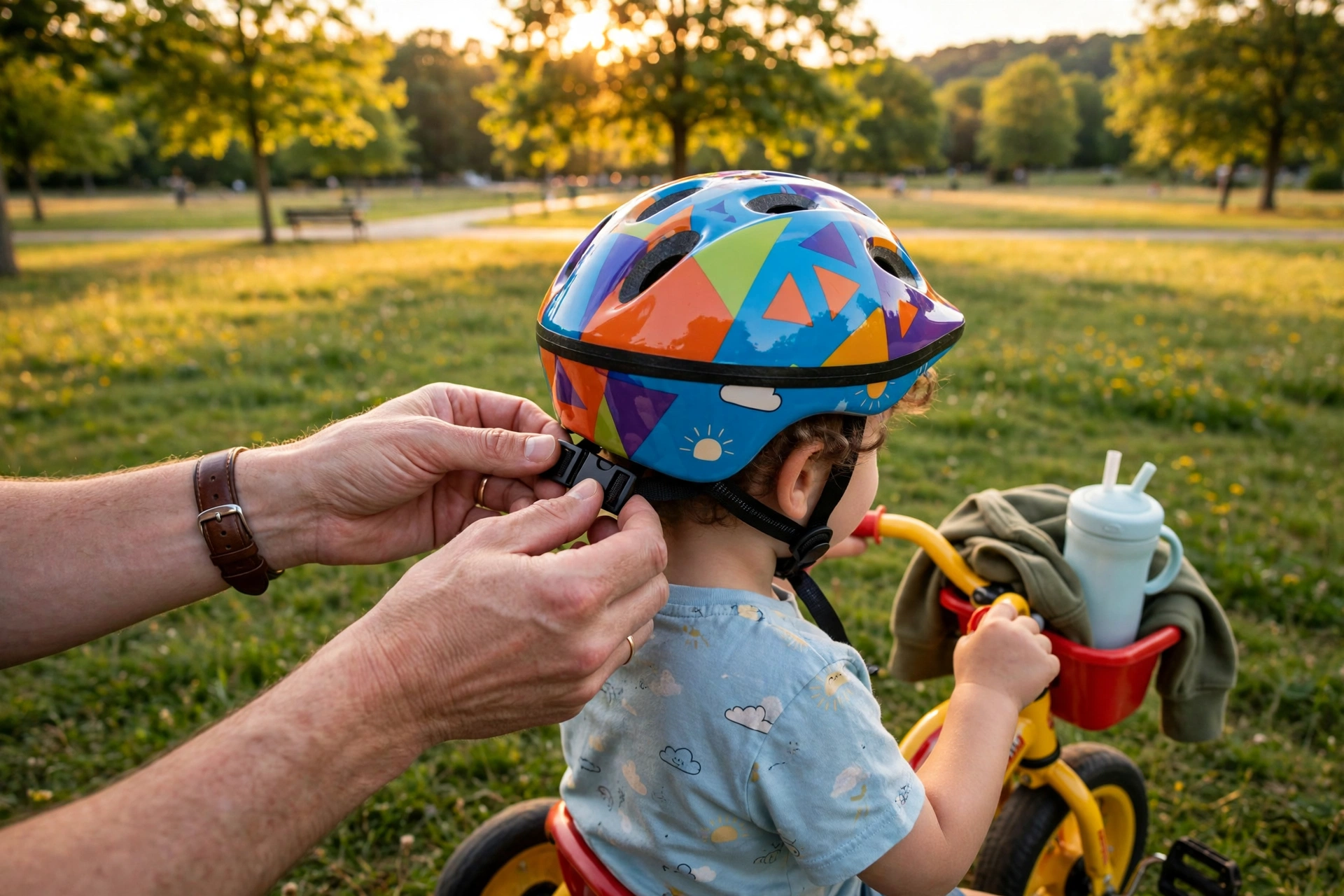
A tricycle helmet should sit level on the head, low on the forehead, with about two fingers’ width between the front of the helmet and the eyebrows. It should feel snug all round without pressing hard anywhere, and it should not rock forward, backward, or side to side when the child shakes their head gently. If the helmet slides over the eyes or exposes the forehead, it is either the wrong size or it needs adjusting.
Start by measuring your child’s head with a soft tape measure, just above the eyebrows and around the widest part of the head, and compare the measurement with the size guide on the helmet. Many kids’ helmets come with a dial or pads that let you fine-tune the fit, so use those to take up any slack. The chin strap should be snug enough that you can only fit one or two fingers between the strap and the chin, and the side straps should form a neat V shape just below each ear. Some helmets also include MIPS, a low-friction layer inside the helmet that is designed to reduce rotational forces in certain angled impacts. It is not essential for a tricycle helmet, but it is a feature some parents look for.
How Can You Get a Child to Keep a Helmet On?
Getting a small child to keep a helmet on is often harder than choosing the helmet itself. The simplest trick is to let the child choose: take them to the shop or show them a few options online, and let them pick the colour or design they like best. A child who picked their own helmet is much more likely to wear it proudly than one who had it chosen for them.
It also helps to make the helmet part of the routine from the very first ride. Put the helmet on before the tricycle comes out, every single time, so there is no negotiation about whether today is a helmet day. Praise the child for wearing it, and wear your own helmet when you ride a bike nearby, so the helmet looks like something everyone wears. If the child complains that the helmet is uncomfortable, check the fit and the straps before assuming they are just being difficult: a pinching strap or a helmet that presses on the forehead is a genuine reason to take it off. Also check the fit every few months, as children outgrow helmets quickly, and replace the helmet after any hard impact, even if there is no visible damage.
Can a toddler wear a helmet on a tricycle?
Yes, in general terms a toddler who is walking confidently and riding a tricycle can wear a lightweight kids’ helmet. Measure the head first, choose a toddler-sized model, and check that it sits level and feels comfortable before the first ride.
Do kids need a helmet for a tricycle indoors?
Most families only use a helmet for outdoor riding, where falls happen on hard surfaces. Indoors, a helmet is usually unnecessary, and a child should not wear one in a cot or car seat. Use your judgement based on the surface and the space.
What size helmet does a 3-year-old need for a tricycle?
It varies, so always measure the head just above the eyebrows and compare it with the helmet’s size guide. In general terms, many 3-year-olds fit a small kids’ size, but head sizes differ widely, so the measurement matters more than the age.

Olivia
Writer at Helmet Today, covering helmet reviews, fit and riding safety.