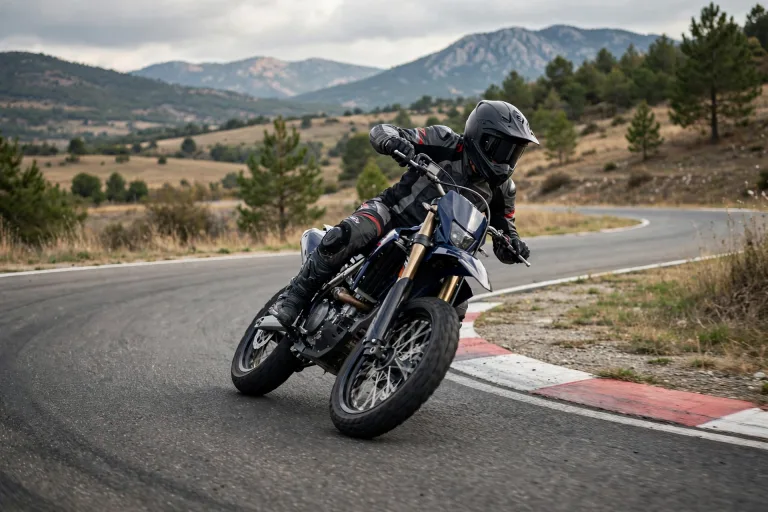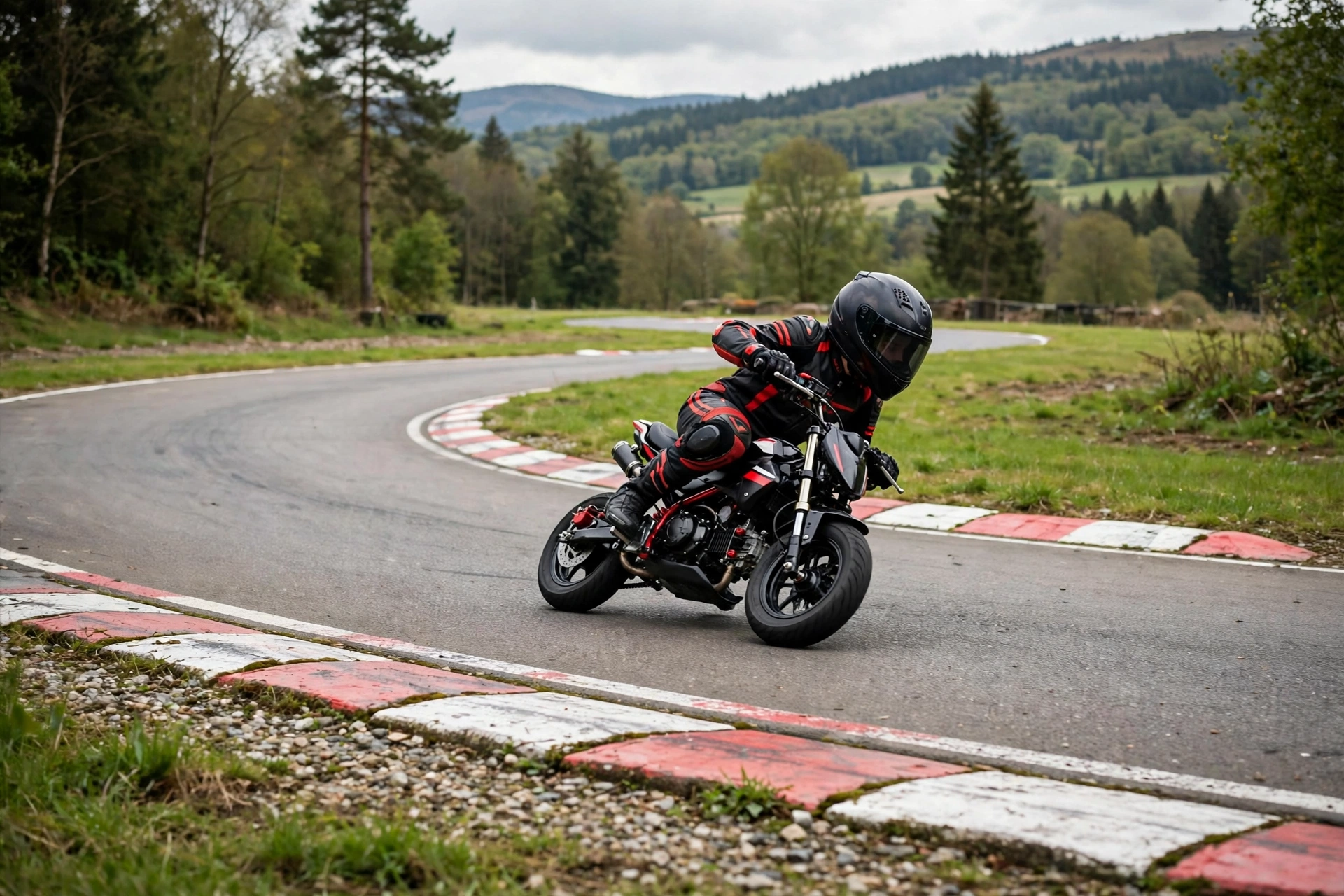
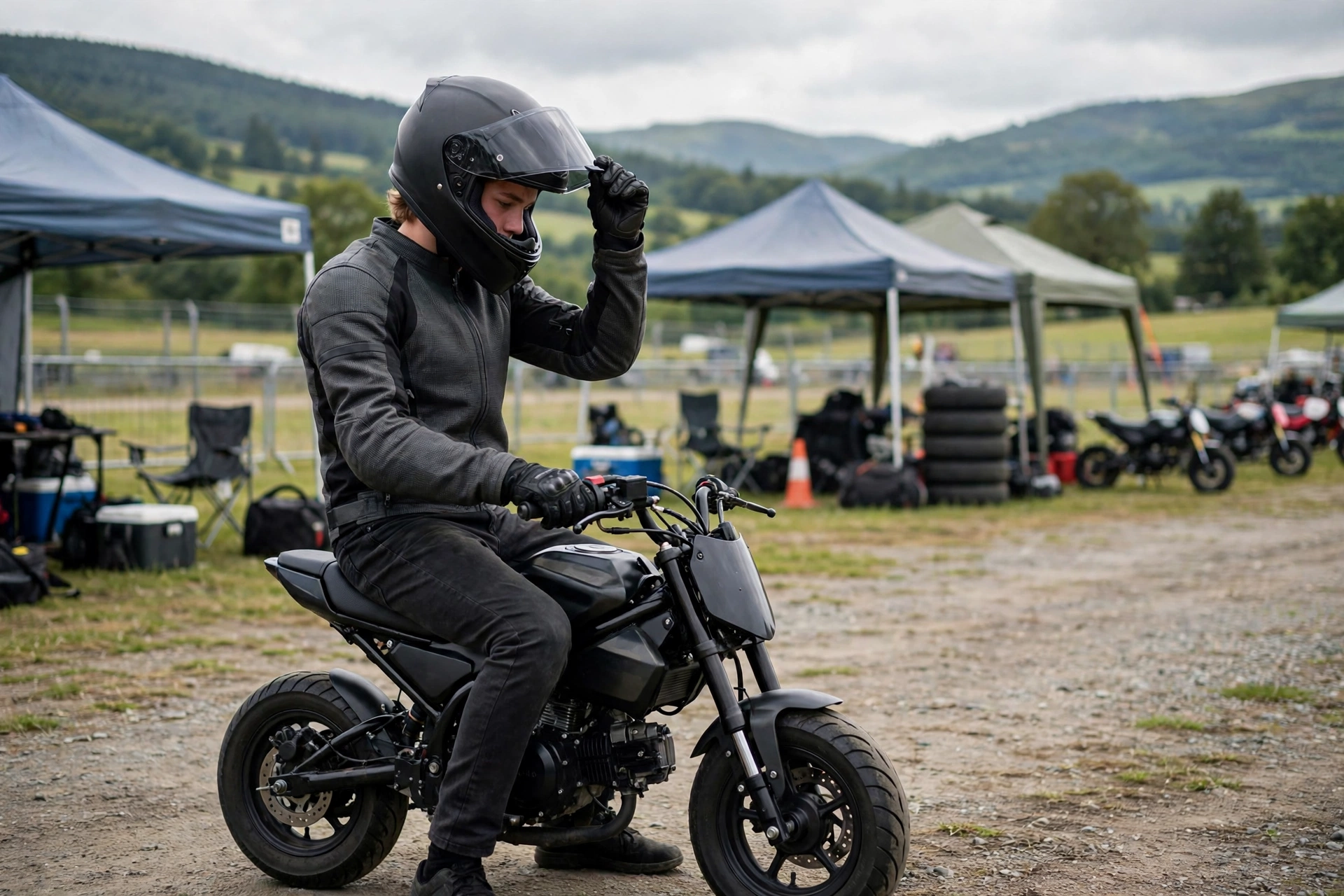
A helmet for mini moto riders is a well-fitting full-face helmet that protects the rider’s head, face, and jaw while riding a small, fast motorcycle on a paved track. In general terms, mini moto bikes are small in size but quick and low to the ground, and a fall at speed on tarmac can be serious, so a proper full-face helmet is the most important piece of kit a mini moto rider owns. It should fit snugly, give a clear view of the track, and stay firmly in place.
Mini moto, sometimes called pocket bike racing, is popular with young riders and with adults who enjoy close, fast racing on kart tracks. The bikes are scaled-down motorcycles with real engines, and they can reach speeds that demand real protection. Because the rider sits so close to the ground, even a low-speed slide can bring the head into contact with the tarmac, the kerb, or another bike. A helmet is therefore not an optional extra; it is part of the sport.
What kind of helmet do mini moto riders need?
Mini moto riders need a full-face helmet made for motorcycling, with a hard outer shell, a shock-absorbing liner, a clear visor, and a secure chin strap. The full-face design matters because it protects the chin and jaw as well as the top and sides of the head, and in a fall on tarmac the face is often the first part to touch the ground. An open-face helmet or a bicycle helmet is not a substitute.
The helmet should be made for road or track motorcycle use, and it should meet a recognised motorcycle helmet safety standard. In general terms, a helmet that is built for motorcycling is tested for the speeds and the kinds of impact that a mini moto rider can expect, while a helmet made for another sport is not. Check the standard before you buy, and buy from a trusted source, since a cheap copy may not protect you at all.
How should a mini moto helmet fit?
A mini moto helmet should fit snugly all round, with the padding pressing gently and evenly against the cheeks and the forehead, and no loose spots. When you put it on, it should feel tight at first, and it should not move when you shake your head from side to side. The chin strap should be fastened so that you can fit no more than two fingers between the strap and your chin.
Fit is especially important for young riders, who grow quickly and who may be tempted to wear a helmet that is too big so that it lasts longer. A helmet that is too big can twist or come off in a crash, and a helmet that is too small will hurt and distract the rider. In general terms, a mini moto helmet should be replaced as the rider grows, and the fit should be checked at the start of every season, or whenever the rider complains that it feels loose or tight.
What about the visor and ventilation?
The visor is a key part of a mini moto helmet, because the rider needs a clear, wide view of the track, the corners, and the other riders. A clear visor is the best choice for most riding, and it should be free of scratches, since a scratched visor can blur the view in bright sun or under floodlights. Some riders use a tinted visor on sunny days, but a clear visor is the safest all-round option.
Ventilation matters too, because mini moto racing is physical work and the rider can get very hot inside a full-face helmet. Look for a helmet with vents at the front and at the back that you can open and close, and check that the lining can be removed and washed. In general terms, a helmet that keeps the rider cool and comfortable helps the rider to concentrate, and a rider who can concentrate is a safer rider.
Do mini moto riders need other protective gear?
A helmet is the most important item, but it is not the only one. Mini moto riders should also wear gloves, boots, and a leather or textile suit that covers the arms and legs, since a slide on tarmac can graze the skin badly. Knee sliders are common in racing, and some riders wear a back protector as well. The helmet protects the head, but the rest of the body needs protection too.
Young riders should be supervised by an adult, and they should ride only on a proper track with clear rules and marshals. In general terms, the track, the gear, and the supervision work together: a good helmet is no substitute for a safe track, and a safe track is no substitute for a good helmet. Both are needed for a young rider to enjoy the sport safely.
How do you choose and look after a mini moto helmet?
Choosing a mini moto helmet starts with fit, then the safety standard, then comfort and weight. Try on several models, and pick the one that fits snugly, feels balanced on your head, and gives a clear view through the visor. A lighter helmet is less tiring on a long race day, and a helmet with a removable lining is easier to keep fresh. Some helmets also include a system designed to reduce rotational forces in a fall, such as MIPS, which is worth considering when you compare models.
Look after the helmet by storing it in a cool, dry place, cleaning the visor with a soft cloth, and checking the strap and the lining before every ride. Replace the helmet after any crash in which your head hits the ground, even if the outside looks fine, since the liner can be damaged inside. In general terms, a well-chosen, well-fitted, and well-cared-for helmet is the best protection a mini moto rider can have.
Can a child wear an adult mini moto helmet?
In general terms, a child should wear a helmet sized for their head, not an adult helmet that is too big. Youth sizes exist for a reason, and a helmet that fits properly protects far better than one that is loose.
Do mini moto riders need a full-face helmet?
Yes. A full-face helmet protects the chin and jaw as well as the rest of the head, and in a fall on tarmac the face is often the first part to hit the ground.
How often should a mini moto helmet be replaced?
Replace it after any crash, and consider replacing it after several years of regular use, or as soon as the rider outgrows it, since a helmet that no longer fits cannot protect properly.

Olivia
Writer at Helmet Today, covering helmet reviews, fit and riding safety.