
No, in general terms you should not use a horse riding helmet for cycling, because a riding helmet is made for a different kind of fall and is not designed to protect a cyclist in a road or trail crash. A horse riding helmet and a cycling helmet may look similar at a glance, but they are built to different standards, with different shapes, different ventilation, and different ideas about the impacts they must handle. A proper cycling helmet is the safer choice on a bike, every time.
It is easy to see why the question comes up. Both helmets are light, both sit close to the head, and a rider who already owns a riding helmet may wonder whether it can do double duty on a bicycle. The short answer is that it is not worth the risk. Helmets are not generic head coverings; each type is shaped and tested for the falls that happen in its own sport, and a helmet used outside its sport may not protect the head in the way its wearer expects.
What is the difference between a horse riding helmet and a cycling helmet?
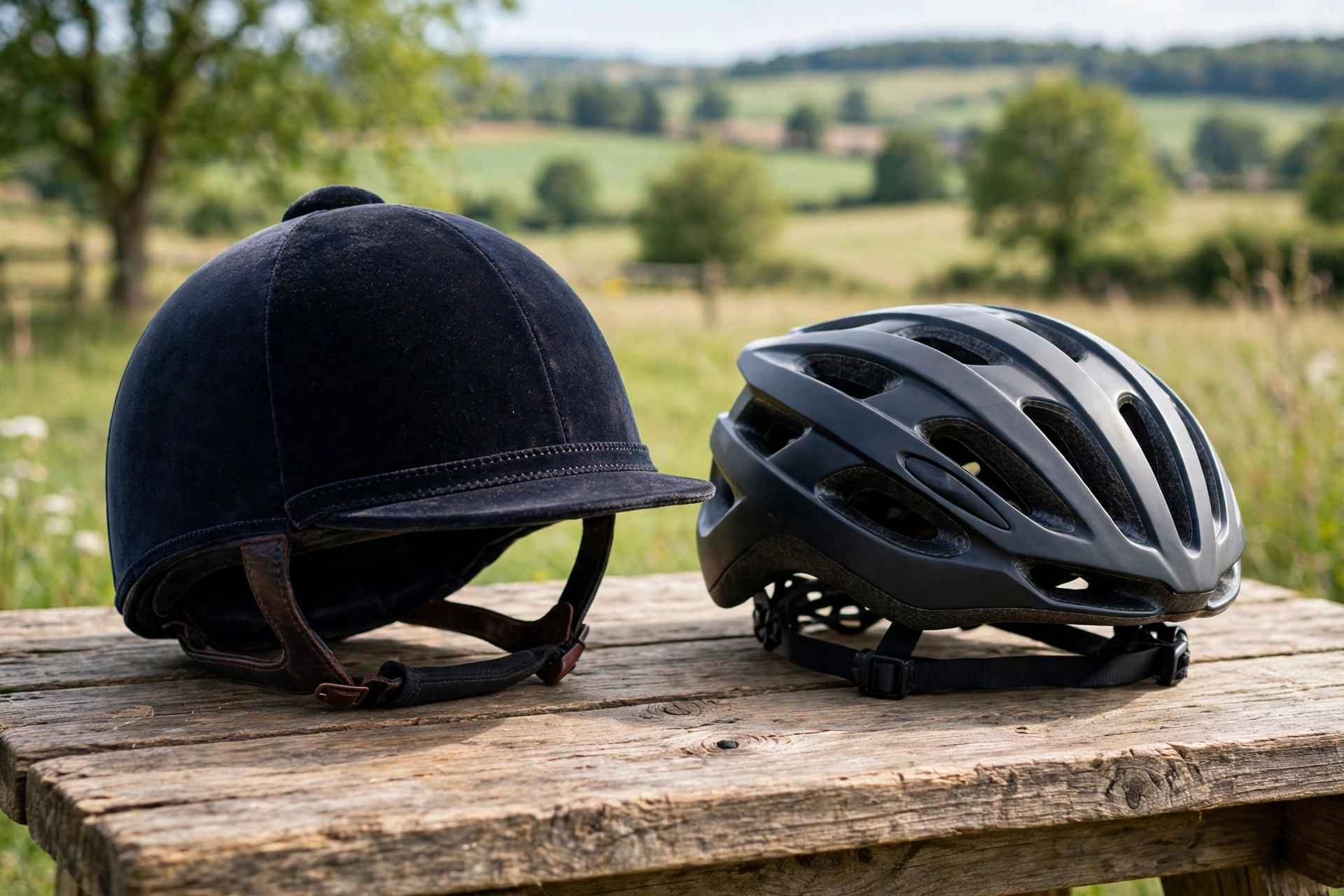
A horse riding helmet is designed for a fall from a horse, which is usually a fall from height onto a hard or uneven surface, often with a risk of being kicked or stepped on. In general terms, it has a hard, smooth shell, a fixed peak, and a shape that covers the back and sides of the head well. A cycling helmet is designed for a fall from a bicycle, which is usually a forward fall at speed, often onto a road or trail, with a risk of sliding along the surface.
The two helmets also differ in ventilation and weight. Cycling helmets have large vents to keep a rider cool during hard effort, and they are shaped to let air flow over the head at speed. Riding helmets have fewer vents, because a rider on horseback moves more slowly and needs a helmet that stays put during a fall from height. The straps and fitting systems differ too, with each helmet made to suit the movement and the head position of its own sport.
Why is a riding helmet not made for cycling?
A riding helmet is not made for cycling because the impacts it is designed for are different from the impacts of a cycling crash. In general terms, a cycling fall often involves forward speed, a glancing blow, and a slide along the ground, while a fall from a horse more often involves a drop from height and a direct blow. A helmet that handles one kind of impact well may not handle the other in the same way, and the standards the two helmets are tested to reflect that difference.
The shape of the helmet matters too. A riding helmet has a fixed peak that can catch the ground or a branch in a cycling fall, and its coverage is arranged for a rider sitting upright on a horse rather than leaning forward over handlebars. A cycling helmet is shaped to work with the rider’s forward-leaning position, with vents placed to cool the head at speed. Using a riding helmet on a bike means wearing a helmet whose shape and testing do not match the crash it may have to handle.
What could happen if you cycle in a riding helmet?
If you cycle in a riding helmet, the main risk is that the helmet may not protect your head as well as a cycling helmet would in the same crash. In general terms, a helmet that is not made for cycling may not absorb the kind of impact a cyclist suffers, it may shift on the head during a slide, and its peak may catch on the ground and twist the helmet. None of this means a riding helmet offers no protection at all, but it does mean the protection is uncertain, and uncertainty is a poor thing to rely on in a crash.
There are practical problems too. A riding helmet is warmer and less ventilated than a cycling helmet, so a cyclist may overheat on a long ride. The fixed peak can block vision when the rider leans forward, and the fit may not suit the riding position. A cyclist who is uncomfortable is also more likely to take the helmet off, which removes the protection altogether. For all of these reasons, a riding helmet is a poor substitute for a cycling helmet.
What should you wear instead?
On a bicycle, you should wear a cycling helmet that fits well and meets the safety standard for cycling in your country. In general terms, the helmet should sit level on the head, cover the forehead down to just above the eyebrows, and stay in place when the chin strap is fastened and the head is shaken gently. A good cycling helmet does not need to be expensive, and a low-cost helmet that fits and meets the standard is far better than a riding helmet worn on a bike.
Some cycling helmets include a system designed to reduce rotational forces in a fall, such as MIPS, which is a feature worth considering when choosing one. But the most important things are still fit, coverage, and a helmet made for cycling. If you ride both horses and bicycles, keep a separate helmet for each sport, and use each one only for the sport it was made for.
Can a cycling helmet be used for horse riding?
No, in general terms the rule works both ways: a cycling helmet should not be used for horse riding either. A cycling helmet is made for the forward falls and slides of cycling, not for a fall from the height of a horse, and its large vents and light shell are not arranged to protect a rider from a kick or a fall onto uneven ground. Riding schools and stables expect riders to wear a proper riding helmet, and a cyclist’s helmet would not meet that expectation.
The simple rule is to match the helmet to the sport. Each helmet is shaped, vented, and tested for the falls that happen in its own activity, and swapping them leaves a gap in protection that the wearer cannot see. Owning two helmets may feel like an extra cost, but it is a small price for head protection that actually matches the risk. A helmet that is made for the job is always the safer choice.
Can you use a horse riding helmet for cycling?
No, in general terms a horse riding helmet is not made for cycling falls, so a proper bike helmet is the safer choice. The two helmets are built and tested for different kinds of impact.
Is a riding helmet better than no helmet on a bike?
A riding helmet may offer some protection, but it is not a reliable substitute for a cycling helmet, and it may shift or catch in a crash. A low-cost cycling helmet that fits well is a far better option than a riding helmet on a bike.
Do riding and cycling helmets look the same?
They can look similar at a glance, since both are light helmets that sit close to the head. The differences are in the shape, the vents, the peak, and the standards they are made to, which are hard to see but matter a great deal in a fall.

Olivia
Writer at Helmet Today, covering helmet reviews, fit and riding safety.